Friday, November 5, 2010

The right tool

When doing any project, there is a tendency to use the project as a reason to acquire another tool (he who dies with the most tools, wins).  But then this delays the project, which now depends on shopping for the tool.

Sometimes, the "best" tool for the job is the one you have, rather than the shiny, expensive, special-purpose one you see in the catalog.  Because with the tools you have, you can get right to work.  Bob over at Boat Bits talks about a personal example of this.

On the other hand, one should not fall into the trap of the lazy craftsman either:

"All tools are hammers, except for screwdrivers.  Screwdrivers are chisels."

Wednesday, November 3, 2010

Keeping the water out

Here in Seattle, keeping the water out is a nearly full-time job.  Aaron and Nicole from s/v Bella Star walk us thru a very well-done repair here:
We’ve had a leak since we got the boat that we were finally able to fix with some helpful insight from another HC33 owner.  Thanks Steve!  The leak was coming from the hole in the deck where our diesel heater’s stove pipe passes through the deck.

To fix it, the first thing I did was remove the charlie noble (boat chimney) to get at the hole.
IMG_6560 (Small)
Next was to remove the fairing block – it was cracked in half so I used epoxy to glue it back together.  For this project I used West System G/Flex due to its greater elasticity.

We could see right where the water was coming in.
IMG_6556

With the fairing block removed I used a Dremel with a sanding cylinder bit to clean out the old sealant and prepare the surface for some epoxy and fiberglass tape.
IMG_6564

Then I applied the epoxy and fiberglass tape.
IMG_6570

I let that cure overnight and then cut off the excess with the Dremel and a cutoff wheel.  ALL HAIL THE DREMEL!  I also sealed up the holes in the deck where the fairing is screwed down.
IMG_6589

Then I taped off the area in preparation for applying the sealant. 
IMG_6591

I reattached the newly fixed-up fairing pad and tightened the screws just enough to that the sealant was squishing out.  Then wiped away the excess.  (With sealants you want to wait until it’s cured before you screw down the item tightly.)
IMG_6593

I pulled the tape while the sealant was still wet.
IMG_6594

I let that cure overnight, then tightened up the screws.

Next was to repeat the tape and sealant process with the charlie noble.
IMG_6734

So after we got everything put back together all we had to do was wait for it to rain.  We didn’t have to wait long.  Fortunately the work paid off and the leak is fixed.
IMG_6736
Usually, finding the leak is much more difficult than fixing it.

Monday, November 1, 2010

Standoffish?

One of the problems with running this blog is that I end up with lots things that I see that I need to do. This is another... I have been putting this off for some time - with the current *very* extended sunspot cycle minimum, my interest in radio projects has waned along with the propagation conditions. Carol on s/v Estrellita 5.10b describes here the installation of the wiring between their SSB radio and their insulated backstay:
We use one of the big wires on that run from the deck to the top of our mast as an antenna for our single sideband radio. This wire is called a backstay, and thus the antenna is called a backstay antenna. In order to use the wire that way you have to also have a tuner to tune your wire during SSB usage.

Below, images from an install that I never blogged about. In order to connect the back stay to the tuner I had to cut the co-ax and reinstall it on the tuner. In order to do that I had to solder a PL-259 connector.

Rrrright. So, I don't know how to solder. Many youtube videos and a borrowed solder gun later, I had a not pretty but the good news is that the ugly solder is so far effective because our signal is good. Let's hope it lasts... The work stations, old & new connectors:


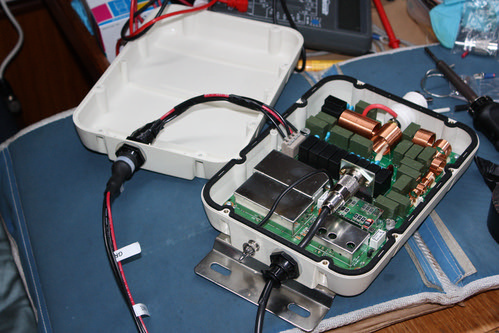
I was then able to open our AH-4 tuner and connect the new cord:

The wire was threaded through the ceiling of the aft cabin to the aft port section of the lazarette space and the tuner was installed there. The antenna wire then went from the tuner, through the cockpit combing to the backstay which serves as our antenna.

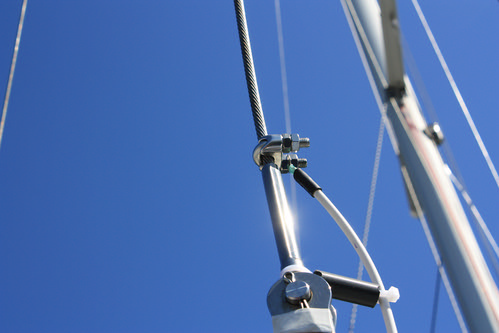
I used some nylon rod to keep the GTO-15 wire from touching the backstay. I had the brilliant idea to drill holes prior to cutting it so there would be a notch for the wire to sit into. Alas, it turns out the hole I drilled wasn’t really big enough or necessary. Just cutting the rod into 2” sections would have been plenty.


The installation with stainless still wire nut, nylon spacers connected with zip ties, and although you can’t see it the wire terminates in a ring terminal that has been double shrink wrapped at the connection
So, making standoffs for Eolian's antenna connection is now on the list of projects generated from this blog:

Friday, October 29, 2010

Solar Panel Install on Estrellita 5.10b

Livia and Carol have described the installation of their solar panels on s/v Estrellita 5.10b. Nice machining and a very professional job.  And I like how they planned ahead for the need to remove the panels quickly in an emergency.
Back when we installed our solar panels I had taken these photos so I could talk about the install. I had a pretty complicated time figuring out how to get everything to fit on top of the bimini. I'm not sure exactly why because in hindsight it seems so simple. Hopefully some of these visuals might help someone else work out their installation.

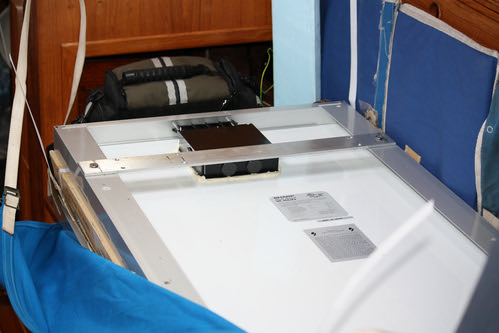
We mounted aluminum barstock on the back of the frame to give us more options for mounting and also to act as a stiffener/brace to the existing aluminum frame.
Aluminum bar stock on solar panel

We fastened the aluminum barstock to the frame with spacers I cut from starboard and stainless u-bolts with wing nuts. The wing nuts and u-bolts are intended to simply the removal process in an emergency because they can be removed by hand without tools.
Solar panel spacer, u-bolt, wing nut

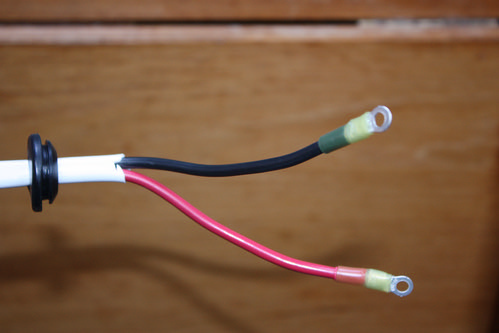
We used sealing ring terminals on the ends of the wire which were fit through the gasket provided by the manufacturers (2 Sharp 80W and 1 Kyocera 85W).
Inside solar panel connection

This is what the inside of the built in junction box looked like. We wired the panels in parallel and this panel has the wires from the preceding panel as well as wires going out to either the next panel or the MPPT controller.
Inside junction box (Sharp 80W)


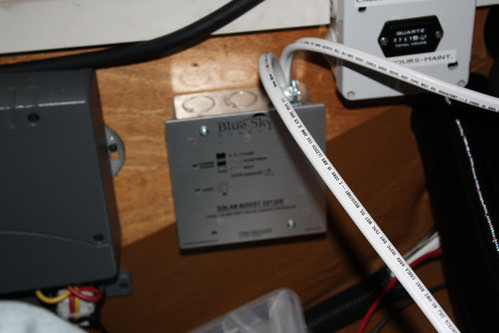
The end wires come through the cockpit combing and down under our aft berth to our Blue Sky MPPT controller like this.
Blue Sky 2512ix

An overview of how the panels were working during this past summer is here.
And by the way, you can now find solar panels on eBay for less than $2/watt...

Wednesday, October 27, 2010

Dutching in

On a boat of any age, there will be places where the woodwork has been damaged.  In Eolian's cockpit, the coaming cover had holes drilled to accommodate pegs in the cushioned seat backs (to keep the seat backs in place).  Because of the design, it was easy to apply substantial leverage on the pegs and holes when lifting up the seat backs.  Not surprisingly then, there were places where the pegs broke out the edge of the teak cover board.

What to do?  We'll pick just one of the breaks in Eolian's coaming cap to follow - one in which the Previous Owner had sanded and finished the split-out surface in an attempt to disguise the damage:


Piece broken out, and then refinished!

We will be gluing in a new piece of wood, in a process called "dutching in".  Sorry, I don't know where this name came from.  In order to do this and have a thin glue seam, the contour of the area to be repaired must match the contour of the piece which will be ductched in.  This is easiest by far if we are matching two flat surfaces.  So, using whatever tools are appropriate for your repair (I used a hammer and a chisel here), clean up the surface of the area to be repaired, creating a place for the filler piece to nestle into.  Choose your filler piece carefully - it should have grain and color that are a good match for the area being repaired.

Next, using epoxy (I used 30-minute stuff here), and whatever clamps are required to hold things together until the epoxy goes off, glue in the filler piece:

Repair piece is epoxied into place

Once the epoxy has hardened, use whatever tools are required to trim away the extra wood.  In this example case, I again used a chisel, but a small saw could have worked too, or perhaps a Dremel tool.  Then sand the repair area.  You'll see that in the example, I did not pay too much attention to the actual peg hole because I was going to re-drill it anyway to take a bronze bushing:

Trimmed and sanded

Finished; bushing installed

It's really not hard to do. Just don't be in too big a hurry... spend the time to make the patch as invisible as possible.

Look closely at any classic wooden boat - you will undoubtedly find dutched in areas...  now that you know what you are looking for.

Monday, October 25, 2010

In praise of DIY

I have long been an adherent of the DIY philosophy - you might have guessed that, given the purpose of this blog.  Most boaters are DIY'ers by nature - thus the popularity of this site!   Aside from the obvious cost savings, when you successfully complete a project yourself, there is a wonderful feeling of satisfaction, of competence.

And in the boating world, DIY makes even more sense.  There are those who proclaim that "the only tool I need is a Visa card."  That certainly works, if your boat never leaves the dock.  But when you are at sea, that credit card is not very useful - except, perhaps, if you are in need of a thin plastic shim.

Over at Boat Bits, Robert has posted an essay on this subject that I encourage you to read.
Related Posts Plugin for WordPress, Blogger...