There was a time when I had an oversized garage with a table saw and a long workbench with a drill press, belt sander, vise and rows of drawers filled with a variety of tools. Now, instead of a garage, we have a dock box and the trunk of our car. I thought that there might be some interest in the simplified set of tools that I am using, a cordless drill, circular saw and router.
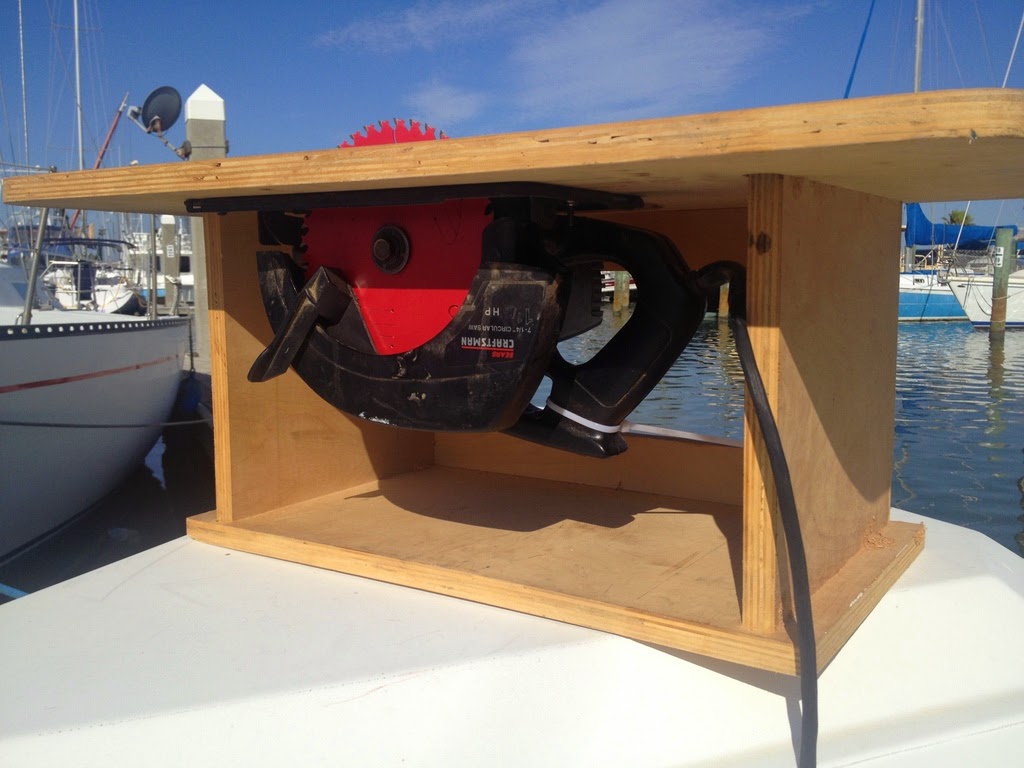
This is my combination table saw and router table. It is a simple plywood construction shown with the circular saw mounted underneath. The trigger on the saw is not easily accessible or lockable. So, I strapped it down with a tie wrap and the saw is turned on and off by plugging and unplugging the power cord. I know that this is unsafe on a variety of levels but knowing that is exactly what makes me doubly cautious. Plus, the circular saw is not nearly as powerful as a real table saw and not as likely to kick back violently. So far, I have had no accidents or even a close call.
I mounted the saw under the table such that the edge of the saw's base is parallel to the table edge. After making a plunge cut to bring the blade through the table top, I laid a guideline the full length of the table that is aligned with the side of the blade. I measure and make marks relative to the guideline at both ends of the table and clamp a board on the marks to serve as a rip fence. It's a little tedious but works very well.
A piece of half inch plywood screwed at a 90 degree angle to a 1x2 inch rail that rides against the edge of the table makes a usable mitre guide. I added a strip of wood to the top to clamp stop blocks for repeated cuts.
This the same table with the router mounted underneath. The clamped on fence and miter guide are useful with the router as well. With a 1/2x1 inch straight bit and 1/4 and 1/2 inch quarter-round bits, I can make all of the joints and decorative cuts that I need for boat projects.
This is my favorite new tool, a portable drill press. Our rigger let me use the real drill press in his shop to drill a variety of holes through a 3/4x2 inch strip of teak which I use as a drilling guide.
There is something about my "no line" glasses that makes it impossible for me to line the drill up for a hole perpendicular to a surface. The drilling guide is a huge help.
This is another indispensable tool that I use often. Many times, the most difficult part of a job is just getting the workpiece to stay put while you hammer, drill or file on it. A solid vice can be a life saver. This one is mounted a 1 1/2 inch ash board. The board has feet at both ends so that work can be clamped directly to the board as well as in the vice.
For me, the key to getting reasonably accurate work is to build a jig for everything. This a drilling jig that I used to locate the holes for hinge pins in a spice rack project.
With patience (the really hard part), you can finish projects that you can be happy with, even though the tools that you are using are limited.
Showing posts with label dock. Show all posts
Showing posts with label dock. Show all posts
Tuesday, September 16, 2014
Dock Box Carpentry
Given Norm Abram's shop, getting really good results from wood working projects is relatively easy. But doing it on the dock, with a very limited set of tools that all have to go in the dock box when you are done... not so much. As promised, here is Walt on s/v Suppose's post on "Dock Box Carpentry". He makes it look easy:


Thursday, September 27, 2012
Fender Boards
Here in the Pacific Northwest, with our large tidal ranges, virtually all marinas have floating docks. Consequently it is highly unlikely that you would ever have to tie up to a piling.
Why do I bring that up? Well, because fenders are designed to protect a boat from a horizontal object, like a dock. No fender, by itself, will be able to protect your boat from a vertically-oriented object, like a piling. But our situation here is not everyone's. Not even everyone here, since pilings are frequently found in docking situations on our lakes. So what to do?
The fender board is the answer. Drew at Sail Delmarva shows us what a fender board is and how to make yourself one which is considerably evolved from what I have seen in the past. His board is well-constrained so that it will stay in position on the fenders. Read on...
Why do I bring that up? Well, because fenders are designed to protect a boat from a horizontal object, like a dock. No fender, by itself, will be able to protect your boat from a vertically-oriented object, like a piling. But our situation here is not everyone's. Not even everyone here, since pilings are frequently found in docking situations on our lakes. So what to do?
The fender board is the answer. Drew at Sail Delmarva shows us what a fender board is and how to make yourself one which is considerably evolved from what I have seen in the past. His board is well-constrained so that it will stay in position on the fenders. Read on...
Do you need em'? Yup, if there is a lot of tide, strong storms or wakes, yup.
Example. In Chincoteague, as much as we like the town dock, there are few "no wake" signs, no posted speed limit, and you get rocked now and then by small but speedy boats. There is also a good tide range. and a 3 knot tidal velocity. The picture was taken only a few hours into their first use and we've already worn a noticeable grove. There was always a small pile of saw dust resting on the board.
Example. We got hit beam-on by a powerful storm while in Rockhall, tied to a bulkhead. Fortunately, we had a spring line and good breast lines, and our fender board. I've had fenders pop out in these circumstances, and the pounding on the pilings is scary. All we felt this time was some gentle swaying, even as the hail blew horizontally.
Note the grove in the middle, only a few hours old on a calm day. Yes, it should be centered up on the rub rail; we moved it up later. It seems fenders are always placed when dead tired from a long run, in this case about 85 miles. Lucky we got it out at all.
Very simple to make from a scrap of 2x6 treated lumber. Any thinner and it will wear through rather quickly. Forget paint.
Deploying the board is sort of a 2-person job and we don't use it at every marina, but if you suspect storms or wakes, it is very nice. Don't know why I waited so long.
- Pick a length. Ours is ~ 4 1/2 feet and I'm happy with it.
- Drill holes for the line that restrains the fenders horizontally. Our are 5/16-inch polyester line, though some suggest bungee cord. I trust line more. Counter bore the holes so that the stop knots are recessed (reduce wear and reduce snags).
- Drill vertically through the board (3/8-inch to take a 5/16-inch line) to take the time that suspends the board (loop on one end, stop-knot on the other). This takes a long bit, which I was lucky to have.

Subscribe to:
Posts (Atom)


 Posts
Posts


