Showing posts with label marlinespike seamanship. Show all posts

Tuesday, October 21, 2014

Low-Buck Projectapalooza

Over at Dock 6, Brian has experienced those two best days of boat ownership:
  • The day he sold his boat
  • The day he bought his new boat
And of course, with a new boat, there are lots of, erm..., opportunities.  Read along with Brian as he makes NextBoat his own:

  "Yes, I'm workin' all the time..."
                                        -Rush


The stages of New/Old Boat ownership:

       Stage 1. Admiration stage- admire how much roomier (or prettier or shinier or faster or just plain better your New/Old Boat is than your Old/Old Boat.)

                Stage 2. Installation stage- Start installing stuff.  Begins approximately 7 minutes after the onset of Stage 1.
Stage 2 never, ever stops.

If you have bought the right boat, the first stage never stops, either.

Having lived with and aboard NextBoat for almost 3 months, much Low-Buckness, and some Mid-Buckness, has ensued.

For those of you still following along, (thanks!) you know the story.  For those who just stumbled into this meandering morass of a blog, here’s the short version: 
We owned a boat, wanted a slightly bigger boat, found a bigger boat, bought a bigger boat, sold the slightly smaller boat…

Now we are pouring money and time and effort into the slightly bigger boat. 

And enjoying every minute of it.

The upside of NextBoat is that she had been well maintained by two previous owners.  The downside is that there were few upgrades, and some gear that we consider necessities  was missing entirely.  Like, oh….

A compass.

Didn’t have one. 

Apparently, never had one since new- the binnacle was as smooth and unblemished as a baby’s transom.

We'll come back to that later.

So, after peering into the purse  and seeing the present paucity of pennies, (prolonging our  perpetual pondering of whether we are presently poverty stricken or penurious,)  providence presently allowed us to press the button on a plenitude of purchases, provided by the profits of this profligate’s penmanship.

In other words, I got paid for some scribbles.  Cool. 

So, with cash in hand, we got all Bugs Bunny and Road Runner on the boat.
(Okay, come on, I can’t be the only one who remembers the theme to the “Bugs Bunny and Road Runner Hour”?  Come on, sing it with me, “….On with the show, this is it…”)
er...
*turns the Obscure Weirdness dial down to 7*

A flurry of mouseclicks and credit card approvals and straight-up hand-to- hand cash transfers later, we had a whole bunch of new stuff to stuff aboard our new ride.
SWMBO is a ginger, and with a redhead’s propensity to burst into flames upon exposure to sunlight, she immediately noted that NextBoat lacked cockpit canvas of any sort.  A shadeless boat with a redhead aboard is an unhappy boat for all aboard.  Luckily, a beaten and battered and unused-by-the-previous-owners dodger was included in the purchase.

It needed help. 

Canadian Canvas Works underpromised and overdelivered,  restitching the entire top in less than 48 hours. 

The skipper of Cyclone sold us a languishing bimini from his currently-for-sale S2 8.0A, and with a little cutting and sweating we soon had a comfortable cockpit.


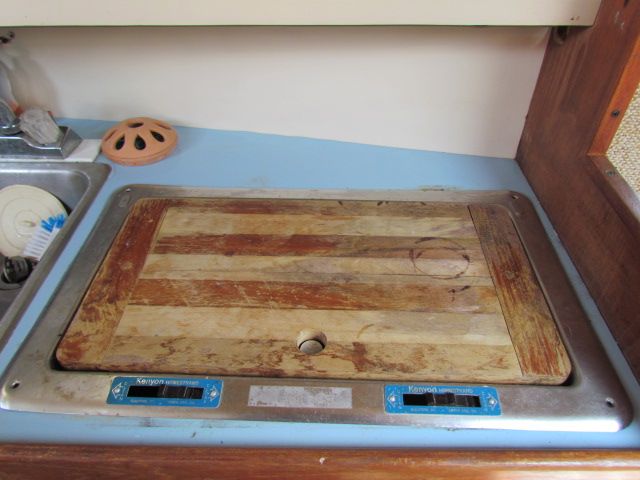
The stove that came with the boat had to go.  Kenyon Homestrand pressurized alcohol stoves may have worked just fine when new, but 30+ years later….

…  not so much.

The scary quotient, however,  had increased considerably.

After following the less-than-simple lighting instructions, ( Pump tank of flammable fuel, tunr burner valve to introduce flammmable fuel to burner, close burner valve, light flammable fuel,  let it burn out, then reopen valve and relight ) we inevitably faced a *WOOF* of ignition, resulting in burners with flames that had only one setting- Total Conflagration.


Seriously, the few attempts at using this DeathBlaster stove to create Two Burner Tastiness resulted in singed entrees trailing the faint odor of burnt eyebrows.

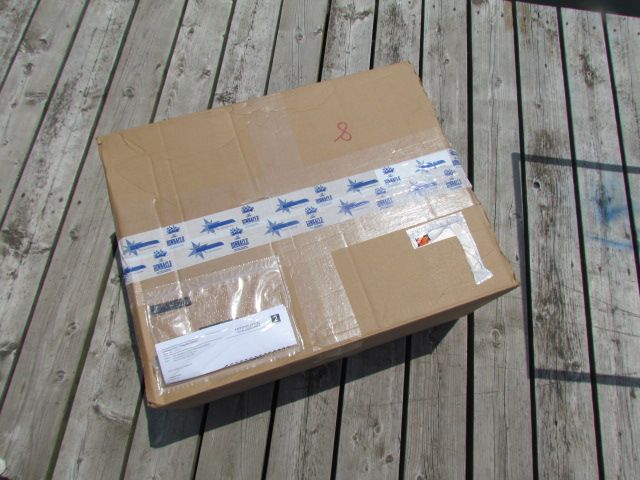
A quick click to Binnacle.com got us a great deal on a Cookmate non-pressurized alcohol stove.  Under $250, including shipping.


  Installation took less than a half hour, and the result is incredibly satisfactory.


 Great temperature control, easy to light,  and the  burner capacity is measured in weeks, not hours. 6 weeks of regular use have borne out the value of this investment.

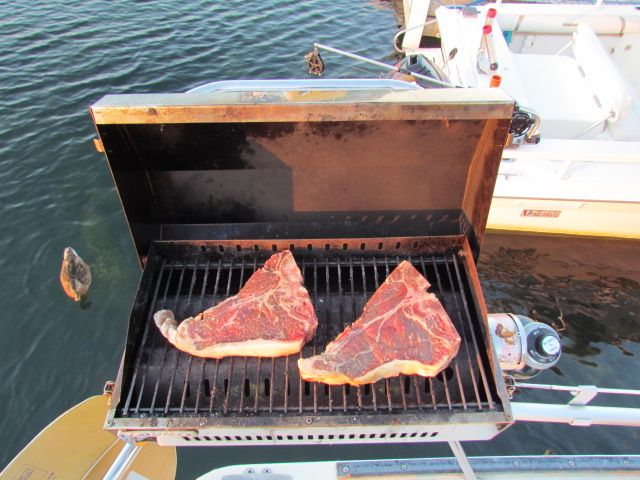
Further, we have upped the culinary ante by permanently installing the Kuuma Stow-n Go propane grille we bought during our first season aboard Whiskeyjack, but rarely used.


We have used this grille more this season than in the past 6 seasons combined.

Which means we are using more propane.

Which presents another challenge:  Storage.

The one drawback to this center cockpit layout is that it eliminates all cockpit storage- no lockers, or lazarettes or cubbies on deck at all.  I had no desire to store 1 lb.  propane cylinders in the cabin, so a solution was required.

A quick trip to Home Hardware  netted  2 feet of 6" PVC pipe, an end cap, a cleanout, and a couple of hose clamps.  Less than $25 later, we were able to store 3 propane bottles on deck safely.

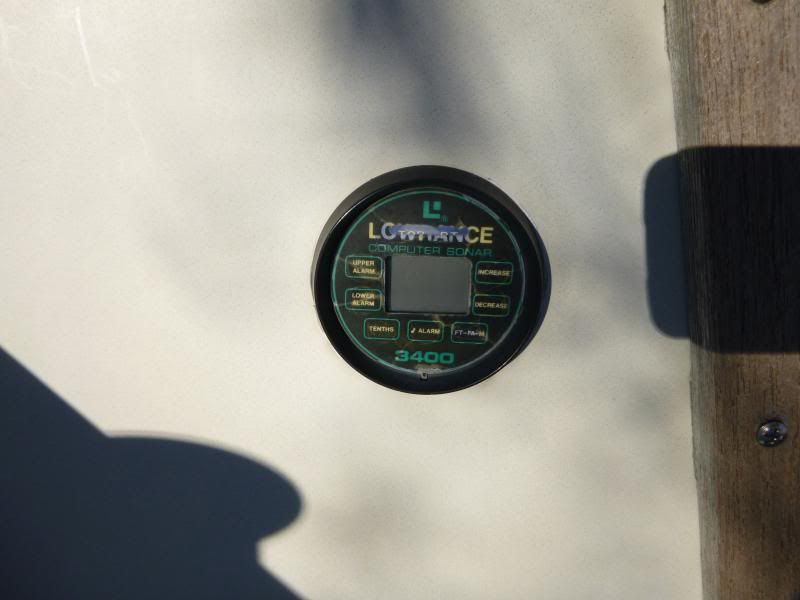
   So, back to that no-compass thing:  The existing cockpit instrumentation on NextBoat consisted of an inoperable Lowrance depth gauge.


That’s it.


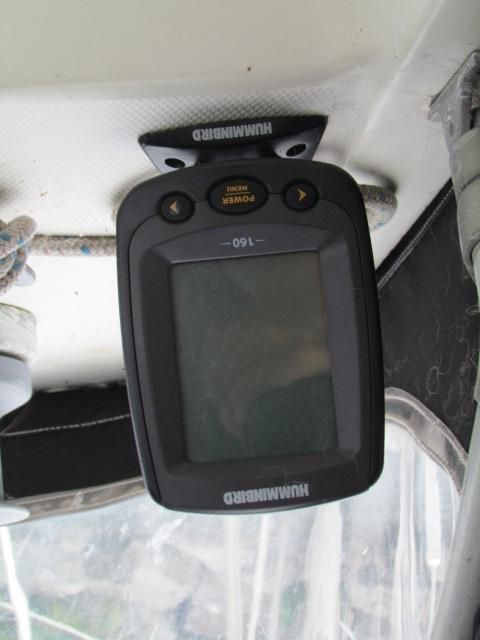
A  quick trip to Dovercraft Marine  netted us a Humminbird 160 fishfinder  for $80.  Some headscratching on where to locate the transducer and how to route the cables  and roughly an hour or so of sweating and drilling and and wiring later, we not only had depth display, but water temperature as well.


Back to that absence- of -cockpit- storage issue:
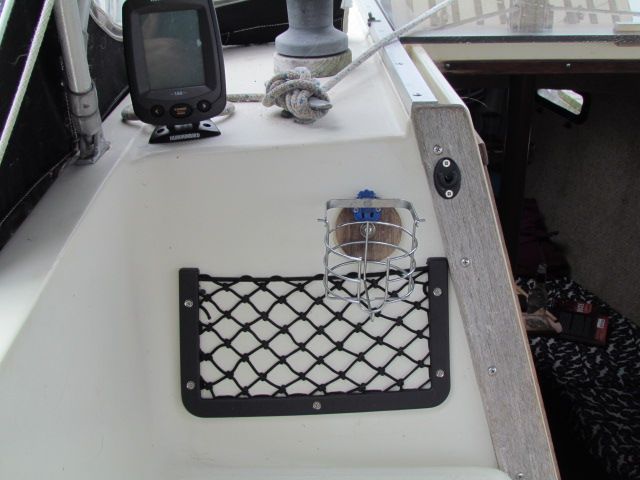
 I picked up a couple of these mesh map pockets a half decade ago, and finally got around to using one!  Very handy for books, sunscreen, sunglasses, all the stuff that would otherwise end up in the way.


With depth out of the way, time to deal with the compass issue.  I opted to go with a small handheld compass as a backup to a small Lowrance chartplotter at the helm, from Radioworld.

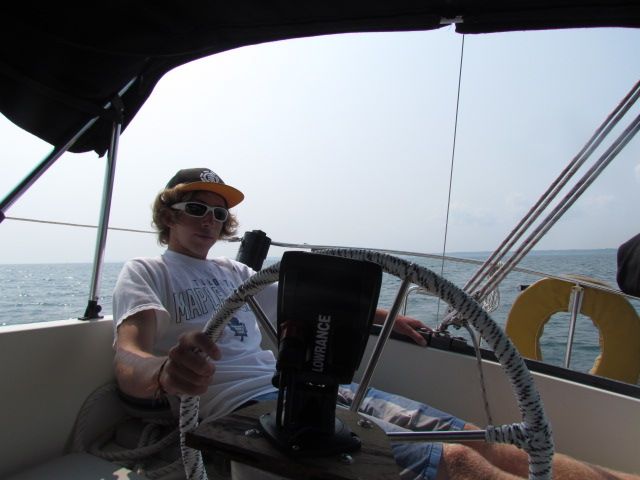
   I LOVE these things.  Lowrance "Gold" plotters include a 2 gig Navionics chart card,  and the plotter we had on Whiskeyjack never let us down.  The seated helm position on NextBoat makes the 4"ish screen size practical,  and, though small,  the screen is easy to read, the controls are intuitive and the menus easy to understand. The included mount swivels and tilts, making it viewable from anywhere in the cockpit....

...even if you are a slacker teenager, as Jordan demonstrates:


  $250 well spent.

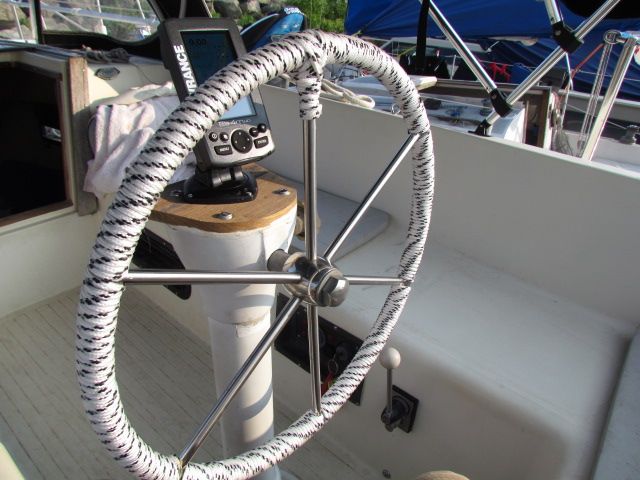
  $3 worth of 1/4" line and an hour or so of time dressed up the wheel...


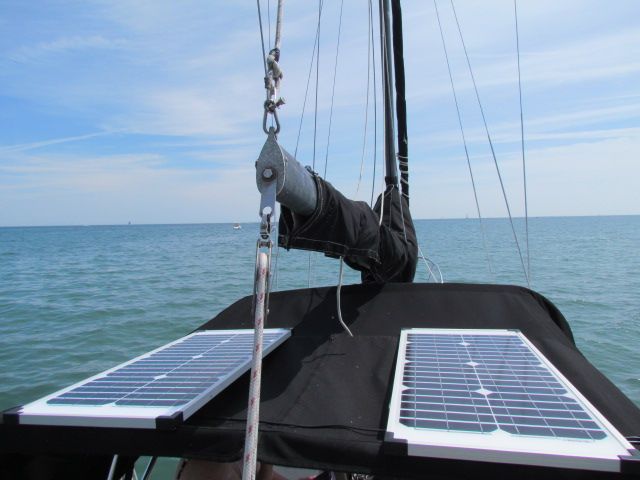
All of this new electrical gear requires improved electrical charging management-  Two $99 40 watt solar panel/ 7 amp charge controller kits from Canadian Tire were installed to charge the battery bank.  When docked, or flat water motoring, the panels live on the bimini-


 When the wind picks up, they migrate to the aft deck.  An upcoming project is to sew pockets into the bimini to secure these lightweight panels up there full time.

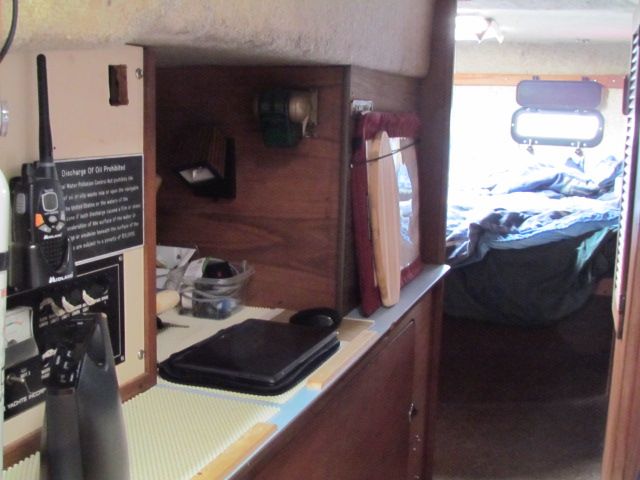
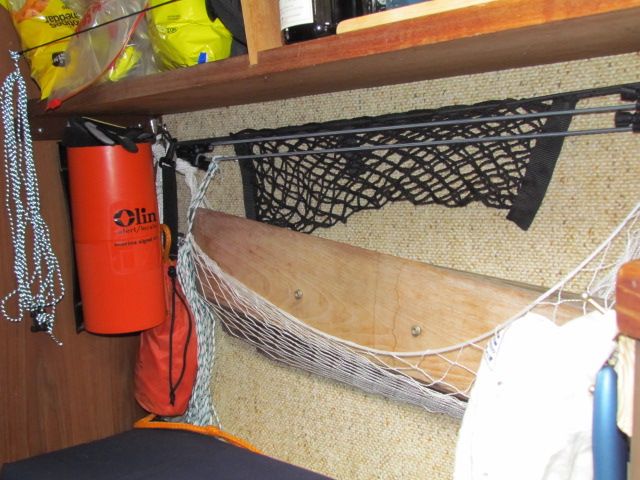
   Down below, hammocks were hung and bungies were strung and non-skid mats were laid to keep everything that has a place, in it's place.


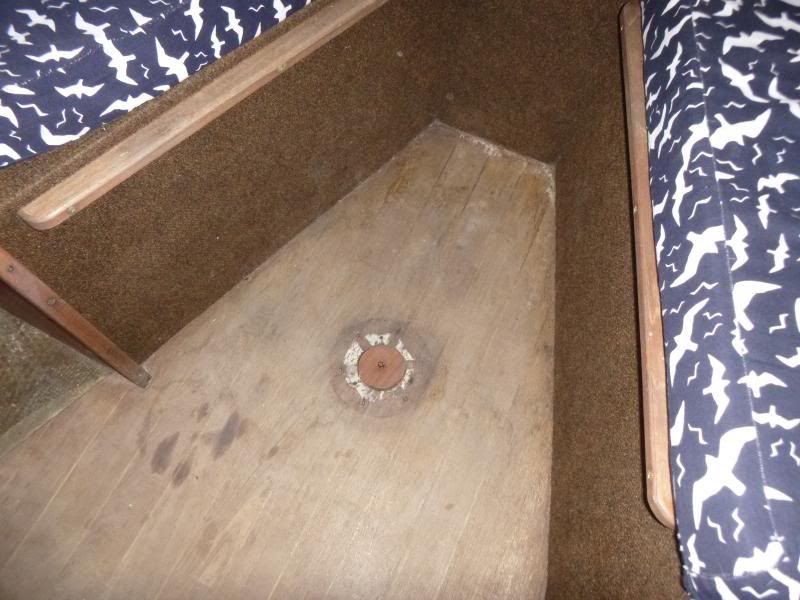
The settee-berth did not have a table, although there was one installed at some point in the past:


A while back some of the stuff that James was clearing out of his boat shed ended up in my boat shed.  Among the assortment of stuff was a table base and post.  a little  plywood and edgebanding later, we now have a salon table:


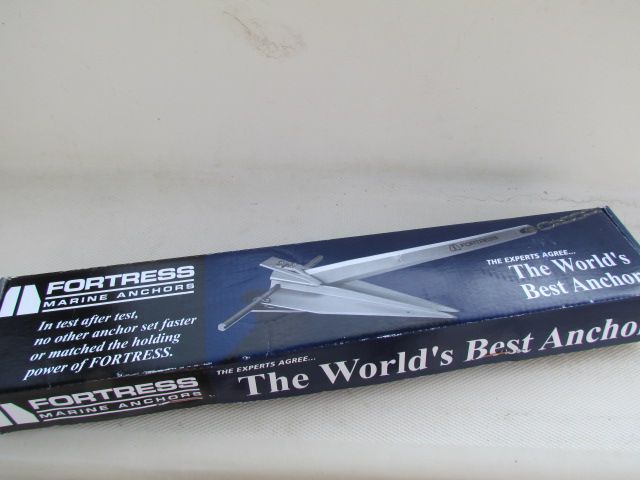
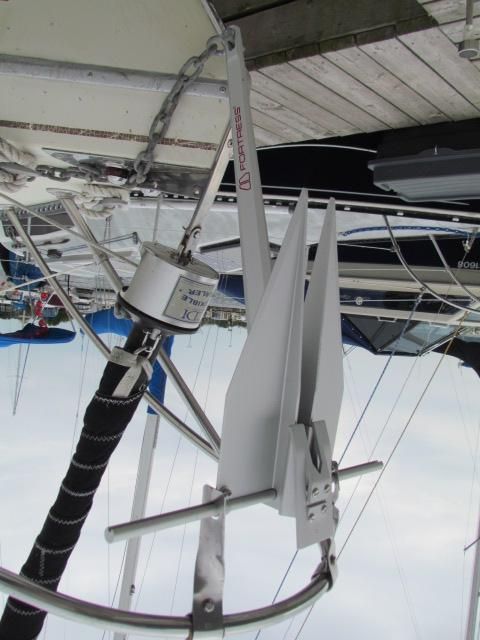
   We managed to bend the shank on the anchor that came with NextBoat, and decided this was an opportunity to reduce weight on the bow and make anchoring a less strenuous task for the crew on the foredeck, by replacing the current steel anchor with an aluminum Fortress anchor....


...which requires assembly.


slightly larger flukes, slightly longer shank, half the weight of the previous anchor should make anchor launching and retrieving easier.

  We'll let you know how it goes.

Last but not least, a quick little project with a big "why didn't they do this from the factory?"  factor:
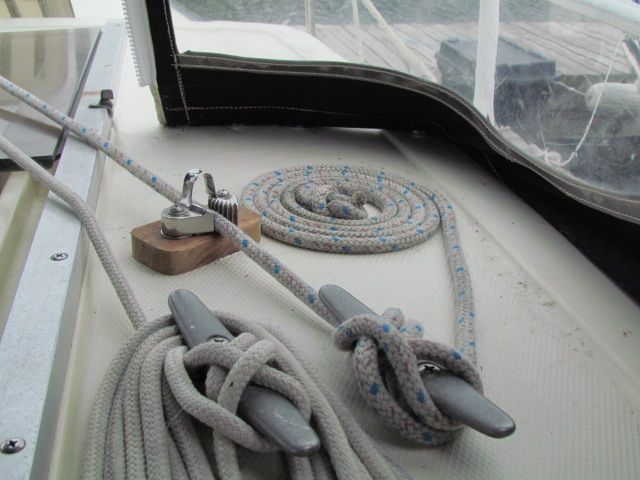
There are no clutches on the cabin top, and the only cleats are horn cleats...

 which leave much to be desired when it comes to tying off halyards.  You get a couple of wraps on the winch to get a full pull on the mainsail halyard, only to lose tension when you try to secure the halyard around the cleat, leaving you with a baggy sail.

  We installed a cam cleat ahead of the horn cleat. No more baggy sails for us!

We also ran the mainsail reefing line to the coachroof, enabling us to reef the main without having to leave the cockpit.

Finally, we made life easier for the mutts.  We carpeted the companionway ladder, to make it easier for them to climb/descend.


Ellie demonstrates that she now has ample room to run around.
Lots more projects ahead, lots more work to do, but, she's getting there.
 She is becoming a home.

"Talk the Dock!"

Thursday, May 15, 2014

Wire Cable vs. Stanchions

Over at Sail Delmarva Drew puts the test equipment he has built to work investigating the ability of various recommended lifeline materials to resist chafe thru the stanchions...
I've been investigating chafe protection and Amsteel as it relates to lifeline replacement. Certainly, wire cable is the gold standard. But now I'm not so sure....

After an hour of sawing back-and-forth through a 10mm hole in SS tubing, it had eaten a nice groove and built a corresponding burr on the inside:

After 1 hour.


And though the wire did not look very worn, when we flexed just a bit there was a different story....

Also 1 hour. The damage was not apparent until flexed. Most of the broken wires were inside.

How did Amsteel fare, in the same hole? Before the wire created the burr? Much better with very little wear in an hour. Afterwards, no as well, but still the damage was little more serious than that to the stainless cable. Given that I plan to use 1/4 Amsteel, which is nearly twice as strong as the cable to start with, I'm feeling OK. 1/4-inch it is sufficiently strong that even after 10 years in the Chesapeake sun (not so strong as the desert southwest or tropics) it should have equivalent strength, and with proper chafe guards, the strength loss in the holes should be less than wire. Protected from the sun, the pass-troughs may be the strongest part by then.

How does Amsteel like the new hole? Not so bad as you might think and about the same as it like the raw hole, just after I drilled it without deburring. By way of comparison, after the hole was deburred it showed ~ 1/3 this much wear, and if coated with Spinlock RP25, no wear after 2 hours (840 cycles).

After 1 hour on the wire cable gouged hole. About the same as a raw drilled hole, yet much worse than a polished hole.

Alternatively, I tried a dyneema anti-chafe sleeve floating for 3 hours. It could have run for 100 hours without showing wear.

A floating dyneema cover reduces wear to zero.


By way of comparison, this hole wore a polyester line through the cover in 20 seconds and in half in 5 minutes. Amsteel is tough stuff.

Thursday, April 24, 2014

Want Your Ropes to Wear Like Iron? Maxijacket!

Drew at Sail Delmarva is hard at work again. He has built two machines for torture testing rope, and has discovered a product that we should all have aboard. Read on...
I investigated this product primarily on a whim. A magazine editor had asked about it in passing, and someone had given me a sample of a related product, Spinlock RP25. I didn't expect a whole lot from some liquid coating, or at least not the results I would get from some physical covering. And I was dead wrong.

Both were sawed on the grindstone for 4 minutes: Spinlock RP25 on the top and Maxijacket on the bottom. As a baseline, bare rope looked like the RP25 in 2 minutes.
The Spinlock RP25 does have its applications too. It performs better on HMPE ropes (Amseel et. al.), reducing both wear and cover/core slippage, and has the flexibility to use on running sections of rope. I'l use RP25 on section of my Amsteel lifelines.

Who would think a simple coating could out-last plain rope by 6-8 times? Who would think it could out-last clear vinyl tubing by 10 times? Where the grindstone could cut a rope in half in 5 minutes, with Maxijacket it is barely scuffed.

Applications? I'm testing many things, mostly applications where traditional chafing gear doesn't fit. Defender marine is dipping all of the chain-to-rope splices, and Brian Toss tells me he's dipping most halyard splices. The furler drum exit is a tough spot, particularly if you use the genoa partly furled much.

Mooring lines, with and without coating. I tried chafe gear, but it kept creeping off. This is easier to clip and extends the life of the wear section to match the rest of the line.

Topping lift. Abrasion was the problem, so I used some webbing as a thimble and dipped the whole knot. This allows me to down-size from 3/8" to 5/16", saving some windage.
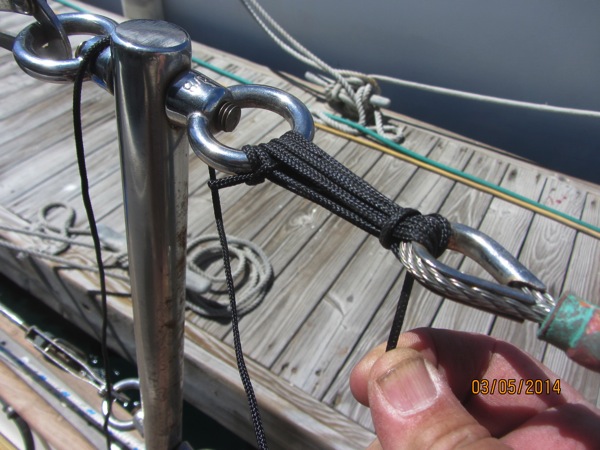
Just too good not to share. It seems impossible that a product resembling thick latex varnish (you can get clear and colors) can make such a a difference. While West Marine charges more than you want for more than you need, Knot and Rope sell a small jar--probably all a sailor needs for a few years-- for $7.10. A bargain.


-------

 It seems my marine science project business has gotten completely out-of-control, with no less than 9 projects underway plus follow-ups. Clear vinyl, glycols and coolants, rope, vapor filters. Then there are possible investigations into heater efficiency and operation. Crazy... and fun.

Tuesday, April 1, 2014

Who needs turnbuckles?

Steve and Lulu who live aboard s/v Siempre Sabado don't use turnbuckles on their lifelines - they use lashings...
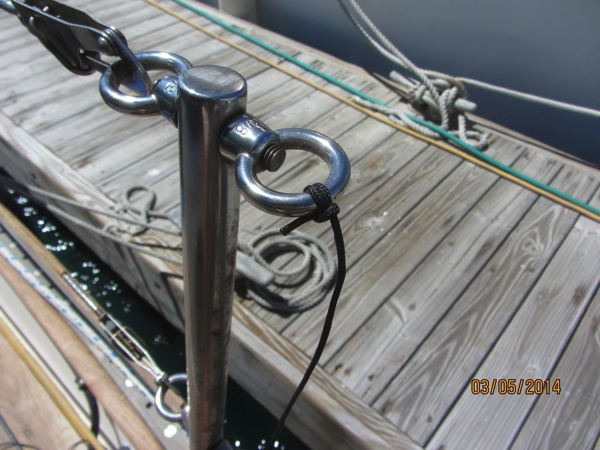
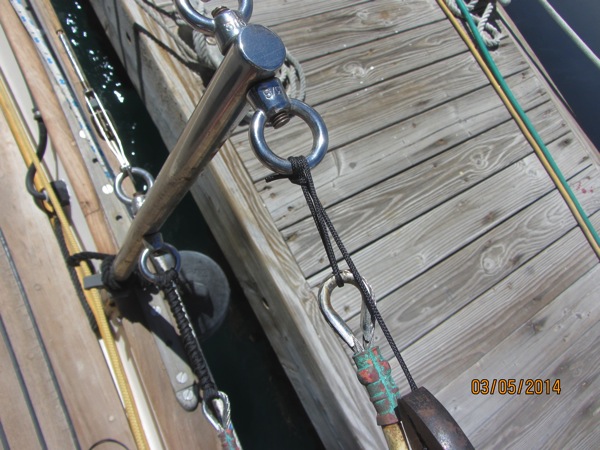
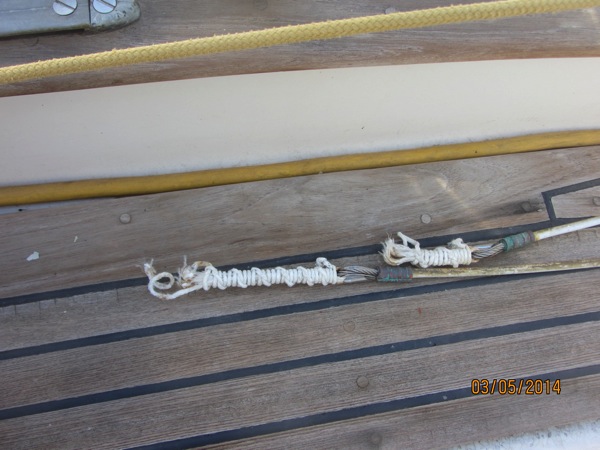
As reported earlier, when we got back to Siempre Sabado from our trip to the U.S., something just didn’t look right.  Then I saw it:  the upper lifeline was no longer attached to the stanchion.  There were a few strands of nylon left on the stanchion ring but that was it.  Then, a couple days later we were visiting with some friends on the dock.  Lulu was sitting on the cabintop and put her feet up on the lower lifeline.  Guess what?  Yep, that was enough to break through what remained of the lashing on the lower lifeline.  I suspect that the degradation that led to the final failure probably happened in the last 6 months or so.  Last time we were out was when we were coming back to La Paz last May (Jeez! Has it been that long?).  During that trip we didn’t notice any issues with the lifelines in spite of abusing them with the dinghy every time we launched or retrieved it.  Nevertheless, I’ve added replace lifeline lashings to my annual to-do list.

It’s been almost exactly two years since I replaced our lifelines in Mazatlán.  At that time, I didn’t really document the lashing process itself so I thought I’d take care of that today.

This time, instead of white 1/8″ nylon braid, I used black 3/32″ nylon braid.  The main reason for the change was that I though black might be a little less susceptible to damaging UV rays, but mostly because we have a huge spool of it we bought at a commercial fishing outfit in Puerto Peñasco.  Not sure what the fishermen use it for but they must use a lot since the huge spool we bought was the smallest one they sold.

The first step is to tie the line to the ring on the stanchion.  I used a fisherman’s bend.

IMG 2235

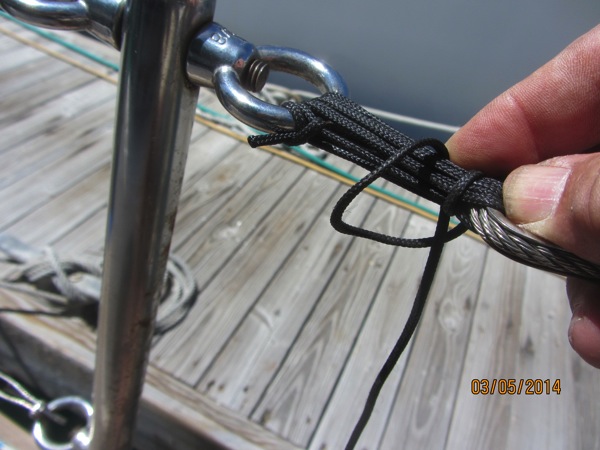
Then just start wrapping line between the ring and the lifeline, pulling it as tight as you possibly can each time.

IMG 2236

I suggest using pliers to pull the line tight.  I figured this out a little too late.

IMG 2244

Once you have as many wraps as you think is appropriate (I used 6), pull it tight and tie it off with a half-hitch pulled mondo-tight with the pliers.

IMG 2239

 Now, just keep tying half-hitches, always in the same direction, until you reach the other end.

IMG 2240

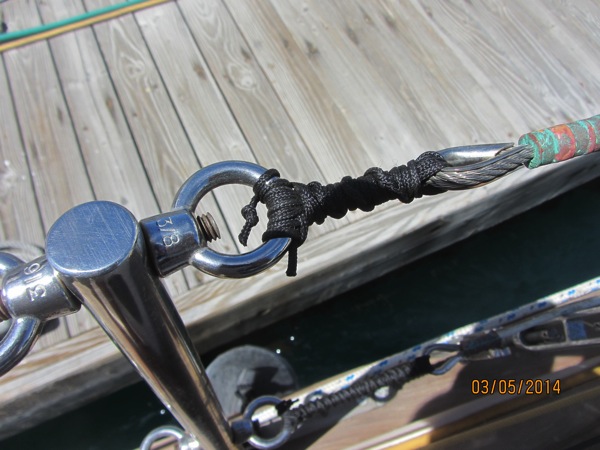
When you reach the end, you can finish it a couple of ways.  Last time I just tied a last half-hitch and then tied an overhand knot up close in the end.  This time I decided to tie the end off with a clove hitch on the stanchion ring followed by the pulled-very-tight overhand knot.  I didn’t get this overhand knot as close to the ring as I would have liked but I suspect it’ll be just fine.  As soon as the wind dies down, I’ll apply some heat and fuse the overhand knot to itself so it’ll never ever come loose.

IMG 2243

Personally, I don’t think these look quite as nice as the white ones did but they look a LOT better than the parted ones laying on deck.

IMG 2234
IMG 2246

If you have a gate in your lifelines, be sure it’s closed before you start lashing.  You can put incredible force on the stanchions when you pull the lashings tight and you don’t want to bend a stanchion.  I didn’t put the slight bend in this stanchion, it was that way when we bought the boat.  Although it’s open now, I did have the gates closed while lashing.

So there you have it.  Change your lashings at least yearly.  It’s too easy and cheap to do to take a chance on the line lasting any longer than that.

Tuesday, February 11, 2014

Hookers for Splicing

Crossover noun \ˈkrs-ˌō-vər\: when skills from a field are applicable in another, unrelated field.  Livia, living aboard s/v Estrellita give us an example:
P1020421If you crochet or knit, consider doing the splicing for your boat.

Anyone can splice, but if you are a crocheter or a knitter, it is as if you have already completed a rigorous pre-splicing bootcamp, and are primed and prepped to become an above average splicer.

Reasons why hookers are ready to splice:
  1. P1020425
    You already know how to read complicated verbal directions with poorly drawn diagrams and translate them into actual products. If you can take something like "dch ch 2dch" and create a popcorn stitch then you are ready to take a rope manufacturers splicing directions and run with them.
  2. The tools are simpler versions of ones you already know how to use with precision. If you can wield a crochet hook in one hand while keeping tension with the other, or suspend an entire sweater on the tips of two pointy sticks, fids will be child's play.
  3. You know to read the entire set of directions before actually doing anything. You check to make sure you have all of the tools and supplies indicated and that you won't be surprised when you reach step 10 and realize you should have done something differently at step 2.
P1020426Tip: Many people are turned off by splicing because they try their first splice with a bit of old yacht braid they have laying about. Old yacht braid ranges from extremely difficult to splice to impossible to splice depending on how far gone the cover is.

Do yourself a favor and buy a piece of brand new line for your first project. My advice is to buy a length of rope of the correct size for a dockline (don't forget to add extra length for the splice) and use that as your first project. Or if you want something super easy, pick a spectra/dyneema splicing project – even easier than yacht braid.

Online splicing directions are everywhere but you can try here or here. We have this basic set of fids which works very well and seems to cover the sizes of lines we use commonly.

Tuesday, February 4, 2014

Got Rope?

Boaters are frugal. Most boaters, that is, and virtually all cruisers. We never throw anything away (which is a discussion for another time). But this means that we make use of EVERYTHING. Drew, over at Sail Delmarva has an example of something that is now in it's third incarnation:
I've had this 30-year old anchor rode hanging in a tree for 15 years, serving a second life as a Tarzan swing. I've got a Kevlar genoa sheet with a shattered core, no longer trust worthy for anything critical.

The rope ladder was a simple project. I've wanted something that was compact, couldn't harm gelcoat, and could be used climbing in or out of the tender. This took about 20 minutes and about 30 feet of line (2x the length + 3' for each rung). A fun night-before Christmas project, complete across my lap, with a glass of hot tea at my elbow, while watching The Polar Express with the family.

The door mat required 100 feet of 1/2 inch line and about 2 1/2 hours to complete. The knot in the middle is rather a lump underfoot, but it looks very traditional. The wrap and sewing took the real time. I soaked it with the borax/washing soda/baking soda anti-mildew blend when finished. My mom thought it a charming gift; since we had enjoyed it on the boat and in the backyard for many years in previous incarnations, it has history with her children and grandchildren.

And 2 lumps of old rope were thus consumed. Good.

Tuesday, January 21, 2014

Rope Wheel Cover

Livia and Carol, living aboard s/v Estrellita 5.10b in the south pacific, have replaced the leather on their wheel with lacing...  it took nearly 180 feet of quarter inch line!
Our leather wheel cover had slowly evolved from “weathered” to “salty” to “embarrassing”. P1020061Yet, we didn’t replace it until it busted open – good cruisers that we are. I had been keeping my eyes peeled for leather wheel covers in the automotive section of various hardware stores until I saw a simple rope wheel cover on a forum. There are quite elaborate rope work options for covering your wheel but I wasn’t really willing to put more than a day of my life into the project and so simple it was.

I bought 60 meters of 4mm nylon line and ended up with some leftover.
P1020065First we stripped off the old leather cover which left bits of itself stuck to the stainless wheel and had to be scrubbed off.

Then I tied the nylon line to one of the spokes and began wrapping. When I reached the next spoke I tucked the line down, half way around the spoke, and then back up onto the wheel, and started wrapping in the opposite direction. Each time I finished a pie wedge, I milked the line tight before transiting the spoke.

Two things I wish I had done at this point were: 1) put the line on a hand spool of some sort, such as you use for handline fishing to make the wrapping easier and 2) not bothered to wet the line when I started and rather just wet it later in the process.
P1020066Hours later when I had finished the wheel I tied the two ends together with a square knot and wet the entire wheel. Then I started half way around the wheel from the knot and milked the line toward the knot and retied the line taking up the slack. Then I went back to the half way point and milked the line the other way.

I’m leaving the square knot for now until I milk the line another time or two and then will probably whip the two bitter ends together and then put something decorative over the whipping.

P1020067Tip: I set things up so that the knot is at the wheel’s top when the rudder is centered. When I put the decorative bit this will help us find that center by feel.
Related Posts Plugin for WordPress, Blogger...