Showing posts with label brightwork. Show all posts

Tuesday, September 9, 2014

Got Milk?

This post originally appeared on Windborne in Puget Sound

I got skunked the other day.

I was at one of the big box home remodeling stores and picked up a gallon of paint thinner, since I was almost out on the boat.  Instead of a metal can or a translucent polypropylene container, it was in a white container.  I didn't give that any thought at all.

Big mistake.

On the boat ready to clean a brush just used for varnishing,  I pulled the DOT seal  and saw...  not at all what I expected.  This was a gallon of milk.  No, seriously - it was an emulsion of paint thinner in water, looking exactly like milk.

Looking more closely at the label (which I should have done in the store), I saw that this was being marketed as "safe" paint thinner.   We Americans will go to any length, to any ridiculous length, to remove any trace of risk, won't we?  But this?  I think this is an EPA-designed thinner, being marketed as "safe".  Of course it is cheaper to manufacture too, since water is less expensive than actual paint thinner.

But tho it is "safe", and has very low VOC, what is it good for?  There is no way I or anyone else would dump this milk into a $60 quart of varnish.  And I wouldn't trust it even to clean my least expensive varnish brush.  I cannot even imagine it being useful as a thinner for water-based varnish, since that stuff is already as runny as milk. 

Kicking myself for my stupidity, I set the container by the marina dumpster.

Maybe someone can use it to make a latte.


Yes, that is 9 gallons of the good stuff. A local TruValue hardware store was selling off their old stock of the "environmentally irresponsible" thinner for $7.89/gallon. I bought all their stock.

I should be fixed for life.

Or perhaps I'll be like the lady who is selling off cans of pre-EPA formula Brasso on eBay, one by one.


Tuesday, April 22, 2014

Fill'er up

This post originally appeared on Windborne in Puget Sound

So, you have a beautiful, bright-finished teak and holly sole. And your brother-in-law brought along his favorite piece of heavy steel 3" angle iron when he came aboard to spend the night (not telling you of course). And he dropped it when getting his jammies out of his duffel.

Now you have a big ugly gouge marring your beautiful sole.  What to do? 

I can tell you that it is possible to fill such a gouge with varnish - our Previous Owner had a TV fall onto the sole - came off of the mount in a seaway.  Not a flat screen... remember those big heavy things with the big cathode ray tube?  Yeah, one of those.  It made a gouge about 1" x 1" and perhaps 1/4" deep.  I did manage to fill it in with varnish - a little at a time.  If you put in too much, it will skin over and not cure.  It took weeks and weeks, all the while with an upside down margerine tub taped over it to keep us from stepping on the work in progress.

I now have a better way.

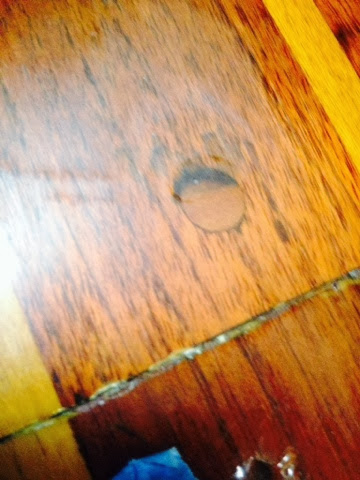
Use 5-minute epoxy.  It fills the gouge without shrinking, and it cures in, well, 5 minutes. 

Here is an example from the sole in our forward cabin, which I am preparing to refresh.  The example is of a bung that chipped out when the sole was installed 36 years ago.  It has been varnished over many times, but there is still a hole there:


5-minute epoxy applied
After the epoxy cures, it will need to be sanded flush.  To do this without sanding thru the adjacent areas, first tape around the epoxy:

Tape (and a sticky note, lower right)
Now you'll be able to sand it flush to the floor, minus the thickness of the tape.  I used 150 grit open coat aluminum oxide paper from Norton.

Only use light pressure on the sand paper.  If you press hard, the paper will conform to the contour of the bump you are sanding - you don't want this.  Instead, you want the paper to cut the high spots, and eventually the entire bump.  If you find that you need to press hard to make the sand paper cut, then it is dull - it is time for a fresh surface or a fresh sheet.

When you have the repair down as far as you can get with the tape in place, remove the tape (it will probably be partly sanded thru), and carefully take the repair down the last couple of mills until it is flush.  Then remove the 150 grit scratches with 220 grit paper.

Ready for varnish

Your brother-in-law been here?
Here's a big gouge that was also in the area being refinished.  Sadly, I didn't have the foresight to document the process using this one.  It too is now ready for varnish.

I imagine that the correct way to handle the big gouges would be to dutch in a small piece of teak.  I may give that a try in the future.

Tuesday, March 4, 2014

I won't steer you wrong

This post originally appeared on Windborne in Puget Sound


So when your wooden wheel needs refinishing, and the weather is too inclement and cold to do the work in the cockpit, what do you do?

This is the solution we've developed here on Eolian:
  • Remove the bronze hub (and take it to the shop for a trip to the buffing wheel - much better than you can do by hand with Brasso, especially the new Brasso)
  • Sand.  I used 220 because I just wanted to rough up the original finish enough to give it "tooth" to hang on to the new finish.
  • Fit a spare piece of 1" stainless tubing to the hole in the center normally covered by the hub
  • String a piece of small line thru the tubing and make fast to the overhead handhold.
  • Put down a piece of polyethylene to catch any drips
  • Apply three coats on three successive days
This allows me to spin the wheel as I apply the varnish so that I can get at all sides.   Of course it does take up a lot of space in the interior, but there is just enough room that a svelte guy (like your correspondent) can slide by.

Thursday, November 7, 2013

How to: Mask a Handrail

Do you keep your teak handrails finished bright?  On Eolian we do, and so varnishing them is a part of the annual varnishing task.  Therefore masking off the loops where they meet the deck is a necessity.  We have 40 loops on Eolian - this is not a trivial task.  So then, how to do it?

There used to be available masking tape that was pre-cut to fit the curves at the ends of the loops, but I can't find it online anymore.  In any case, this was a very expensive solution - we've never used it.

Instead, here's how we mask off the loops, using just regular 1" tape.  To illustrate, I'll show the process on an end loop because there is increased visibility there.

The first step is to find a nice anchorage!  There is no need to do this at the dock.  Why stay at the dock when you could be at anchor in a quiet cove somewhere?  We are anchored in Eagle Harbor for these pictures.
The starting point

First, apply tape strips along the long sides.  As I have mentioned before, it is wise to hold the tape back from the loop by a tiny amount so that the varnish will help with sealing the loop to the deck.
Apply two strips to the sides


Next, apply strips at the ends of the loops.  The fit will be terrible of course, leaving triangular areas uncovered.
Add strips at the ends


Next, tear a 3" or so strip of tape down the middle, lengthwise.  If you are using 1" tape like us, this will give you two short lengths of 1/2" wide tape.
Tear some tape down the middle

Now you can tear off pieces of the narrow strips, making roughly 1/2" square pieces of tape with one straight edge.  These are too small to place accurately with your hands, so I stick them gently to the tip of a knife for ease of handling.


Using the knife as a handle, position the tape, and then press it down with a finger tip when it is correctly positioned.  The knife allows you to get at every corner. 


Apply overlapping pieces of tape to follow the curve.


The process sounds tedious, and well, it is.  But with practice, I do each one in under 2 minutes (and having 40 to do each year gives me lots of practice).
Ready for sanding and varnish

So we're talking about roughly an hour and a half to mask off all the handrails - that's not a terrible way to spend an afternoon at anchor, is it?


Thursday, August 11, 2011

Who is that masked man?

Please welcome new contributor Bob of m/v Brave Spirit!  Bob is a wood worker.  One of the things I have noticed about wood workers is that they seldom like to build one-offs.  It seems that the first step in many wood working projects is the construction of templates and jigs - so you can do it again.  In fact, wood workers are tool makers - a high profession.

So how does that tie in here?  Well, Bob had stripped the teak caprails on Brave Spirit down to bare wood, and was faced with masking off 34 stanchion bases, first for polysulphide sealant, and then for varnish.  But unlike you and I, Bob set about this the way a wood worker would.

He made templates for cutting the masking tape.  First he cut holes in a sheet of 3/16" Plexiglas that were slightly larger than the stanchion bases.  And then in a second sheet of Plexiglas, he cut holes of a size to accommodate the stanchion pipes. 

It works like this:  stretch a couple or three pieces of masking tape over one of the large holes.  Using a sharp knife, cut out the masking tape circle against the edge of the Plexiglas.  Now, what you have still on the Plexiglas is a perfect form for masking off the caprail for application of the polysulphide.  The masking tape circle that you cut out?  Well, that gets centered over one of the small holes and gets its center cut out, making a donut perfectly suitable for masking off the stanchion base itself.  Like this (only in this picture, Bob has already applied the polysulphide and pulled the tape off the caprail):

But there's more.  Bob bought some cheap plastic scrapers and re-contoured them to make the polysulphide fillets clean, even, and identical:


Now that's what I mean when I say that wood workers are tool makers!

Wednesday, October 27, 2010

Dutching in

On a boat of any age, there will be places where the woodwork has been damaged.  In Eolian's cockpit, the coaming cover had holes drilled to accommodate pegs in the cushioned seat backs (to keep the seat backs in place).  Because of the design, it was easy to apply substantial leverage on the pegs and holes when lifting up the seat backs.  Not surprisingly then, there were places where the pegs broke out the edge of the teak cover board.

What to do?  We'll pick just one of the breaks in Eolian's coaming cap to follow - one in which the Previous Owner had sanded and finished the split-out surface in an attempt to disguise the damage:


Piece broken out, and then refinished!

We will be gluing in a new piece of wood, in a process called "dutching in".  Sorry, I don't know where this name came from.  In order to do this and have a thin glue seam, the contour of the area to be repaired must match the contour of the piece which will be ductched in.  This is easiest by far if we are matching two flat surfaces.  So, using whatever tools are appropriate for your repair (I used a hammer and a chisel here), clean up the surface of the area to be repaired, creating a place for the filler piece to nestle into.  Choose your filler piece carefully - it should have grain and color that are a good match for the area being repaired.

Next, using epoxy (I used 30-minute stuff here), and whatever clamps are required to hold things together until the epoxy goes off, glue in the filler piece:

Repair piece is epoxied into place

Once the epoxy has hardened, use whatever tools are required to trim away the extra wood.  In this example case, I again used a chisel, but a small saw could have worked too, or perhaps a Dremel tool.  Then sand the repair area.  You'll see that in the example, I did not pay too much attention to the actual peg hole because I was going to re-drill it anyway to take a bronze bushing:

Trimmed and sanded

Finished; bushing installed

It's really not hard to do. Just don't be in too big a hurry... spend the time to make the patch as invisible as possible.

Look closely at any classic wooden boat - you will undoubtedly find dutched in areas...  now that you know what you are looking for.

Monday, August 30, 2010

How to: Salt varnish

Unless you are an Olde Salt, you may not have heard of salt varnish.

On a cabin sole finished bright, with beautiful gloss varnish, how do you provide essential non-skid areas where they are needed? For example, on the edge of the raised area under the dinette on Eolian facing you, where people want to firmly place their feet while sliding out from under the table?

I had tried various alternatives, including a clear non-skid tape made by 3M (the adhesive failed wherever sun hit it). And then, like in most cases, I discovered that someone had solved this problem a long, long time ago, in a very elegant way: salt varnish.

Here's what you do:
  • Mask off the area to be "non-skidded"
  • Apply a wet coat of varnish
  • Immediately sprinkle it with a liberal layer of regular table salt
  • When the varnish is cured, sponge away the salt with a moist sponge
What is left behind, once the salt is dissolved away, is a layer of rough varnish. Perfect non-skid. And easily sanded for re-treatment when it is needed, since it is just that: varnish. I tried to show it in this picture, but it is not easy to capture, which is one of its virtues, after all.

Monday, August 23, 2010

Fake wood grain, or real?

Eolian was originally sold with wood-grain Formica on the nav station tabletop. When we took possession of her, one corner was coming loose. So I was faced with a decision.

Looking at the bottom of the tabletop, it appeared that the entire tabletop was made of teak. Why then would the manufacturer choose to cover the teak with Formica? One wonders.

Prying up that loose corner, it indeed looked like teak under there. So I decided to go for broke. I broke out the heat gun and used it to heat up the Formica enough to loosen the contact cement holding it down.

I was successful in getting it off in a single piece without doing damage to the underlying teak, except for one small area where a small piece about 1/4" x 1" tore out. After dutching a piece of teak into the tear, I sanded and varnished it. Sure looks a lot nicer, I think.

Tuesday, June 29, 2010

Cleaning the brush: A Chemical Engineer's perspective

This post appeared originally on Windborne In Puget Sound

Good varnishing brushes are definitely not cheap! The quickest way to ruin one is to let varnish dry in the brush - not something any of us wants to do.

But cleaning a brush is not an easy task. You may think that after triple-rinsing it in fresh paint thinner, the brush is clean. But put it away for a couple of days, and when you go to use it next, the bristles are  disappointingly stiff.

As a Chemical Engineer, I learned several things that have made brush cleaning a lot easier.  (What?  Practical knowledge?  Who knew?):
  • Use a counter-current wash system. This keeps the clean end of the system separate from the contaminated end. In a real chemical plant (for example, an alumina refinery) there would be as many as 10 stages or more. Here we will make it simple - we'll use only two.  Do it like this:


    • Save an empty paint thinner container. When you rinse out your brush, dump the now-contaminated solvent into this container. Soon you will have lots in there. As soon as you have enough, this is now your stage 1 rinse.  Squeeze out all the varnish you can from the brush, and then clean it thoroughly in the stage 1 rinse solution. Squeeze out all the stage 1 rinse, and wipe the brush on a rag, trying to absorb as much of the stage 1 rinse as possible. Dump the stage 1 rinse back into the stage 1 container.
    • Next, rinse the brush in 3 small changes of clean solvent. As above, drain all the now contaminated fresh solvent into the stage 1 rinse container, wiping the brush nearly dry between rinses.
    This works because even tho the stage 1 rinse is not pure solvent, it is not very far from it, as compared to the varnish itself. Then the pure solvent is only used to rinse out the stage 1 solvent - not raw varnish. There is a secondary effect: some of the varnish (and paint, and stain, and...) precipitates out in the stage 1 rinse container. When it does so, the stage 1 rinse liquid becomes less contaminated. By doing things this way, your use of fresh solvent will go down considerably, even while your brush gets cleaner.
  • Exclude one of the reactants, and a chemical reaction will stop.  Curing paint or varnish is a chemical reaction between the resins in the varnish and the oxygen in the air (and water vapor, if there are urethane resins involved).  Exclude air, and the reactions stop.  This is why varnish does not cure in the can.
  • Reaction rates roughly double with every 10° rise in temperature. For our purposes here, the converse is the more valuable: reactions rates are halved for every 10° drop in temperature.
Putting these things to work, on a day when I just need to preserve the brush for tomorrow, I give it a quick but thorough rinse in the stage 1 solvent, getting most of the varnish out of the brush, and then wipe it mostly dry on a rag.

Next, I tightly wrap the brush in aluminum foil - this excludes air and water vapor.

Finally, I store the brush on top of one of the holding plates in our freezer.

I really have no idea how long this process will preserve a brush, but I can set a lower limit.  I have pulled a brush out of the freezer (I forgot it was in there) after a month, and it was still pliable, ready to use.
Related Posts Plugin for WordPress, Blogger...