In September 2015, I posted to updates about converting Pilgrim’s 12V Positive Bus into a custom ANL Fuse Block...
Over the winter we installed the custom 12V positive fuse block and the corresponding 12V negative bus.
For those out there asking what is an electrical bus? An electrical bus is simply a distribution or consolidation point along the path the electricity takes to the device the user wants to power. If the electrical wires are like train tracks snaking around a country side then the electrical buses are the train depots that allow people on the main line to switch trains and take side trains to smaller communities and vice-versa on their return trip. The fuses ensure that the outbound trains (positive wires leading away from the batteries) to not become dangerously over crowded with passengers.
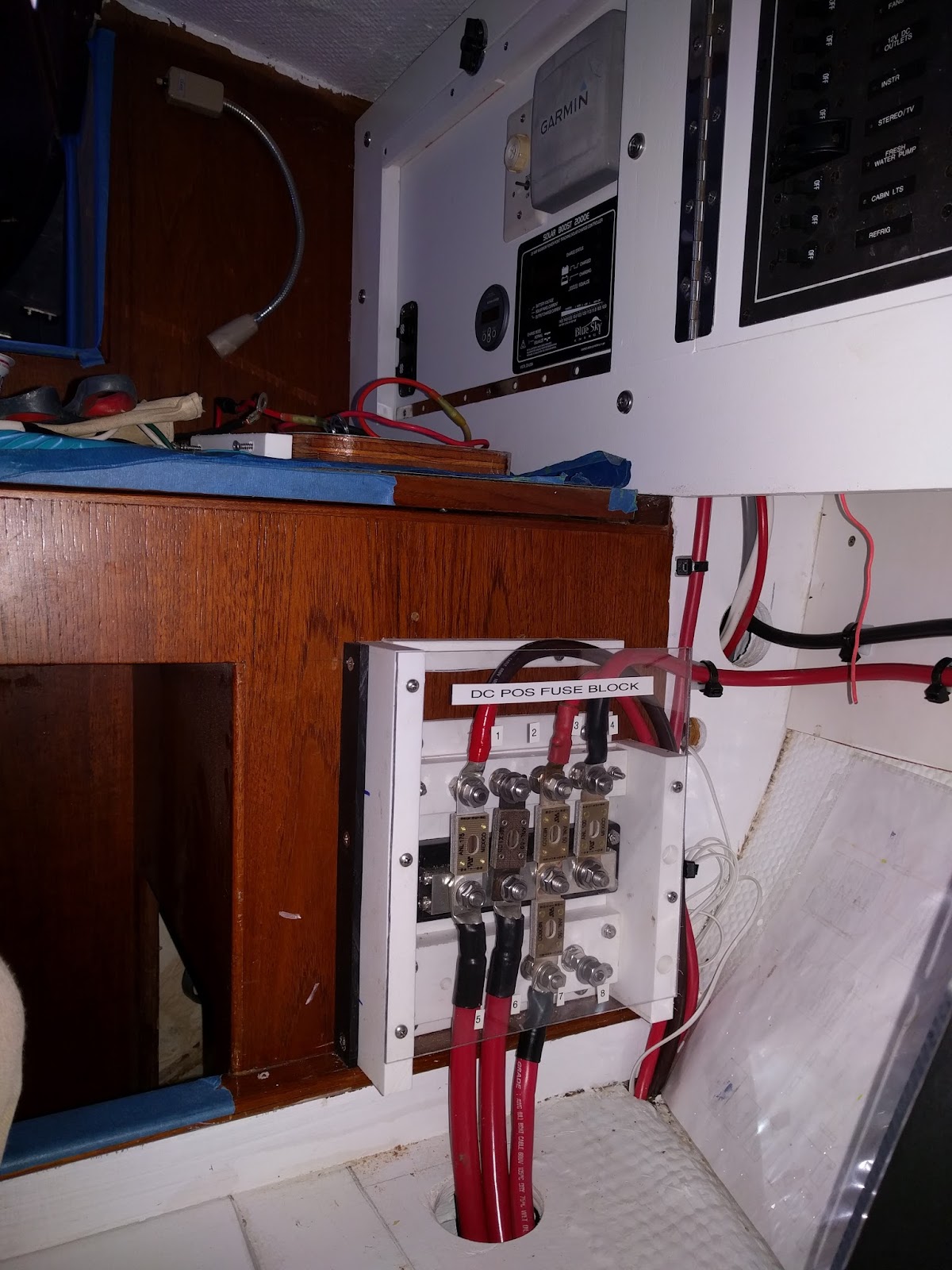
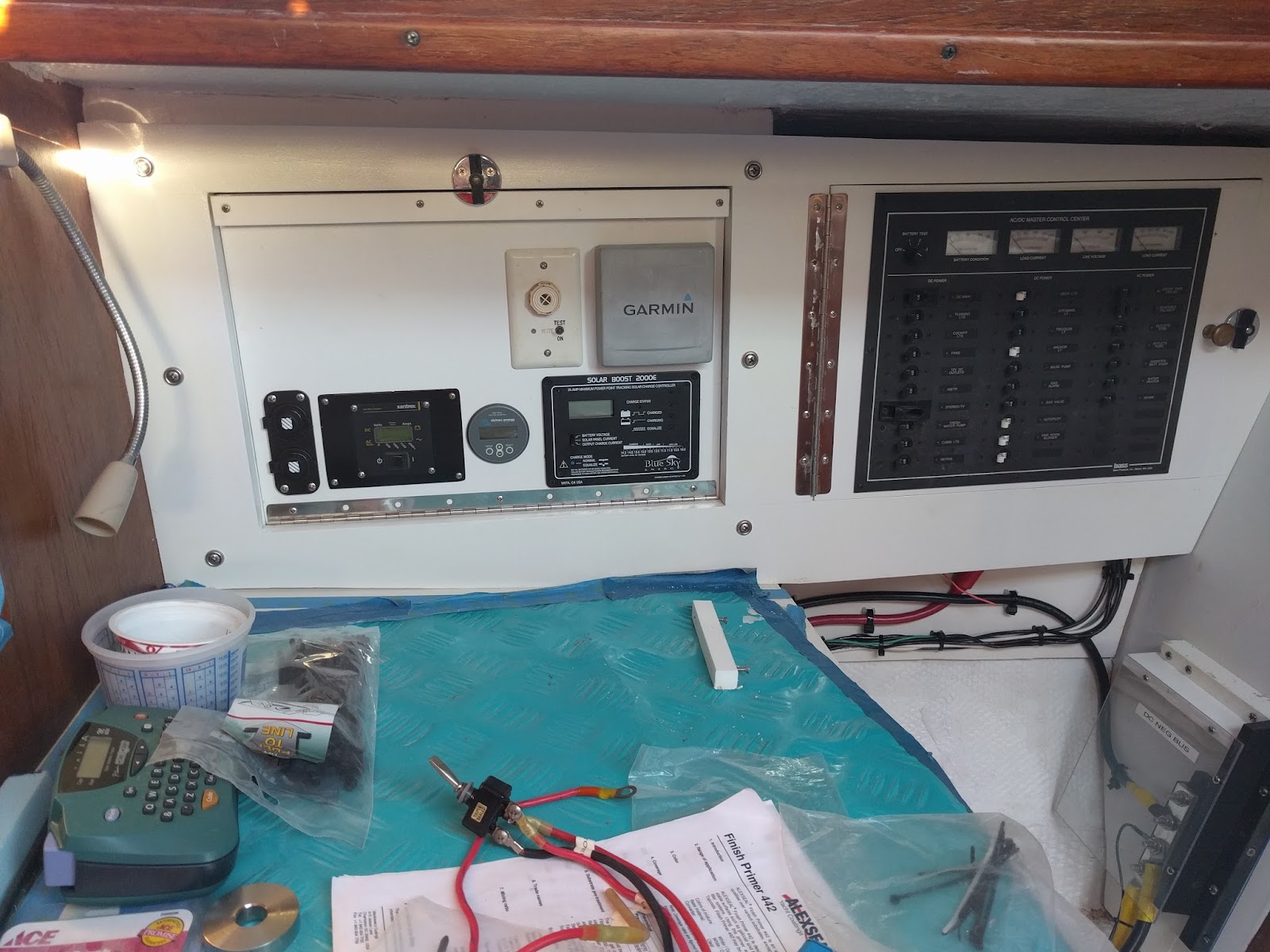
Consolidating the electrical wiring components around the nav station is a priority for us.. Installing the buses below the electrical panel offered a centralized location that provided plenty of room for the large gauge wire runs.
Pilgrim's 12V Primary Buses installed below the electrical panel.
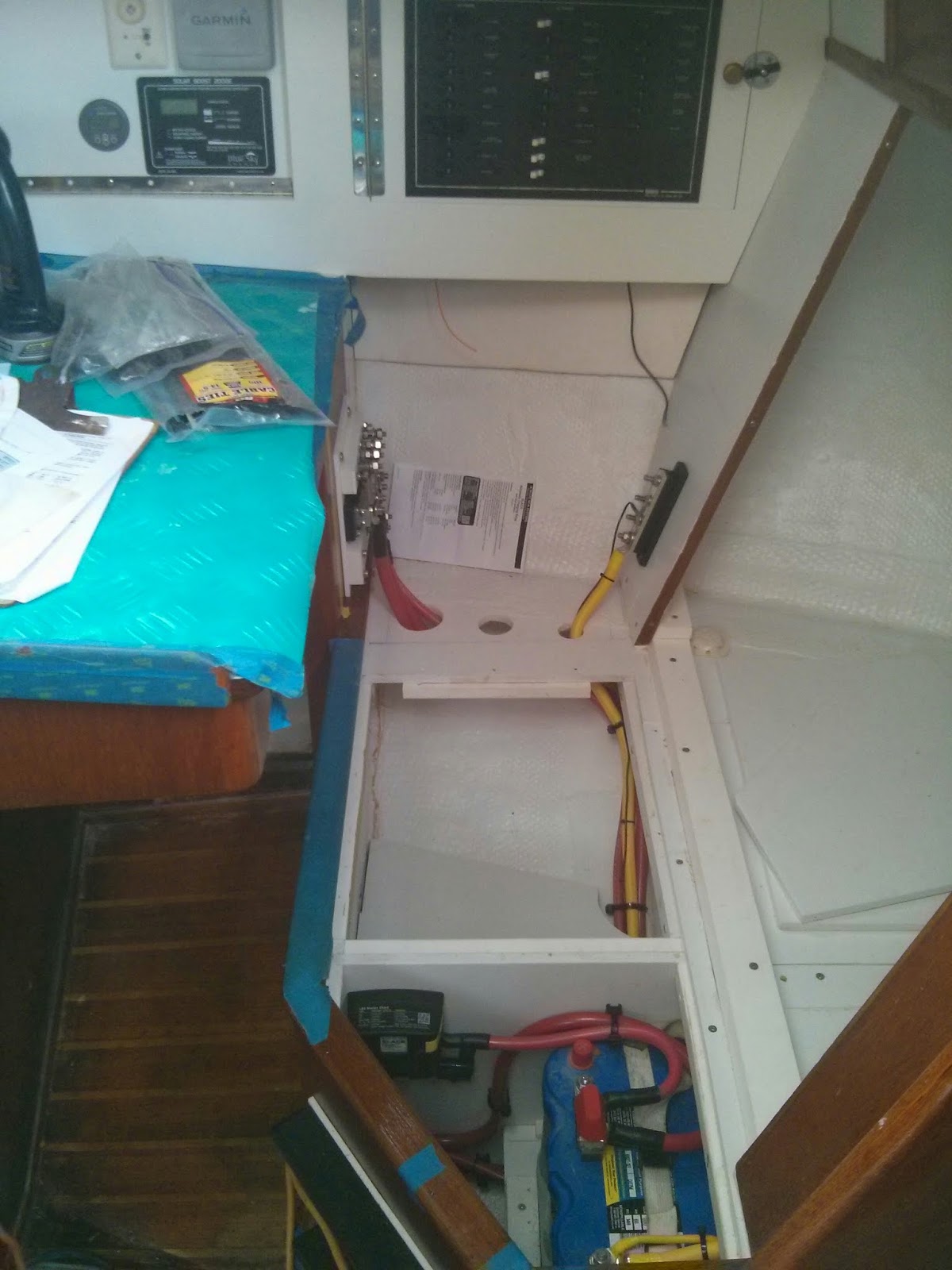
Early on in our refit we chose to eliminate the M382’s quarterberth in favor of additional storage space. Eliminating the berth allowed us to create a seat back at the nav station. The middle two panels of the seat back are removable. The outboard seat back panel is fixed. We installed the negative bus on the fixed vertical seat back panel and the positive fuse block / bus opposite along the original nav station structure.
To prevent accidental shorts in a busy area, I fabricated starboard and plexiglass covers for the two buses.
12V Primary Positive Bus / Fuse Block with plexiglass cover.
12V Negative Bus at lower right in image.
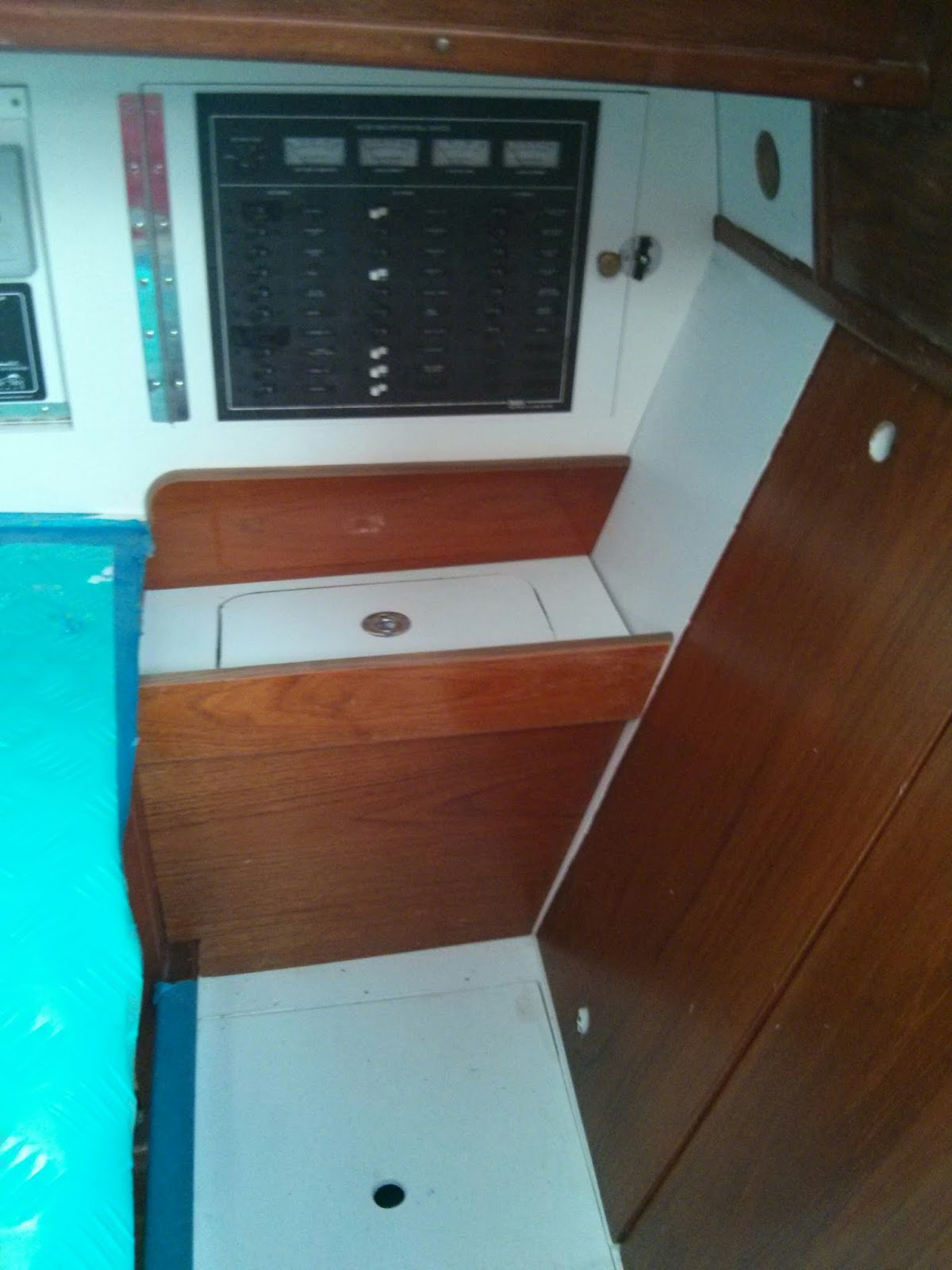
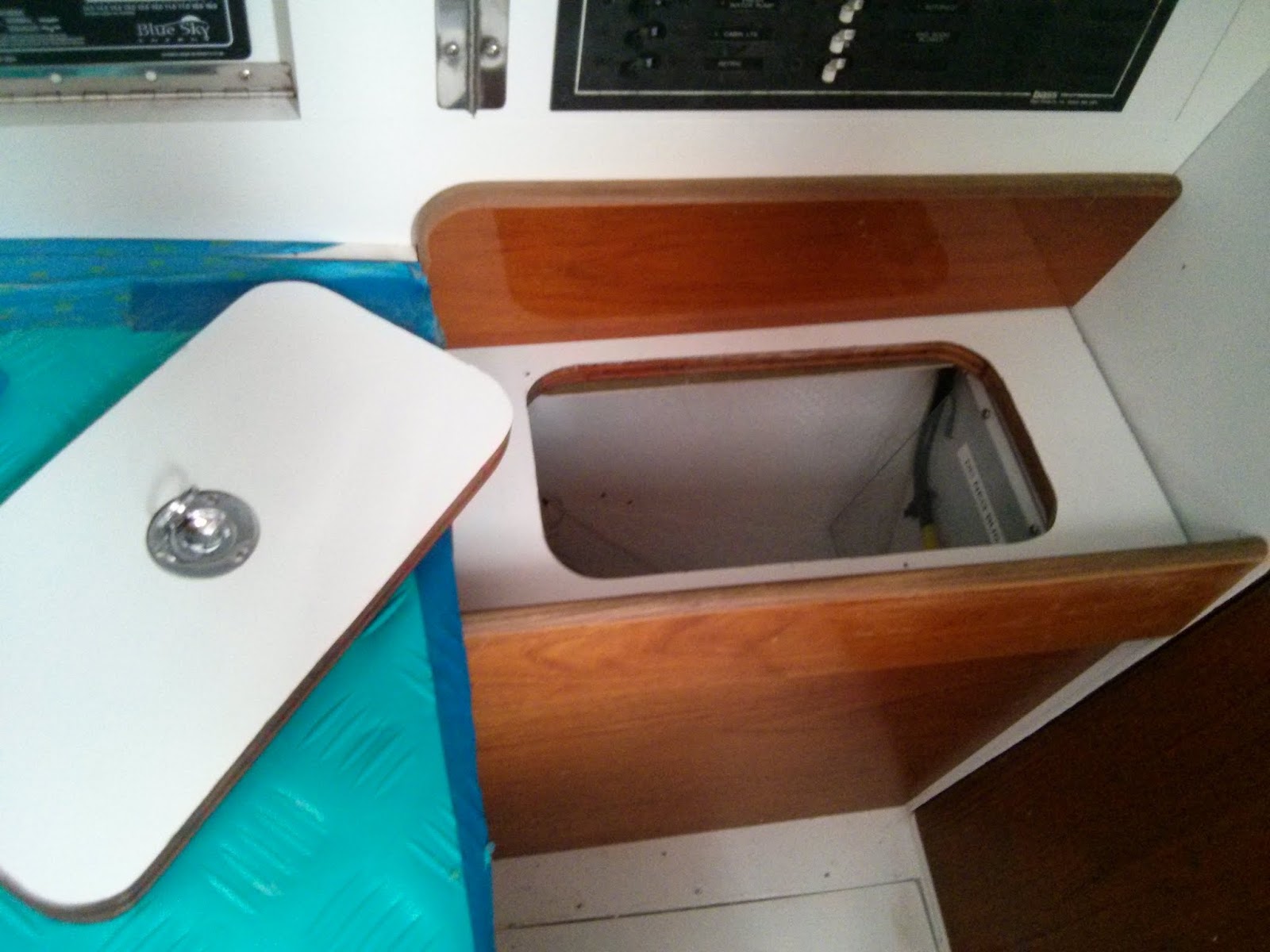
The final step was to create a functional armrest to house the unsightly wiring runs and electrical components.
New arm rest at nav station. The armrest has a removable panel to allow for storage and quick access to the fuses.
Removable panel in arm rest allows for easy access to fuses and storage space.
If additional access is necessary for repairs or upgrades the armrest is designed to easily remove the vertical wood panel via four screws.
Additional photos and notes can be found in our on-line albums.
Re-wiring Pilgrim Photo Album
Nav Station Refit Photo Album
Will post more updates on Pilgrim’s electrical system soon.
Showing posts with label s/v Pilgrim. Show all posts
Showing posts with label s/v Pilgrim. Show all posts
Tuesday, July 5, 2016
Where Do The Buses Go?
Jeff and Anne continue their full refit of s/v Pilgrim. Living around and on boats for a long time, with a solid engineering understanding of what makes a good one (and a bad one...) has really informed Jeff's work on the boat. If you'd like to see how a boat *should* be wired, here's a glimpse into the work. But you'll need to read the rest of Jeff's posts to get the full picture.


Tuesday, March 29, 2016
Crimping Lugs onto Large Gauge Electrical Wires
First of all, thank you, all of you, for your patience and for your well
wishes. They are very much appreciated! The neck surgery was to
correct a nerve pinch in my cervical spine that was causing me to lose
the use of my right hand. Recovery is proceeding apace.
OK, enough of that.
Aboard s/v Pilgrim, Jeff & Anne continue their refit. Today they show us how to make up terminals on heavy gauge wire... I do encourage you to check out the comments on the original post - there are some useful pointers in there to suitable tools for crimping.
OK, enough of that.
Aboard s/v Pilgrim, Jeff & Anne continue their refit. Today they show us how to make up terminals on heavy gauge wire... I do encourage you to check out the comments on the original post - there are some useful pointers in there to suitable tools for crimping.
Our recent installation of Pilgrim’s primary 12V DC wiring required the numerous large gauge, 4 to 00, electrical wires. If you’re wondering which is the larger wire a 4 or 00, then check out our previous post – Let’s Talk Marine Wire, October 18, 2015.
Large gauge wire runs at electrical panel and starter battery.
Large gauge wire runs at house battery bank.
Here are a few things I picked up about crimping lugs onto large gauge wires.
Happiness is having the right tools for the job at hand. The key for installing wire terminals on large gauge wire is having the proper crimping tool. Unfortunately appropriately sized, quality crimpers are expensive and rarely part of the DIY sailor’s quiver of tools. Fortunately I am currently able to borrow a great crimping tool with dies for crimping 6ga through 4/0ga.
If anyone out can recommend a source for purchasing a quality pair of crimpers functional on 6 to 2/0 wire, then please share the info in the comments.
Tools and materials: Clockwise from the top - heat gun, medium duty wire cutters (blue handle), large gauge wire crimper with multiple dies, 2/0 x 5/16 post lugs, heat shrink tubing, 2/0 wire.
Heavy duty wire cutter and a sharpie style marker are essential tools missing from the image above.
I’m not certain if there is a technical difference between lugs and ring terminals. In my vernacular ring terminals are used with smaller gauge wire and typically have heat shrink insulation already installed. Lugs are typically non-insulated fittings for larger wire. If anyone out there has a different definition / delineation, then please let me know.
Ring terminals and lugs need to be sized to the correct gauge of wire and to the correct post diameter. In the image below both lugs are for 2/0 wire. The lug on the right fits a 3/8” post and the one on the left fits a ¼” post.
22ga to 8ga insulated ring terminals on left. 6ga to 2/0ga lugs on right.
Two 2/0ga lugs with holes for different size posts.
Avoid aluminum when purchasing wire connectors. Like marine wire all terminals and lugs should be tinned copper.
I’ve found my medium duty wire cutters will realistically work on wire up to around 1 gauge. 0 through 4/0 wire will require large cable cutters. Sailing vessels should be carrying large cable cutters to deal with wire rigging in the event of a dismasting (See our C’est la Vie post: Dis-masted – Part 2 if you doubt the necessity of having large cable cutters aboard.) Cutting 4/0 wire is easy with the large cable cutters.
Once the wire is cut to the proper length, slide a section of heat shrink tubing for each lug to be installed onto the wire. Sliding the heat shrink over the wire at this point will aid in avoiding any fraying of the wire once the insulation is removed. Next, using the lug as a guide mark the amount of insulation to be stripped off the end of the wire.
The medium duty wire cutters are my tool of choice for stripping wiring larger than 10 gauge.
Stripping 2/0 wire using medium sized wire cutter.
Apply gentle pressure to the handles while rotating the cutters around the wire. I prefer to rotate back and forth through 180 degrees. Rotating through 360 degrees is ergonomically awkward and often results in a spiral cut on the insulation. Stop the motion when you begin to feel the strands of copper against the edge of the cutters. Knowing when to stop cutting and how much pressure to apply comes with practice.
Once the insulation is gone, I move directly to installing the lug. Expediency at this step will aid in avoiding any fraying of the small stands of copper wire.
Crimping a lug on a 2/0 battery cable.
Once the crimping is completed, I give the lug a through visual quality inspection. If satisfied with the connection, then slide the heat shrink tubing over the junction and let the heat gun do the rest.
Numerous 2/0ga battery wires in Pilgrim's house battery bank.
Happy Crimping!


Tuesday, January 26, 2016
Fabricating a DIY ANL Fuse Block
Jeff and Anne continue with their thorough refit of s/v Pilgrim. Here they tackle the fusing of the primary wires in the 12V electrical system. And they do it right. Jeff made this as two separate posts, I have collapsed them into one here.
Pilgrim’s progress is crawling towards the installation of the primary DC electrical wiring. The primary wiring components are:
- Battery Bank(s)
- Large gauge, high amperage wires connecting primary components
- Shunts to allow for the installation of battery monitors
- Switches for directing or cycling on/off the flow of power through primary wiring & components
- Bus Bars to make multiple wire connections in which all the wires are on a common circuit.
- Terminal blocks to make multiple wire connections in which the wires are on separate circuits.
- Terminal posts for making connections in which the wire(s) are on separate circuits.
- Fuses to protect the wiring and components from excessive amperage.
We purchased a BlueSea 600A Power Bar to serve as the primary distribution point for the DC positive wiring. The wiring leading from the positive bus will be fused at the battery box. A few of the other wire runs will need to be fused proximal to the bus bar.
Simple Diagram of Pilgrim's Primary 12V DC+ Distribution Bus
We are installing ANL Fuses for Pilgrim’s primary wiring system. Rather than purchase individual ANL fuse holders for each circuit requiring a fuse “downstream” of the positive bus, we are fabricating our own ANL Fuse Block.
Materials used to create DIY fuse block clockwise from top: Starboard, BlueSea Bus, ANL fuses, 5/16" Stainless Steel Fasteners.
Our fuse block will utilize a ¼” thick Starboard™ base to mount the BlueSea Bus adjacent to a DIY terminal block. The gap between the bus and the terminal block will be set up to accommodate ANL Fuses. ConFUSED yet? Hang in there pictures are worth a thousand words.
Our DIY terminal block will consist of ¾” Starboard™ with 5/16” countersink machine screws as studs.
Laying out the spacing for the 5/16" countersunk holes.
The holes in the ¾” Starboard™ are positioned to match the alignment of the BlueSea bus bar. The holes are drilled and countersunk to fit the 5/16” machine screws.
Inserting the 5/16" machine screws in the starboard block.
The screws are inserted from the underside of the block with the threaded portion of the screw exposed on the topside. A washer followed by two nuts jammed against one another secure the screws to the Starboard™ block.
Inserting a couple ANL Fuses between the new block and the prefab bus ensured proper positioning when we mounting the two pieces on the base.
Completed fuse block sans the wires and one fuse.
The bus and the terminal block are held in position by #10 counter sink machine screws capped with lock nuts. The base extends ¾” beyond the assembly on each side. This excess base will provides area for mounting screws.
When installed in Pilgrim the fuse block will have large gauge wires and/or an ANL fuse attached to each post.
Mock up of wiring attached to fuse block (still missing one fuse.
The image above is a mock-up of the future installation aboard Pilgrim. From the top down…
- The upper wire feeds power from the engine alternator when the engine is running.
- The second wire (currently missing an ANL fuse) runs to a BlueSea Systems Automatic Charging Relay (ACR). The ACR charges the starter battery when voltage in the circuit is between a preset range. The ACR also isolates the house bank during engine starting.
- The third wire feeds power to our battery & bilge pump management panel. Here is a link to our previous post: Installing the New Battery & Bilge Pump Management Panel – June 28, 2015
- The lower wire (labeled “B”) runs to the house bank of batteries. This wire run is fused proximal to the battery bank.
After reviewing the installation manuals for the BlueSky 2000E PV Solar Charge Booster, the AirX Wind Generator, and the ProNautic 12.40 Battery Charger, Pilgrim’s DC+ wiring schematic continued to evolve. The DIY ANL Fuse Holder (see previous post) needed to double in capacity.
Original Fuse Block Design:
Updated Fuse Block Design:
I disassembled the original fuse block; doubled the size of the base; and added a second row of terminals.
Expanded DIY ANL Fuse Block
The missing fuse feeds the Battery & Bilge Pump Management Panel. We are still figuring out the correct size fuse for this circuit.
Eager to check out Pilgrim’s DC wiring schematics? I do plan on posting the wiring diagrams after a few “outside consultants” review my plans.


Wednesday, December 16, 2015
Replacing the Leaking Quarterberth Port
Jeff and Anne continue their refit of s/v Pilgrim. Today we follow along with them as they replace a leaking port, a project many of us could have to face. The unusual part of the project is the thickness of the hull at the port location.
Jeff made this as three posts; I have condensed them into one.
Jeff made this as three posts; I have condensed them into one.
While sanding in the engine compartment, a passing a rain shower alerted me to how badly the old, plastic quarterberth port was leaking. All the other ports in the Pilgrim are New Found Metal Stainless Steel ports, installed by a previous owner. Replacing the only remaining original plastic port was on the project list. Watching row of steady drips along the starboard side wall of the engine compartment elevated the project priority.
We believe the plastic port in the quarterberth was installed at the factory in 1979.
Frequently after rains I check the quarterberth area for water intrusion. Never found any signs the port was leaking. It never occurred to me to check the engine compartment. The leak originated around the outer flange of the port. The water then dripped down thru the void between the fiberglass wall of the cockpit foot well and the ¾” plywood cabinetry wall of the quaterberth.
The original port, set in copious amounts of silicone sealant, heartily resisted removal. Ultimately the combination of a razor knife and pry bar won the day.
The exterior view of the hole remaining after the port was removed.
After sanding down the surrounding surfaces, I filled the nearly 1-1/2” wide void around the perimeter of the opening with trimmed down pieces of a pressure treated 2” X 4”.
Fitting treated wood plugs into the void around the perimeter of the opening.
The wood plugs fit snuggly. Once in place, I mechanically fastened the wood filler to both the outer fiberglass and the interior plywood using flat head stainless steel screws.
Filling gaps and irregularities around the opening with thickened epoxy.
Next, the remaining gaps and irregular surfaces were filled with cabosil thickened epoxy. After sanding down the initial round of epoxy filler, the fairing began.
Round one of fairing viewed from the interior.
Fairing required two rounds of epoxy thickened with a micro-balloon filler (q-cells). Each round of filler was followed by additional sanding.
Two rounds of fairing completed. Now ready for primer.
The interior surfaces were finished with two coats of latex primer and two coats of exterior grade latex paint.
The interior completed. Test fitting the masked acrylic window pane.
Since we intend to use Pilgrim’s quarterberth as a storage area only, we chose to install an acrylic window pane rather than a new opening port. We realize not installing an opening port will reduce ventilation in the area. We have scrap pieces of tinted acrylic on hand. New ports are very expensive. Using the acrylic will save us money. The window will provide natural lighting for the storage area.
View from the interior with the new window installed.
See our Quarterberth Refit Photo Album for images and notes current progress on this project.
Next up, the outside story… fabricating and installing the new acrylic window pane.
Our previous post, Replacing the Leaking Quarterberth Port, the Interior Story, explains why, and how we removed the original port. The post also shares our reasoning for replacing the port with fixed pane window.
As many boat projects are apt to do, the exterior story begins with… creating a template.
Creating a 1/4" plywood template of the window pane. Yes, that is an electrical tape canister we are using for the corner radius.
The template will allow us to “test” the aesthetics of the panel prior to cutting into our limited supply of acrylic material. The template will also serve as a guide for the router bit used to trim the acrylic. ½” plywood was my preferred template material. Unable to find an appropriate piece of scrap we used ¼” plywood.
Pleased with the look and fit of the template, we then transferred the shape to the masked acrylic.
Template dimensions transferred to the masked acrylic sheet.
Ok, time for a disclaimer… our experience working with acrylic, Lexan, Plexiglass, and similar materials is very limited. We welcome any comments or suggestion on working with these types of materials.
The material we are using is ½” thick Chemcast Cell Cast Acrylic Sheet. We reclaimed the scrap material from a project on another vessel. Since the material was previously installed it lacked the protective coating found on virgin material. When possible we kept the pane masked with painters tape during the install process.
Prior to cutting the actual pane, I experimented with various cutting tools and techniques. The jigsaw with Plexiglas specific blades generated too much heat. The heat melted the acrylic and created a rough, scored edge. Perhaps the jigsaw blades would work better on thinner material? Using the hand held circular saw with a multi-purpose blades (24 to 40 teeth) yielded similar results to the jigsaw. The best solution I found was to use a fine crosscut blade (90 teeth) in the circular saw to rough cut the acrylic. Then use a router with a flush trim bit for the final shaping.
With the template as a guide, I used a router with a flush trim bit to clean up the edges of the acrylic window pane.
I clamped the rough cut pane atop the plywood template. The template then served as a guide for the flush trim router bit. Since the guide wheel on the router bit transfers any irregularities from the template to the finish material it is important to sand down the rough edges of the template. Yeah, I learned this the hard way.
Unfortunately the painters tape masking did not play nice with the router. My solution…
Masking the base of the router proved more effective than masking the acrylic face.
Remove the masking from the acrylic and place a couple strips of masking on the base of the router. Masking the base of the router worked for both the flush trim bit and the round over bit used to radius the outside edge of the pane.
Next the edges of the acrylic were sanded beginning with 220 grit and progressing up to 600 grit sandpaper. Sanding the edges up to 600 grit brought them back to a dull, smooth surface. I certain by a polished edge could be achieved if so desired.
Part 1 of the Exterior Story focused on shaping the window pane (Link: Replacing the Leaking Quarterberth Port, the Exterior Story – Part 1.) Thanks to everyone the left suggestions and links on the last post. Now we are on to installing the window.
Drilling over-sized holes for fasteners in the acrylic window pane.
Due to thermal expansion / contraction the pilot holes for mechanical fasteners need to be over sized. I also drilled a slight counter sink on the exterior pilot holes to provide space for butyl tape bedding. This work was all done on a drill press.
Clamping window in place to test fit, mark fastener locations, and scribe window opening on interior face.
The window moved from the drill press to a test fit on Pilgrim. While the window was clamped in place we marked the fastener locations on the exterior. On the interior we used a marker to trace the window opening onto the masking.
Using a marker to trace the interior window opening onto the masking.
After removing the pane, we gently ran a razor blade along the outline of the opening on the interior of the window. This allowed us to remove the section of masking in contact with the hull while leaving the remaining window masked. We then drilled the pilot holes the cockpit wall.
Acrylic in contact with hull exposed and pilot holes drilled.
We are using #12 stainless steel pan head screws to mount the window. To allow for thermal expansion we included a neoprene washer between the head of the screw and the pane of acrylic. The screws are bedded with butyl tape. We are also using butyl tape to bed the window.
Applying butyl tape to fasteners and acrylic.
We applied three rings of ¾” wide X 1/8” thick butyl tape to the exposed acrylic on the interior face of the pane. We have found Amazon to be a good source for butyl tape. Here is a link to the tape we are using on this project – Dicor Butyl Tape.
Fortunately the installation occurred on a hot, sunny day. Both the acrylic and the butyl tape are easier to work with when they are warm. In cold temps the acrylic is less flexible and more prone to cracking. The cold butyl tape is much more firm and less likely to form into a good seal. If completing this project in the winter, then we would have used a heat gun to warm the assembly prior to attempting the installation.
The installation went smoothly. We over tightened the pane slightly until we observed butyl tape squeezing out around the entire perimeter. Then we backed off the screws until the neoprene washers returned to their original shape ( approximately ¼ to ½ a turn.)
Using a plastic "knife" to remove the excess butyl tape
We use a plastic “knife” to cut away the excess butyl tape.
The completed installation.
After completing the install, overnight thunderstorms confirmed the new window is water tight.
See our Cockpit Refit Photo Album for additional images and other projects associated with the cockpit.


Tuesday, November 10, 2015
New Companionway Drop Boards
Jeff and Anne on s/v Pilgrim take on a small project that many, many boats need:
Rare is the boat project that can be completed in a single afternoon.
Pilgrim's tired, teak drop boards. Pilgrim arrived in Beaufort with three teak companionway drop boards. The existing teak drop boards are both too thin, between ½” and 5/8”, and too short. Due to the inadequate size, the boards would bind up unless extreme caution was employed when removing or installing them.
The solution? Two new ¾” thick King Starboard drop boards. Since the Starboard does not require painting or varnishing, the project fit neatly into a couple hours…
- Lay out the proper dimensions.
- Rough cut the Starboard with a circular saw.
- Using a router, create a rabbit joint between the upper and lower boards. Set up the joint to shunt water outside the boat.
- Using flush trim and round over bits in the router, finish the edges of the boards.
- Install the hasp.
Pilgrim's new Starboard drop boards. The new boards slide easily in and out of position. Unlike the top of the slider or the exterior companionway step pictured above, the new drop boards will never require refinishing.
We plan to replace all the exterior teak in the image above… in due time.


Tuesday, October 13, 2015
How To Make Holes In Your Boat
Making a hole in your hull is serious business, even more so if your hull is foam-cored. Jeff and Anne aboard s/v Pilgrim and in the midst of a complete refit demonstrate how it should be done...
We have added two new 1-1/2” thru-hulls above the water line. The port thru-hull will serve as the discharge for the upper, larger capacity bilge pump (3700 G/H).
The starboard side thru hull will act as a drain for the deck scupper. We did not like the long hose run from the starboard scupper to the torpedo tube drain manifold. We also wanted to rig a method for collecting water off the deck if necessary.
Prior to drilling any holes we assembled the new starboard deck drain plumbing.
Test fit of new plumbing for starboard deck drain. Note old drain hose at far right. Test fitting the new plumbing allowed us to accurately mark the location for the starboard thru hull. The port side fitting connects to a single flexible hose so identifying the exact location was less critical.
Since the location of the holes was marked on the inside of the hull, I began the drilling using a ¼” bit to drill a pilot hole from the inside out. The ¼” hole matches the diameter of the hole saw pilot bit. Next, I chucked a 1-7/8” hole saw into the drill and moved outside the hull. Drilling the larger hole from outside allows for properly aligning the hole perpendicular to the hull and creates less dust inside the boat.
We drilled two 1-7/8" holes in the hull. The Morgan 382, 383, & 384 hull’s have a foam core above the waterline. This is the first time we have drilled large diameter holes above the waterline and subsequently our first look at the coring material.
Close up of plug offers a glimpse of Morgan's construction techniques. The hull is slightly over one inch thick… the outer fiberglass layer is 5/16”; the foam 9/16”; and the inner fiberglass layer 1/8”Placing holes in cored hull’s or decks requires additional effort to ensure water never reaches the core material. In smaller, fastener sized, holes this can be achieved by over drilling the size of the hole and then filling it back with epoxy. Larger holes for plumbing fixtures require a different approach.
Using a small flat screw driver and a couple different styles of picks, we removed all the coring material within approximately ½” of the hole.
Foam core removed from the area around the hole. The plan is to fill the newly created void around the hole with thickened epoxy. So the next couple steps are the usual epoxy prep… 80 grit sanding, acetone wipe down, mask area... We used a syringe to apply the epoxy and a plastic spreader to achieve a nice clean finish.
Filling the area around the hole with thickened epoxy. After a couple days for the epoxy to fully cure, we returned to the project. Using a #49 cabinet rasp and some 80 grit sand paper, Anne cleaned up any excess epoxy from the holes. While I cut down the length of the threaded section of the thru-hull to properly fit the valve on the starboard side.
Prior to applying any sealant we dry fit the two thru-hulls and masked the surrounding area. For the final install we used 3M 5200 sealant. Anne worked the interior and I the exterior.
New thru hull fittings are just above the waterline and five feet forward of the torpedo tube drain on either side of the hull. We are still waiting on hose to connect the bilge pump to the new fitting on port, but we wasted no time installing the new starboard deck drain plumbing.
New deck drain w/ option for filling water jugs installed. Since the installation we have weathered a couple heavy rains. The starboard deck scupper is performing much better with the new system.
What was that you said?
Why yes that is a new battery selector and bilge pump switch panel in the image above. I’ll post more info on that project very soon.


Subscribe to:
Posts (Atom)


 Posts
Posts


