Take one empty wine box, open top, extract empty bag, fold flaps down, insert produce bag or similar size, and secure with rubber band. I cut a piece of a foam meat tray to make a lid/pusher, and it's all set. You will be amazed how much trash can be pressed down into this cube! When its full, twist the bag closed, tape the cardboard shut and it can easily be stored till you get to a dock. For super recycling, the box can be opened up and the trash block removed and the cardboard recycled too.
Showing posts with label galley. Show all posts
Tuesday, May 30, 2017
The Cardboardeaux Trash Compactor!
Every boat has a limiting capacity of something... water, fuel, provisions stowage, black water, etc. What is it that makes you tie up to a dock? Aboard Eolian, the first thing we seem to run out of is stowage for trash. With that in mind, please welcome new contributors Jonathan and Sarah who live aboard their Baba 35, s/v Odyssey. They have a wonderful solution for the trash/garbage stowage problem:
Labels:
galley,
s/v Odyssey,
stowage,
tips
Tuesday, July 12, 2016
Corrosion, Corrosion
This post originally appeared on Windborne in Puget Sound
For a boat on salt water, corrosion is an omnipresent demon.
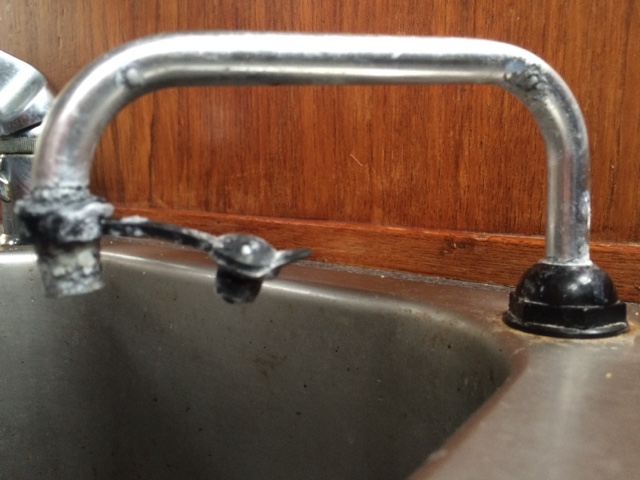
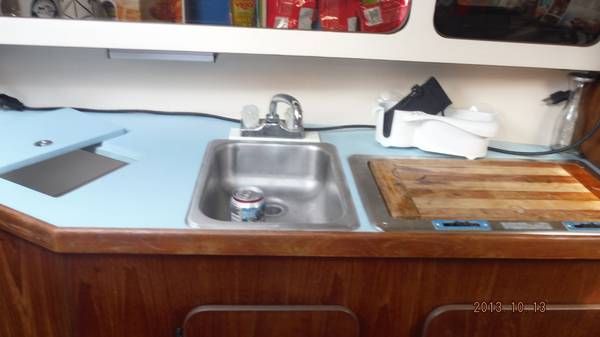
Even inside. This is the spout on our galley sink which is piped to a saltwater foot pump. And to the cooling water discharge from our 12V refrigeration system, meaning that it has saltwater flowing out of it whenever the refrigeration compressor is running, as a telltail. Look closely at the inside of the right-hand bend... yup, the aluminum has corroded thru. I don't understand this... aluminum is supposed to be reasonably proof against saltwater. The pipe is clamped to the sink in a plastic fixture, and is connected below the sink via vinyl tubing... ruling out galvanic corrosion. The entire refrigeration system is 12V, so stray 110V current cannot be an issue. The compressor is powered by an external motor thru a V-belt.
But.
The motor and compressor are mounted on the same metal plate, and there are some pressure switches to control the motor mounted on the compressor.
Is that enough to cause stray current corrosion, tho there is no direct connection between the refrigeration unit and the aluminum tubing except via the saltwater itself?
Or is the corrosion simply the result of flowing saltwater washing away the protective oxide layer on the inside of the aluminum tubing? I am very interested in what the net.wisdom has to say about this...
Regardless, this is the second spout that I have installed there, and they have gotten ridiculously expensive. I am not planning to buy a third one.
Instead, I bought some thin-gauge 316 stainless tubing from Online Metals. Now, if you've ever attempted to bend tubing, and especially thin-gauge tubing, you know that it requires special tooling to prevent kinking. The tooling constrains the tube so that it can't collapse and kink while it is being distorted. I looked up what a tubing bender for 7/16" tubing costs on the Interwebs, and Oh. My. Gosh.
OK, a Plan B is needed.
It is also possible to prevent collapse/kinking if the tubing is filled solidly with something incompressible. Apparently some people have used ice (fill with water; freeze), but I was concerned that I'd never get the tubing bent before the ice started to melt. This is where Wood's metal comes in.
I just happened to have some.
All that remained was to reheat the bent tubing in another boiling water bath to remelt the Wood's metal and pour it out.
And since our galley sink has two of these spouts (one for salt water and one for fresh water, foot-pumped from the tanks), I made another spout. Gotta be symmetrical, don't you know.
A little boat yoga, and the galley sink looks better than it ever has!
For a boat on salt water, corrosion is an omnipresent demon.
Even inside. This is the spout on our galley sink which is piped to a saltwater foot pump. And to the cooling water discharge from our 12V refrigeration system, meaning that it has saltwater flowing out of it whenever the refrigeration compressor is running, as a telltail. Look closely at the inside of the right-hand bend... yup, the aluminum has corroded thru. I don't understand this... aluminum is supposed to be reasonably proof against saltwater. The pipe is clamped to the sink in a plastic fixture, and is connected below the sink via vinyl tubing... ruling out galvanic corrosion. The entire refrigeration system is 12V, so stray 110V current cannot be an issue. The compressor is powered by an external motor thru a V-belt.
But.
The motor and compressor are mounted on the same metal plate, and there are some pressure switches to control the motor mounted on the compressor.
Is that enough to cause stray current corrosion, tho there is no direct connection between the refrigeration unit and the aluminum tubing except via the saltwater itself?
Or is the corrosion simply the result of flowing saltwater washing away the protective oxide layer on the inside of the aluminum tubing? I am very interested in what the net.wisdom has to say about this...
Regardless, this is the second spout that I have installed there, and they have gotten ridiculously expensive. I am not planning to buy a third one.
![]() |
| Two pieces of 7/16" stainless tubing |
OK, a Plan B is needed.
It is also possible to prevent collapse/kinking if the tubing is filled solidly with something incompressible. Apparently some people have used ice (fill with water; freeze), but I was concerned that I'd never get the tubing bent before the ice started to melt. This is where Wood's metal comes in.
![]() |
| This is Wood's metal - it is a eutectic alloy of 50% bismuth, 26.7% lead, 13.3% tin, and 10% cadmium by weight. It melts at 158°F |
![]() |
| Wood's metal foundry |
For a foundry, I purpose-bought a can of tomato paste (69¢), and froze the tomato paste, retaining the can - just the right size. I put it in a pan with some water and brought the water to a boil - 212°F, or about 50° of superheat. I then poured the molten metal into the tubing (I had previously blocked one end of the tubing by pushing it into a wine cork - we seem to have plenty of these). I then immediately plunged the filled tubing into a container of cold water - I had read that quenching creates a fine crystal structure in the Wood's metal, making it more ductile (read: easier to bend).
OK, now to bend. I created a bending jig and lag-bolted it to a 4x4 in our shed:
![]() |
| Homemade bending jig |
Yup, it bent just fine - no kinking, no collapse.
![]() |
| Recovering the Wood's metal |
And since our galley sink has two of these spouts (one for salt water and one for fresh water, foot-pumped from the tanks), I made another spout. Gotta be symmetrical, don't you know.
![]() |
| Done (Clever camera angle conceals dirty dishes in the sink) |
Labels:
corrosion,
galley,
s/v Eolian
Tuesday, April 5, 2016
Easy! It's A Kit!
Over at Dock Six, Brian decides to upgrade from an icebox aboard s/v Karma to a refrigeration unit. And it's a kit! Easy, right?
"You want paradise..."
-Foreigner
First, a little personal history:
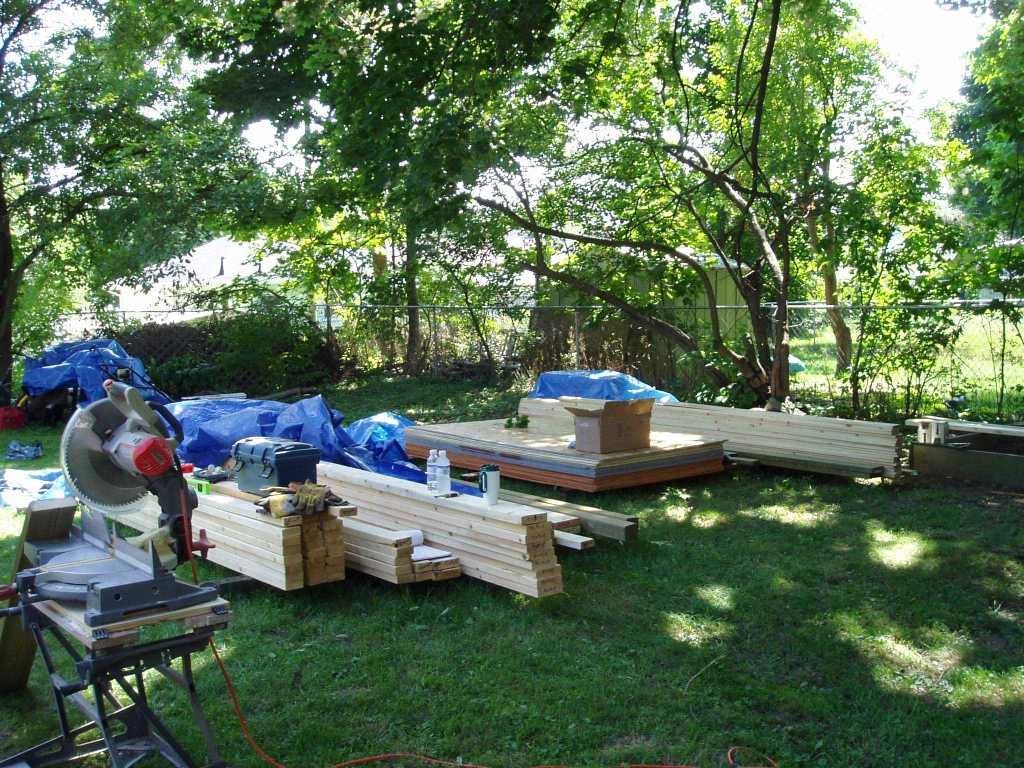
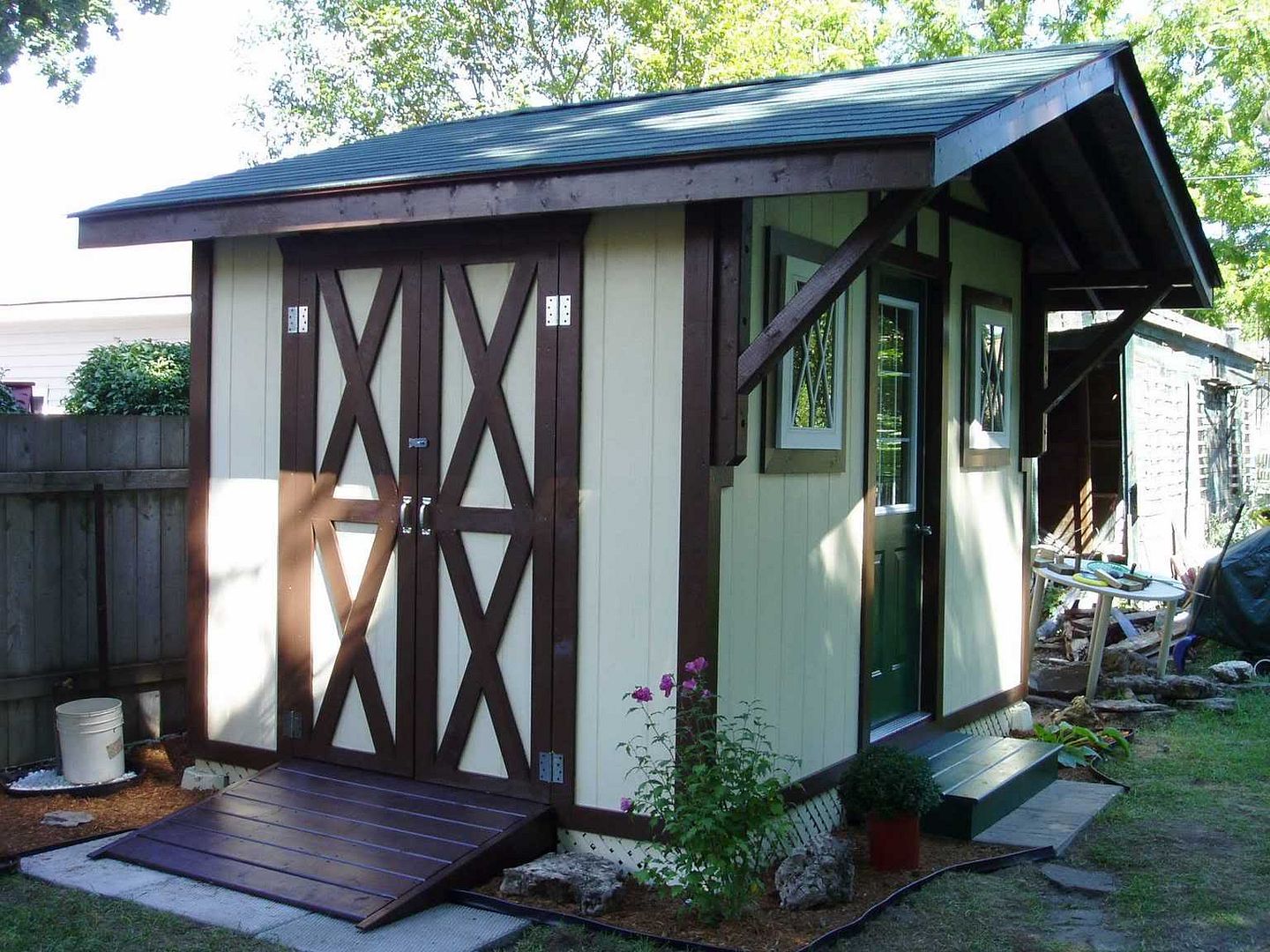
A decade ago, in the era PB (Pre-Boat), SWMBO and I (okay, mostly SWMBO) decided that we needed to replace the shed in the backyard of Stately Jones Manor. The shed was...
... less than stately.
Hell, it was less than intact and decidedly unsafe. Although uitilized as shelter for our underused and oft-neglected lawn and garden equipment, that equipment was now doing double duty holding up the shedding shed.
Clearly, we had to do something.
We knew we didn't want an aluminum panel -and-channel nuts-and-bolts utilitarian box. We wanted a stately wood shed that would be an attractive addition to our backyard, not just a holds-our-crap blight. We also knew we didn't have the ambition or the skill set to build a shed from scratch, and didn't have the ready cash to buy a pre-fabricated shed, or hire a crew to build one for us.
So, we procrastinated and pondered, as the existing shed grew ever less square and vertical and closer to the ground.
Perusing the sale flyers in our local free throw-away newspaper, we discovered a local lumberyard had attractive affordable, stick-built shed kits available.
A shed KIT! Perfect!
I built model kits as a kid, I had assembled damn near a houseful of IKEA furniture, I could definitely build a shed from a kit!
We went to the yard, picked a design we liked from their catalogue, and were assured that our shed kit would be delivered in time for the weekend.
Perfect! We can have this thing assembled before Monday!
Friday, as promised, a truck from the lumberyard pulls up, and deposits our shed kit in the driveway of SJM.
The "kit" consisted of a big pile of lumber, three bundles of shingles,a bag of nails and screws and hardware, a door, and 2 pages of poorly photocopied plans.
"Kit", my ass.
We got it done, and it still does it's job ten years on, but it took a lot longer than a weekend, and it took more manpower than SWMBO and I.
This project taught us some skills, and taught us that we could do it
Ever since, however, I have been dubious of the ease of assembly of any DIY "kit."
Flash forward to the summer of 2015:
Karma, like Whiskeyjack before her, has an icebox. For 8 seasons, we schlepped bins and blocks of ice down the Dock, and dealt with the daily ritual of emptying catchbottles of meltwater. Iceboxes are simple systems, and do a more than adequate job of keeping food and beverages cold. It was a good system on Whiskeyjack that gave us no reason to complain.
On Karma?
Not so much.
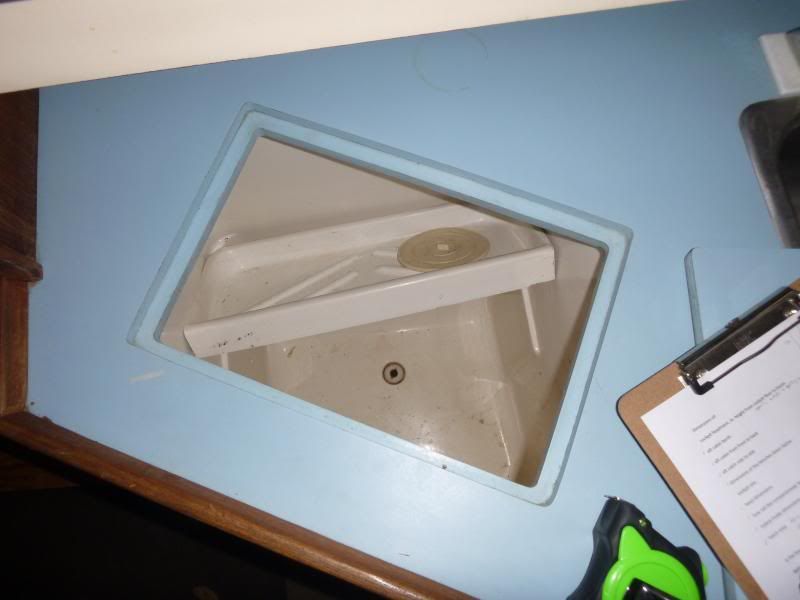
First, Karma's icebox is oddly, trapezoidally, shaped.
This meant that the bins that we used to hold iceblocks and contain meltwater on Whiskeyjack didn't fit. Not an insurmountable issue, it simply means that ice blocks have to be loaded into the icebox naked, and rather than meltwater being caught in a bin, is allowed to drain from the icebox...
.... into the (shallow) bilge. Not ideal.
At the beginning of this season, i redirected the drain into a catchbottle, which required emptying daily. Again, not an insurmountable issue, but one more daily chore, albeit not onerous... unless you're away from the boat for more than a day in which case the catchbottle no longer catches and overflows onto the carpeted sole.
Again, not ideal.
Lastly, the shape of the icebox limited iceblock placement, which in turn limited food and beverage capacity.
Yet again, not ideal.
So, refrigeration became a topic of discussion. Said discussion boiled down to:
Will it fit?
Will it work?
Can we afford it?
Will it fit? Good question. An S2 8.0C is a roomy boat with lots of storage, but just as the icebox is weirdly shaped , so are many of the lockers and bins.
Lots of research and measuring told me that installing a typical refrigeration system's compressor and condensor and stuff wasn't going to be simple or easy.
Measuring inside the icebox, and comparing cold plate sizes online, our options were limited.
Will it work? Good question. Regular Readers know that we are off the grid on the Dock- no water, no shorepower. Our electrical needs are supplied by our solar panels- so, anything electrical that we add to our boathome has to work within the restrictions of the available battery and charging capacity.
Can we afford it? Good question. Tallying the costs, we were looking at an expenditure of anywhere from $1200 to $2200. Ouch. This would be our first four-figure boat project in, like, ever.
So, after pondering, we realized that we didn't think it would fit, weren't sure if it would work, and didn't figure we could afford it.
Then I discovered the Dometic/Waeco/Adler-Barbour Coolmatic Cooling Conversion Kit.
Note that last word.
It's dreaded kit status notwithstanding, it seemed to tick all of our boxes-
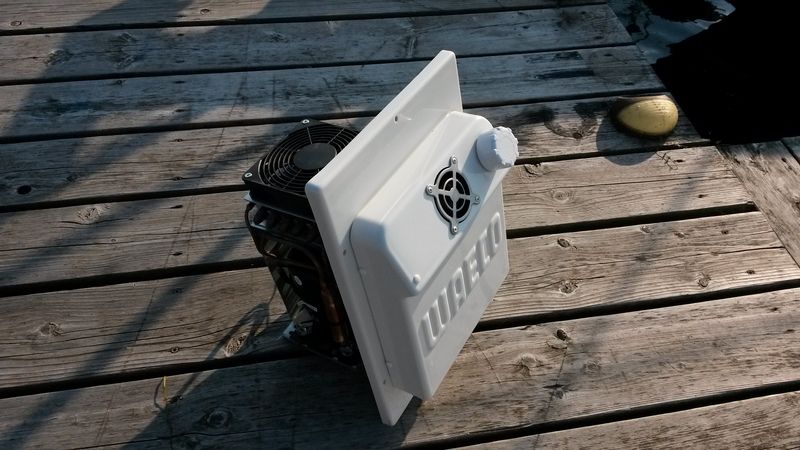
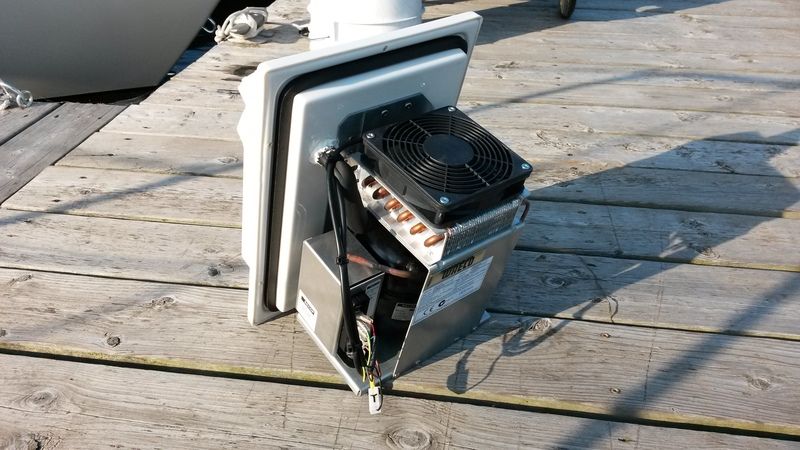
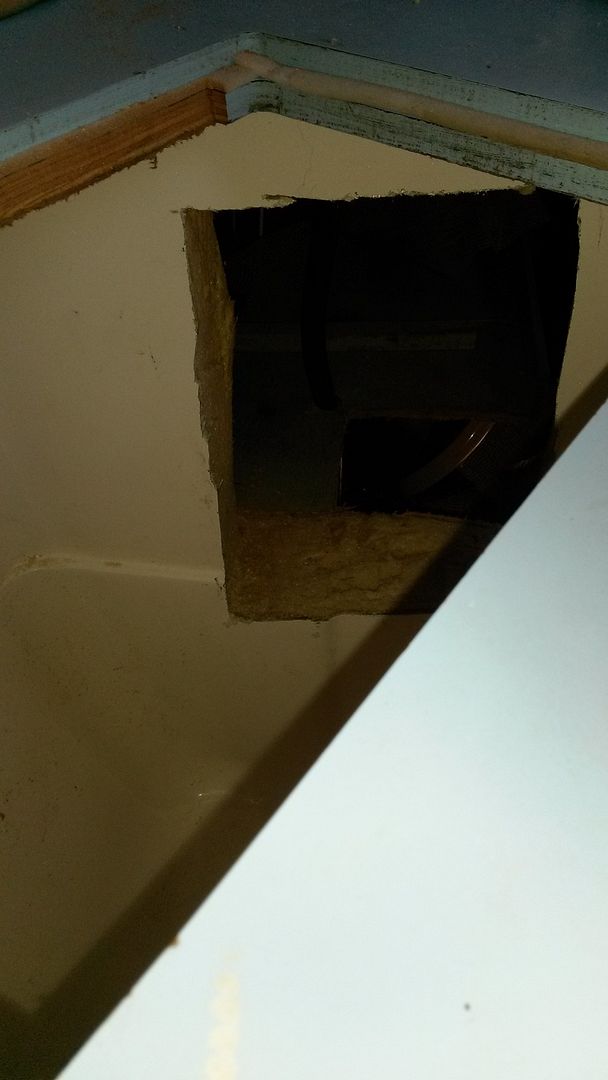
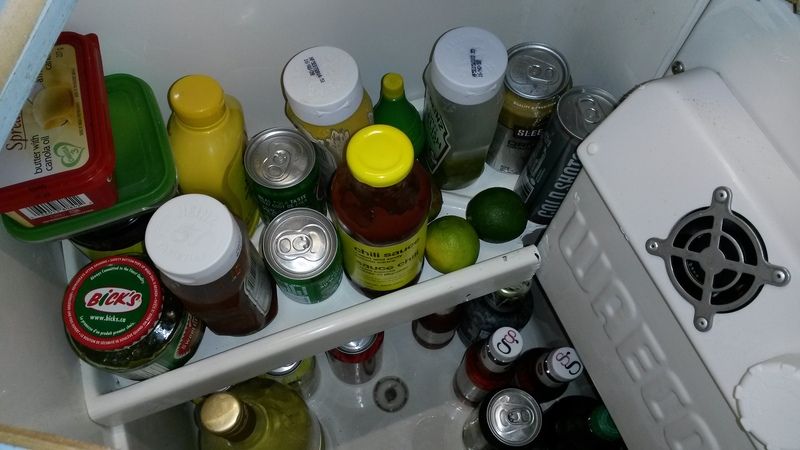
Dimensionally, it fit- instead of being a internal evaporator/external compressor/condenser set up, the Coolmatic is an all-in-one unit measuring about 10" x 12". Cut a hole in the side of the icebox, screw the unit in place, run some wires, done.
That "about" becomes important later.
It wasn't too taxing for our electrical system either- the advertised draw was 4 amps, with a 20-30% duty cycle. In theory, that means it draws less than 1.5 amps per hour, and this would be the largest constant draw on the boat- our lighting is all LED, and the only other energy use is charging electronics. so our 120 watts of solar delivering an average of 60 amps/day should keep us ahead of the charging curve.
It's not a cheap system, but at $799 (on sale), even with tax it didn't break the psychological 4 figure barrier.
So, we pulled the trigger, and ordered one up from our friends at Binnacle.com .
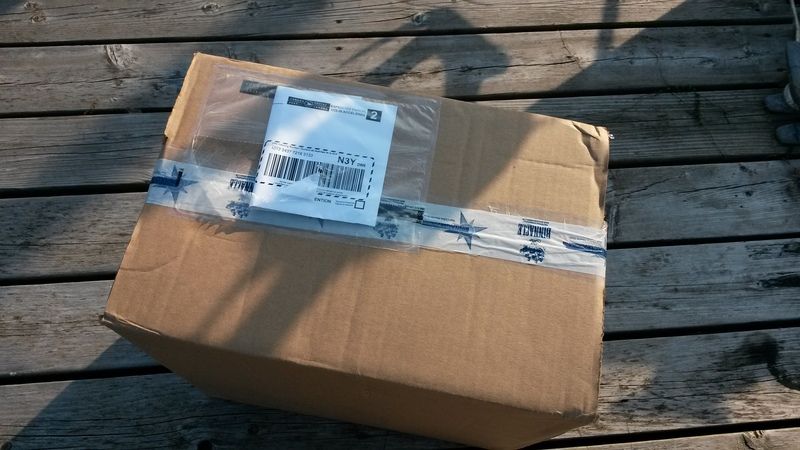
4 days later, a day earlier than promised, a box showed up.
Once unwrapped, our kit is revealed;
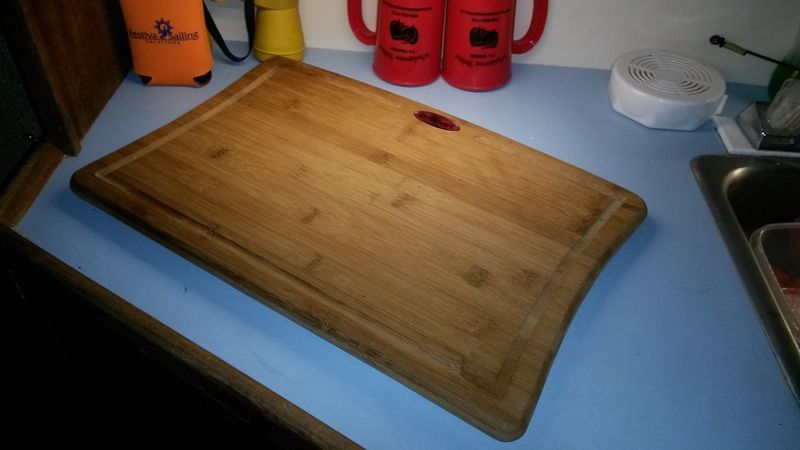
Okay, looks pretty much plug-and-play.Here's the plan:1. Measure and mark the cutout in the side of the icebox.2. Drill pilot hole.3. Cut out panel with jigsaw4. fit cooling unit into hole.5. Screw into place.6. Wire into distribution panel.7. Enjoy cold beverage.I figured it would be an hour's work, tops.SWMBO and I emptied the icebox of contents, transferring said contents to a cooler brought aboard expressly for this purpose, and I embarked on step 1.Jones's 4th Law of Boatwork- no plan ever survives past step 1 unchanged.My initial plan, based on the measurements I had taken before buying this kit, and the measurements quoted in all of the manufacturer's literature, was to install the unit on the aft side of the icebox. Now, with my new Coolmatic in hand, I discover that the aft wall of the icebox was 1/4" too narrow.Well, shit.Okay, so I need to mount it on the forward side of the icebox, and hopefully it will clear the sink and still have decent ventilation around the fan and cooling fins.So, I careful trace the cut-out, according to the template included in the installation instructions, drill my pilot hole, and discover that the forward wall of the icebox is 4" thick...and my drill bit is 3 1/2" long.Well, double shit.Did I mention that I decided to jump into this endeavour during the hottest week of the summer?At this point I am 2 hours in and soaked in sweat. Time to call it a day.Day 2, I cut out the inner wall of the icebox, gouge out all of the insulation ( this icebox has about 3" of insulation), then get out the sawzall and carve out a hole in the panel between the icebox and the sink cabinet.I gently slide the Coolmatic into the icebox...... and it doesn't fit through the icebox opening.SHIIIITTTTTT!!!!!!!!!!Okay, new Step 4(a)- out comes the jigsaw, the ice box opening is enlarged (which means the icebox lid will no longer fit. Son of a ....)Now the Coolmatic will slide into the icebox....... but not slide into the freshly cut hole.I am beyond profanity at this point.So, Step 4(b)- test fit, retrim, test fit, re-trim, test fit, retrim, testfit, retrim, testfit retrim, testfitretrimtestfitretrimtestfitretrimtestfit... it FINALLY fits.I am now 6 hours total into this job, in 90 degree heat. Look up "masochist" in the dictionary- See that picture? That's not me, that's some other poor sap, because I was still installing a FUCKING REFRIGERATION "KIT"!!!Once the "kit" was installed, the rest was relatively straightforward- screw the reefer unit into place, seal it up with some caulking, trim the icebox shelf to fit and reinstall, clean everything up (again), wire it up, and put everything that came out of the icebox back into the icebox......Then build a new icebox lid. I repurposed a cutting board, added some styrofoam insulation to the underside and some foam weatherstripping, and called it done.From start to finish, I had 9 hours into the job, over 3 days.(To be fair, Dockneighbour Frank bought the same unit after seeing ours, and he DID get his installed on his O'day in under an hour. Having a uniform sized icebox with a big lid and easy access makes a ton of timesaving difference.)But, the end result is worth it.This unit is quiet. It is quieter than the fridge in our kitchen at SJM. Power consumption seems to be in line with specs. In the spring I will rework the lid/opening flange to get a better seal, and add some more foam board to the lid for better insulation. The contents of our reefer (can't call it an icebox any more) are kept acceptably cool, with the dial set to 4, but adding a little insulation and improving the seal can't hurt.I'd do it again. we now have more room in our chillybox, no more lugging ice, and no catchbottles to drain daily.The economics are subjective, and a bit of a toss-up. In the short term, it doesn't make sense, from a cost-savings standpoint. A block of ice would last three days in our icebox on average, and if there were serious perishables onboard, we would load in two blocks at a time. At $3/block, call it $150/season. Over 10 years, however, assuming the cost of ice doesn't rise or drop, that's $1500 that we don't have to spend on ice, by spending $800 (plus tax) on a refrigeration "kit" So, long-term, it makes sense.It also means that, while our current electrical system is keeping up, I am now considering adding a second house battery and another solar panel, just in case.But, that's another project, for another day.
Labels:
Dock 6,
galley,
refrigeration
Tuesday, January 6, 2015
Galley Gear Review: Nice Nesting Pots and Pans
Over at Liebster-winning Dock Six, Brian reminds us of a marine truism: "No boat is ever big enough." And he has a solution for it:
No matter how big the boat, every boat is too small.
Especially the galley.
When it comes to boat galleys, to paraphrase James T. Kirk...
Space is the final frontier.
NextBoat*'s galley has more storage capacity than Whiskeyjack's galley, but "more storage capacity" is a relative term. That is like saying that your humble scribbler here is taller than the average 9 year old child.
That doesn't make me a giant.
Ergo, maximizing space is paramount. The more stuff you can fit into the existing space, the more comfortable your life in aforementioned space.
Hence my interest in a set of nesting cookware.
Every year at the boat show I look for a deal on cookware. I like the quality of the Magma set...
image courtesy of Magma
...but I don't like the inventory- there are four pots, but only one pan, in the 10 piece set. Those of you who have read any of the Two-Burner Tastiness recipes understand that I'd rather have two pans, and one less pot, but that isn't an option.
So, my search continued.
Until early this summer.
Wandering through the camping department of my local Canadian Tire, last June, I made an impulse buy.
(why am I not surprised? - ed.)
I had just picked up the bottle of lamp oil I needed, and on the shelf right beside the lamp oil was the camp cooking gear. There were the usual speckled enamel suspects, the stuff that looks rustic and rugged, right up until the moment you actually use it, but in the midst of the sea of stamped-in-China-great outdoors-nostalgia-ware was a SALE ! tag, under a carton of cookware that looked...different.
So I bought it.
Yeah, I'd never heard of "Lagostina" either.
No, those not-shrimp, not-prawns, not-crawfish, not-lobster things? Those are LaNgostinOs.
Which can be cooked in a Lagostina pot.
Here's the deal: Lagostina is an Italian firm that has been manufacturing stainless steel cookware for decades. Their "Campeggio" line is their, as the name implies, line of camping cookware, but while it is compact in size, it is not compact on quality.
These pots and pans are constructed of 18/10 stainless, with three ply (stainless steel/ aluminum/ stainless steel) bottoms for even heating. fold down the handle on the large stock pot and ...
Keep going and in rapid succession you get...
Two, count 'em, TWO pans...
...Two stock pots...
...Two lids that fit both pots and pans....
... and a grip-anywhere, go-anywhere insulated pot/pan handle that is both ambidextrous and has hooks for removing hot pot lids, like when you are steaming Langostinos.
Both pots are graduated, which is a nice touch...
...for measuring the exact amount of liquid for boiling langstinos
Also included is a mesh carrying bag... that was promptly repurposed forother uses aboard.
After 5 months of use, both SWMBO and I can confirm, we LOVE this stuff.
All pieces heat evenly, the bottoms don't warp when warm, the handle is substantial, the construction is solid, the non-stick is real non-stick, and, most importantly...
... These were the ONLY pots and pans we have used for the last 5 months, and we haven't needed to buy more. Cooking for 2-4 on a 2 burner stove? This is all you will likely ever need. It is all we have needed.
Here's an example:
Cracker crusted pork chops, "Booker T" mashed potatoes and peaches and cream corn- two burners, three pots, from one nesting cookware set.
Oh, and a bottle of Ramblin' Road DPA.
Surprisingly, although less than half the price of the smaller one-pan Magma nesting set, the Lagostina cookware comes with a 10 year warranty, compared to the Magma's I year warranty. I am impressed. Retail price at our local Canadian Tire Store was $119.99 cdn.
The only challenge is where to find it outside of the Canada.
Or Italy.
If anyone wants a set, let me know. I'll pick it up for you and ship it out- for actual cost.
Thanks for checking in, and please,
"Talk the Dock!"
Wednesday, November 19, 2014
IKEA stuff for Boats?
To do any fun cooking aboard, you need to have at least a basic assortment of kitchen tools (See? This is a manly post - it's about tools!). And more to the point, you must find a way to store them. And there's the rub - there's never enough space for all your tools. Aboard s/v Dulcinea, John found a solution, at IKEA of all places:
Dollar conscious IKEA Bling!
I have always had this annoying problem in the Galley... I had spatulas, serving spoon, Pasta Rake and so on, but they were just too big to fit in the Drawer. So I stowed them under the stove, but that wasn't working out too well either. they were hard to get to under there, and they seemed to always slide out onto the sole (floor) on a good starboard heel. I was also bothered by all the wasted space behind the stove... at least 8 to 10 inches of usable space...
Enter IKEA. When he found out I had never been to this superstore before, My Brother in law took it upon himself to hijack me on the way back from Bellevue to take a look-see..... Wow, they had a LOT of cool stuff there. I saw a closet organizer I really wanted, but it was too big and too much ($1500) to consider purchasing that day... but they did have something for Dulcinea that might ease my Galley Woes....
OK... I know what you are thinking.... what the .....? a towel bar? well it is a bar, but it is for the Galley.... just the thing to organize my utensils that won't fit in the drawer.... watch closely!
Now this is a very simple install... 4 small screws hold the bar in place. But.... NOTHING is simple on a Boat... First, I had to remove the stove so I could install this baby. I didn't want to completely disconnect the gas line or power, so I sat it on the sole...
the small space the stove fits into... with the stove on the floor in front
Next I had to put myself in the "Backwards cramming into impossibly small space" Boat Yoga pose, to awkwardly drill into the counter, and then put screws in to anchor the bar in place
My torso crammed into the small space
The only place for my legs was on top of the stove and the Galley Counter...
Then, while in this really uncomfortable position, somehow measure, drill holes into but not through the counter, then screw in some small S/S Screws to hold the bar in place. I was originally going to mount this to the back (really the port side), but why drill any more holes into the sides of your boat than you have to?
Now it was time for the Test... I also bought S hooks with the bar, as well as a little cup that hangs on the bar. I put them on and hung some stuff... looks pretty good!
about an hour later, the bar is secured
The test hang....
Finally, I had to consider that this is a Sail Boat, that, when underway with the sails up, will not stay level. I didn't want all that stuff banging around back there, or falling off when in a steep heel, so I found a use for some really small Bungee cords I had laying around....
.... And a Bungee cord shall secure them....
Now, to put the stove back and see how it all fits...
all stored away... in some previously unused space!
My Initial impressions are that this will work well! I will let you know more after I try it out on some extended trips...OH! and the best part of this whole thing was the price! I got the Bar, the hooks and the hanging cup, all for about 5 bucks! with tax! And Dulcinea gets some IKEA bling!
Labels:
galley,
products,
s/v Dulcinea,
scrounge,
stowage
Tuesday, October 21, 2014
Low-Buck Projectapalooza
Over at Dock 6, Brian has experienced those two best days of boat ownership:
- The day he sold his boat
- The day he bought his new boat
"Yes, I'm workin' all the time..."
-Rush
The stages of New/Old Boat ownership:
Stage 1. Admiration stage- admire how much roomier (or prettier or shinier or faster or just plain better your New/Old Boat is than your Old/Old Boat.)
Stage 2. Installation stage- Start installing stuff. Begins approximately 7 minutes after the onset of Stage 1.Stage 2 never, ever stops.
If you have bought the right boat, the first stage never stops, either.
Having lived with and aboard NextBoat for almost 3 months, much Low-Buckness, and some Mid-Buckness, has ensued.
For those of you still following along, (thanks!) you know the story. For those who just stumbled into this meandering morass of a blog, here’s the short version:We owned a boat, wanted a slightly bigger boat, found a bigger boat, bought a bigger boat, sold the slightly smaller boat…
Now we are pouring money and time and effort into the slightly bigger boat.
And enjoying every minute of it.
The upside of NextBoat is that she had been well maintained by two previous owners. The downside is that there were few upgrades, and some gear that we consider necessities was missing entirely. Like, oh….
A compass.
Didn’t have one.
Apparently, never had one since new- the binnacle was as smooth and unblemished as a baby’s transom.
We'll come back to that later.
So, after peering into the purse and seeing the present paucity of pennies, (prolonging our perpetual pondering of whether we are presently poverty stricken or penurious,) providence presently allowed us to press the button on a plenitude of purchases, provided by the profits of this profligate’s penmanship.
In other words, I got paid for some scribbles. Cool.
So, with cash in hand, we got all Bugs Bunny and Road Runner on the boat.(Okay, come on, I can’t be the only one who remembers the theme to the “Bugs Bunny and Road Runner Hour”? Come on, sing it with me, “….On with the show, this is it…”)
er...
*turns the Obscure Weirdness dial down to 7*
A flurry of mouseclicks and credit card approvals and straight-up hand-to- hand cash transfers later, we had a whole bunch of new stuff to stuff aboard our new ride.SWMBO is a ginger, and with a redhead’s propensity to burst into flames upon exposure to sunlight, she immediately noted that NextBoat lacked cockpit canvas of any sort. A shadeless boat with a redhead aboard is an unhappy boat for all aboard. Luckily, a beaten and battered and unused-by-the-previous-owners dodger was included in the purchase.
It needed help.
Canadian Canvas Works underpromised and overdelivered, restitching the entire top in less than 48 hours.
The skipper of Cyclone sold us a languishing bimini from his currently-for-sale S2 8.0A, and with a little cutting and sweating we soon had a comfortable cockpit.
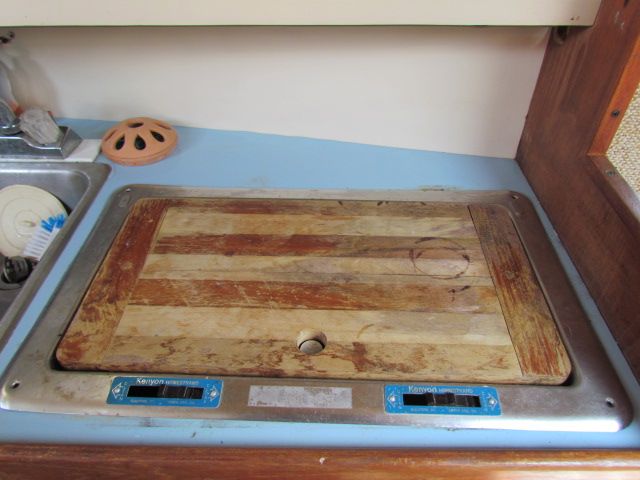
The stove that came with the boat had to go. Kenyon Homestrand pressurized alcohol stoves may have worked just fine when new, but 30+ years later….
… not so much.
The scary quotient, however, had increased considerably.
After following the less-than-simple lighting instructions, ( Pump tank of flammable fuel, tunr burner valve to introduce flammmable fuel to burner, close burner valve, light flammable fuel, let it burn out, then reopen valve and relight ) we inevitably faced a *WOOF* of ignition, resulting in burners with flames that had only one setting- Total Conflagration.
Seriously, the few attempts at using this DeathBlaster stove to create Two Burner Tastiness resulted in singed entrees trailing the faint odor of burnt eyebrows.
A quick click to Binnacle.com got us a great deal on a Cookmate non-pressurized alcohol stove. Under $250, including shipping.
Installation took less than a half hour, and the result is incredibly satisfactory.
Great temperature control, easy to light, and the burner capacity is measured in weeks, not hours. 6 weeks of regular use have borne out the value of this investment.
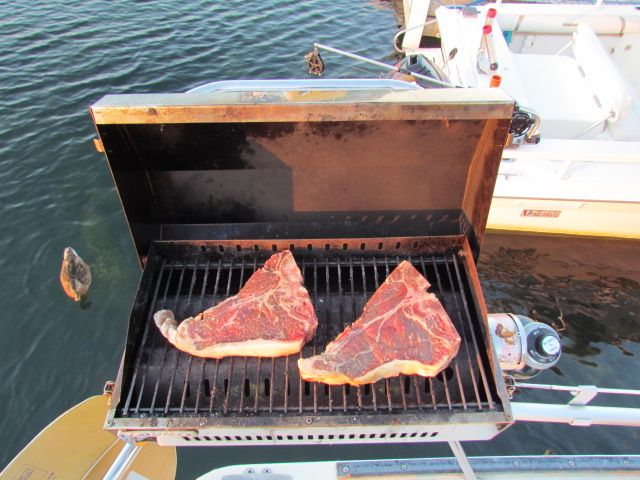
Further, we have upped the culinary ante by permanently installing the Kuuma Stow-n Go propane grille we bought during our first season aboard Whiskeyjack, but rarely used.
We have used this grille more this season than in the past 6 seasons combined.
Which means we are using more propane.
Which presents another challenge: Storage.
The one drawback to this center cockpit layout is that it eliminates all cockpit storage- no lockers, or lazarettes or cubbies on deck at all. I had no desire to store 1 lb. propane cylinders in the cabin, so a solution was required.
A quick trip to Home Hardware netted 2 feet of 6" PVC pipe, an end cap, a cleanout, and a couple of hose clamps. Less than $25 later, we were able to store 3 propane bottles on deck safely.
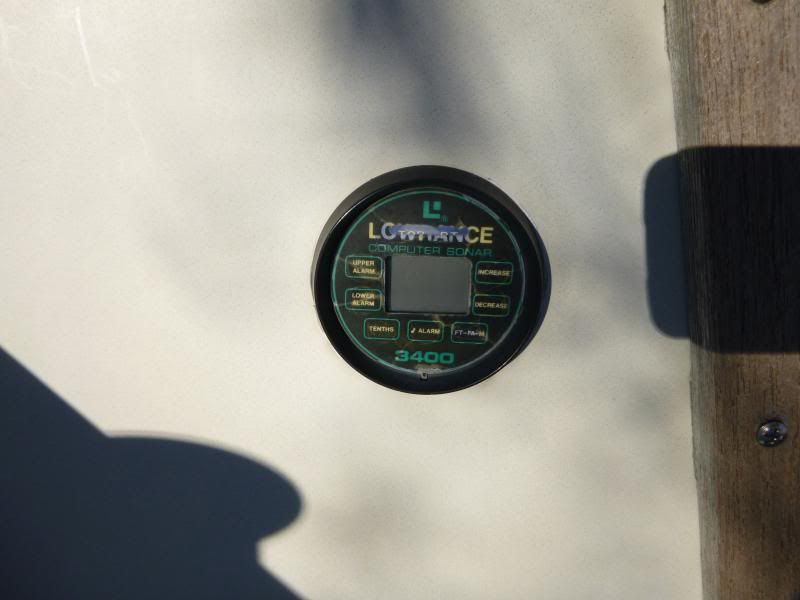
So, back to that no-compass thing: The existing cockpit instrumentation on NextBoat consisted of an inoperable Lowrance depth gauge.
That’s it.
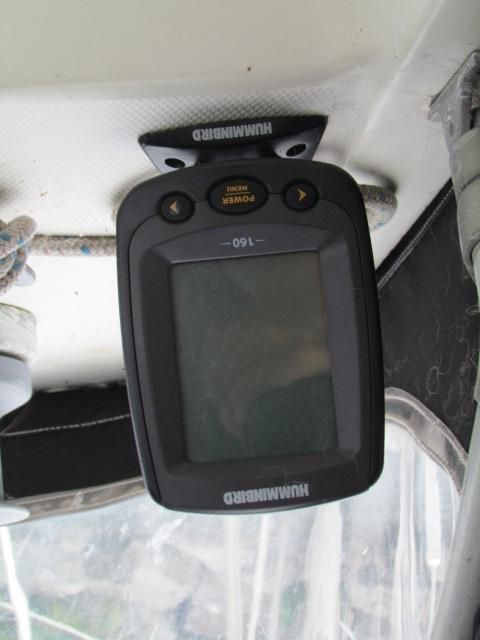
A quick trip to Dovercraft Marine netted us a Humminbird 160 fishfinder for $80. Some headscratching on where to locate the transducer and how to route the cables and roughly an hour or so of sweating and drilling and and wiring later, we not only had depth display, but water temperature as well.
Back to that absence- of -cockpit- storage issue:
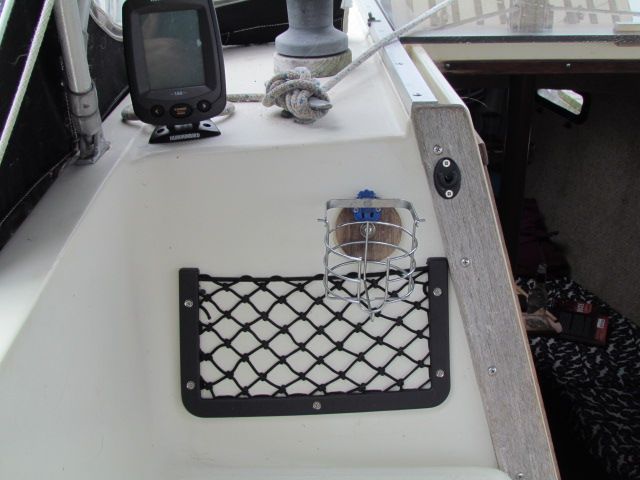
I picked up a couple of these mesh map pockets a half decade ago, and finally got around to using one! Very handy for books, sunscreen, sunglasses, all the stuff that would otherwise end up in the way.
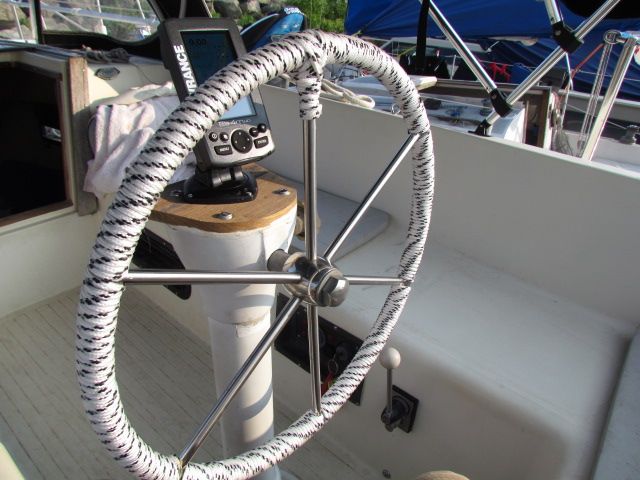
With depth out of the way, time to deal with the compass issue. I opted to go with a small handheld compass as a backup to a small Lowrance chartplotter at the helm, from Radioworld.
I LOVE these things. Lowrance "Gold" plotters include a 2 gig Navionics chart card, and the plotter we had on Whiskeyjack never let us down. The seated helm position on NextBoat makes the 4"ish screen size practical, and, though small, the screen is easy to read, the controls are intuitive and the menus easy to understand. The included mount swivels and tilts, making it viewable from anywhere in the cockpit....
...even if you are a slacker teenager, as Jordan demonstrates:
$250 well spent.
$3 worth of 1/4" line and an hour or so of time dressed up the wheel...
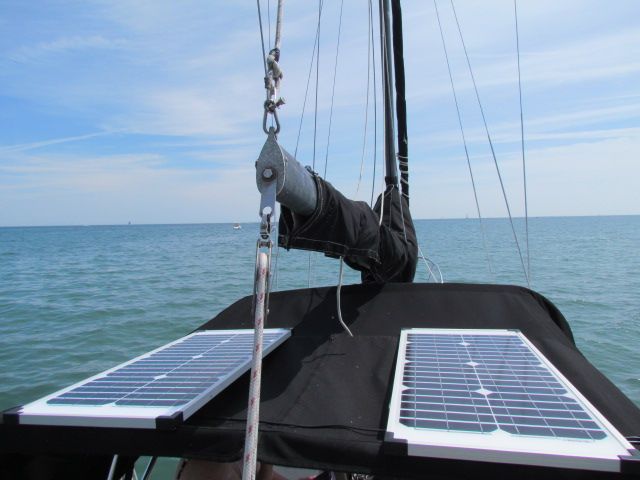
All of this new electrical gear requires improved electrical charging management- Two $99 40 watt solar panel/ 7 amp charge controller kits from Canadian Tire were installed to charge the battery bank. When docked, or flat water motoring, the panels live on the bimini-
When the wind picks up, they migrate to the aft deck. An upcoming project is to sew pockets into the bimini to secure these lightweight panels up there full time.
Down below, hammocks were hung and bungies were strung and non-skid mats were laid to keep everything that has a place, in it's place.
The settee-berth did not have a table, although there was one installed at some point in the past:
A while back some of the stuff that James was clearing out of his boat shed ended up in my boat shed. Among the assortment of stuff was a table base and post. a little plywood and edgebanding later, we now have a salon table:
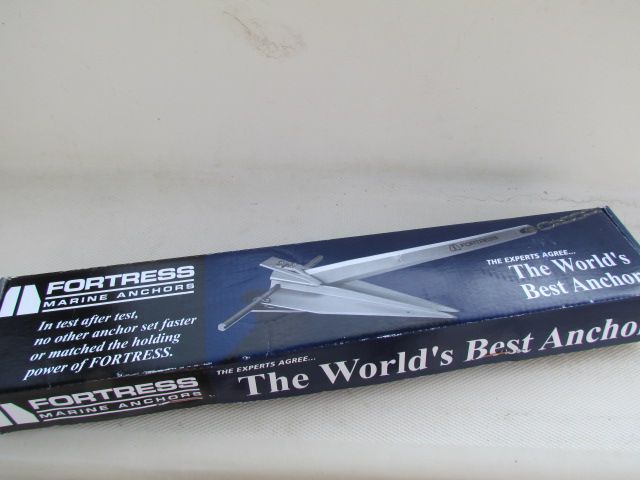
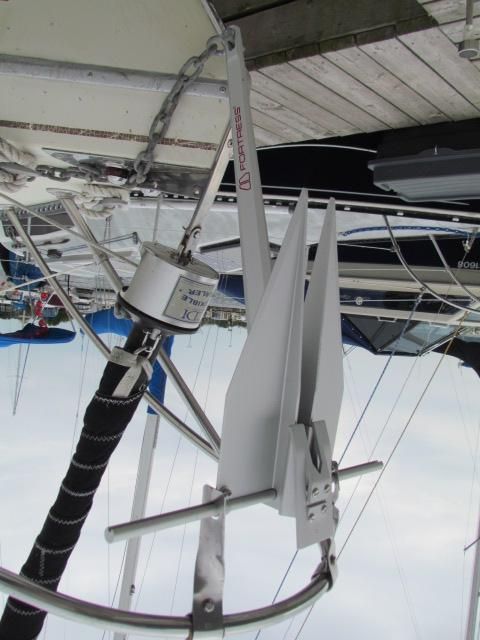
We managed to bend the shank on the anchor that came with NextBoat, and decided this was an opportunity to reduce weight on the bow and make anchoring a less strenuous task for the crew on the foredeck, by replacing the current steel anchor with an aluminum Fortress anchor....
...which requires assembly.
slightly larger flukes, slightly longer shank, half the weight of the previous anchor should make anchor launching and retrieving easier.
We'll let you know how it goes.
Last but not least, a quick little project with a big "why didn't they do this from the factory?" factor:
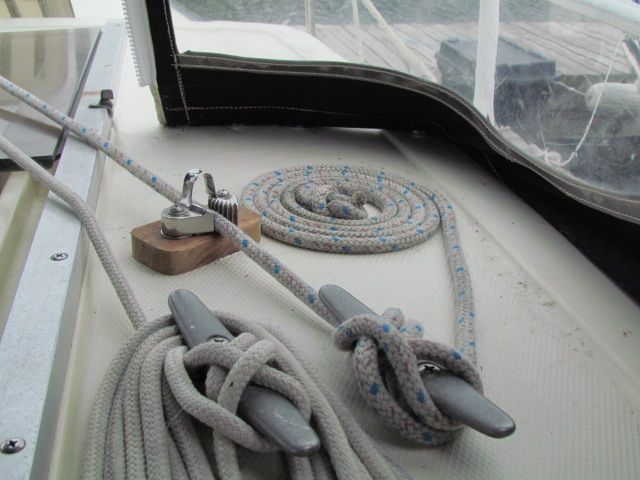
There are no clutches on the cabin top, and the only cleats are horn cleats...
which leave much to be desired when it comes to tying off halyards. You get a couple of wraps on the winch to get a full pull on the mainsail halyard, only to lose tension when you try to secure the halyard around the cleat, leaving you with a baggy sail.
We installed a cam cleat ahead of the horn cleat. No more baggy sails for us!
We also ran the mainsail reefing line to the coachroof, enabling us to reef the main without having to leave the cockpit.
Finally, we made life easier for the mutts. We carpeted the companionway ladder, to make it easier for them to climb/descend.
Ellie demonstrates that she now has ample room to run around.
Lots more projects ahead, lots more work to do, but, she's getting there.
She is becoming a home.
"Talk the Dock!"
Labels:
canvas,
cockpit,
Dock 6,
galley,
marlinespike seamanship,
navigation,
propane,
scrounge,
solar,
stowage
Subscribe to:
Posts (Atom)