Showing posts with label refrigeration. Show all posts

Tuesday, January 31, 2017

Room in the Reefer

This post originally appeared on Windborne in Puget Sound

Guilty.

I am guilty as charged.

Yes, there has been an unconscionable gap in posting to this blog - it's just that not everything in our lives is related to boating, and a bunch of that stuff came up recently.  OK, enough of the Mea Culpa.

Eolian's refrigerator compartment is huge for a boat.  But because it is so tall, much of the space in it either goes to waste, or we spend a long time sorting thru piles of things in there with the door open, looking for something.

Something had to be done.

I decided to make a shelf that would add 50% to the horizontal storage space in there, and put some of that vertical space to use.  Because I am a professional scrounge, I have a good collection of teak scraps discarded by others, gleaned from the dumpsters.  I brought some of this, and a collection of tools to the boat:

Some of the tools

Making a mess of the dock
In a project like this, it is important to make dimensional decisions that will fit with what you plan to store in the reefer.  To that end, I think I may have disturbed some folks at Safeway by walking around with a tape measure, measuring beer boxes, soft drink cartons and other things.  It was kind of surprising to see the variability in carton sizes, even for canned drinks.

The trick in building this shelf was that it needs to be removable, yet it needs to stay in place with a load of food on it when the boat is in a seaway.  I was most worried about the shelf tipping over toward the door when on a starboard tack.  Here's how I dealt with that:
  • The left-hand support bracket has a foot that goes all the way to the door, about twice the length of the bracket.  With this extension, it would be very difficult indeed to tip the shelf on this side.
  • On the right-hand (aft) side, I made the last of the shelf boards extend behind the holding plate, preventing any movement on that side.
Finally, to lock things together when it is in place, I made rabbits in the top edges of the support brackets to accept a rabbit on the cleats on either side of the shelf.  When the shelf is installed, it cannot move toward or away from the door because of these interlocking notches.

Three pieces, with clever interlocking

Yes, the shelf slats seem to be sort of unevenly spaced from side to side.  This is because the left-hand side of the reefer is deeper than the right-hand side due to hull taper.

Sadly, in my first attempt at making the side brackets, I failed to take into account that the rear wall of the reefer matches the hull contour.  So I had to redo the brackets.  In fact, every board was custom cut and fitted because of the hull contour and because the hull is tapering in as you go aft (to the right in the picture).

But in the end I got it.  And we've added 50% to our reefer storage.

Et voilà!
Seems like a pretty small thing for a day and a half's work.  But there was a lot of thinking and trial fitting.  And that beer box is no longer full...

Tuesday, April 5, 2016

Easy! It's A Kit!

Over at Dock Six, Brian decides to upgrade from an icebox aboard s/v Karma to a refrigeration unit. And it's a kit! Easy, right?


     "You want paradise..."
                    -Foreigner


    First, a little personal history:

    A decade ago, in the era PB (Pre-Boat), SWMBO and I (okay, mostly SWMBO) decided that we needed to replace the shed in the backyard of Stately Jones Manor.  The shed was...

... less than stately.

    Hell, it was less than intact and decidedly unsafe.  Although uitilized as shelter for our underused and oft-neglected lawn and garden equipment, that equipment was now doing double duty holding up the shedding shed.

   Clearly, we had to do something.

   We knew we didn't want an aluminum panel -and-channel nuts-and-bolts utilitarian box.  We wanted a stately wood shed that would be an attractive addition to our backyard, not just a holds-our-crap blight.  We also knew we didn't have the ambition or the skill set to build a shed from scratch, and didn't have the ready cash to buy a pre-fabricated shed, or hire a crew to build one for us.

   So, we procrastinated and pondered, as the existing shed grew ever less square and vertical and closer to the ground.


    Perusing the sale flyers in our local free throw-away newspaper, we discovered a local lumberyard had attractive affordable, stick-built shed kits available.

     A  shed KIT!  Perfect!

   I built model kits as a kid, I had assembled damn near a houseful of IKEA furniture, I could definitely build a shed from a kit!

   We went to the yard, picked a design we liked from their catalogue, and were assured that our shed kit would be delivered in time for the weekend.

   Perfect!  We can have this thing assembled before Monday!

    Friday, as promised, a truck from the lumberyard pulls up, and deposits our shed kit in the driveway of SJM.


  The "kit" consisted of a big pile of lumber, three bundles of shingles,a bag of nails and screws and hardware, a door, and 2 pages of poorly photocopied plans.


     "Kit", my ass.

     We got it done, and it still does it's job ten years on, but it took a lot longer than a weekend, and it took more manpower than SWMBO and I.


     This project taught us some skills, and taught us that we could do it

      Ever since, however, I have been dubious of the ease of assembly of any  DIY "kit."

      Flash forward to the summer of 2015:

      Karma, like Whiskeyjack before her, has an icebox.   For 8 seasons, we schlepped bins and blocks of ice down the Dock, and dealt with the daily ritual of emptying catchbottles of  meltwater.  Iceboxes are simple systems, and do a more than adequate job of keeping food and beverages cold. It was a good system on Whiskeyjack that gave us no reason to complain.

   On Karma?

    Not so much.


    First, Karma's icebox is oddly, trapezoidally, shaped.


 This meant that the bins that we used to hold iceblocks and contain meltwater on Whiskeyjack didn't fit.  Not an insurmountable issue, it simply means that ice blocks have to be loaded into the icebox naked, and rather than meltwater being caught in a bin, is allowed to drain from the icebox...

....  into the (shallow) bilge.  Not ideal.

    At the beginning of this season, i redirected the drain into a catchbottle, which required emptying daily.  Again, not an insurmountable issue, but one more daily chore, albeit not onerous... unless you're away from the boat for more than a day in which case the catchbottle no longer catches and overflows onto the carpeted sole.

     Again, not ideal.

    Lastly, the shape of the icebox limited iceblock placement, which in turn limited food and beverage capacity.

     Yet again, not ideal.


     So, refrigeration became a topic of discussion.  Said discussion boiled down to:

     Will it fit?

     Will it work?

      Can we afford it?


     Will it fit?  Good question.  An S2 8.0C is a roomy boat with lots of storage, but just as the icebox is weirdly shaped , so are many of the lockers and bins.

 Lots of research and measuring told me that installing a typical refrigeration system's compressor and condensor and stuff wasn't going to be simple or easy.

 Measuring inside the icebox, and comparing cold plate sizes online,  our options were limited.

     Will it work?  Good question. Regular Readers know that we are off the grid on the Dock- no water, no shorepower.  Our electrical needs are supplied by our solar panels- so, anything electrical that we add to our boathome has to work within the restrictions of the available battery and charging capacity.

    Can we afford it?  Good question. Tallying the costs, we were looking at an expenditure of anywhere from $1200 to $2200.  Ouch.  This would be our first four-figure boat project in, like, ever.

    So, after pondering, we realized that we didn't think it would fit, weren't sure if it would work, and didn't figure we could afford it.

   Then I discovered the Dometic/Waeco/Adler-Barbour Coolmatic Cooling Conversion Kit.

   Note that last word.

  It's dreaded kit status notwithstanding, it seemed to tick all of our boxes-

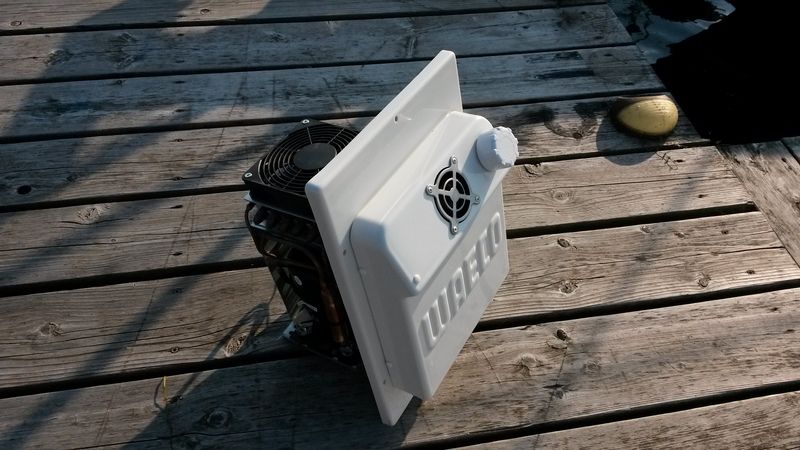
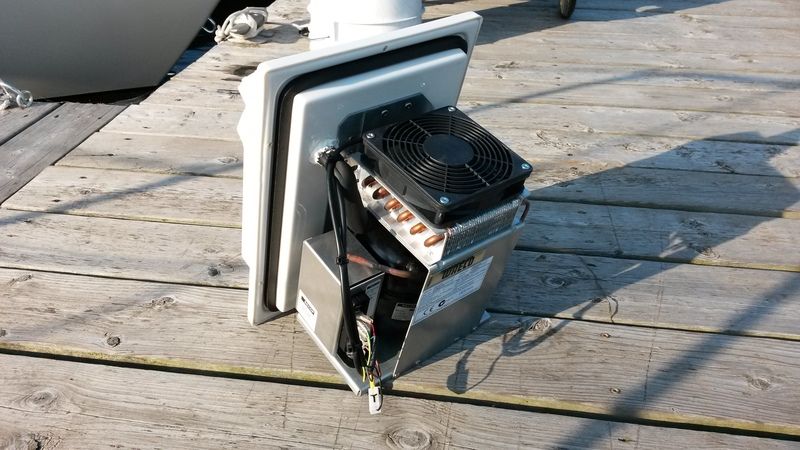
   Dimensionally, it fit- instead of being a internal evaporator/external compressor/condenser set up, the Coolmatic is an all-in-one unit measuring about 10"  x 12".  Cut a hole in the side of the icebox, screw the unit in place, run some wires, done.

   That "about" becomes important later.

   It wasn't too taxing for our electrical system either- the advertised draw was 4 amps, with a 20-30% duty cycle.  In theory, that means it draws less than 1.5 amps per hour, and this would be the largest constant draw on the boat- our lighting is all LED, and the only other energy use is charging electronics. so our 120 watts of solar delivering an average of 60 amps/day should keep us ahead of the charging curve.

   It's not a cheap system, but at $799 (on sale), even with tax it didn't break the psychological 4 figure barrier.

   So, we pulled the trigger, and ordered one up from our friends at Binnacle.com .

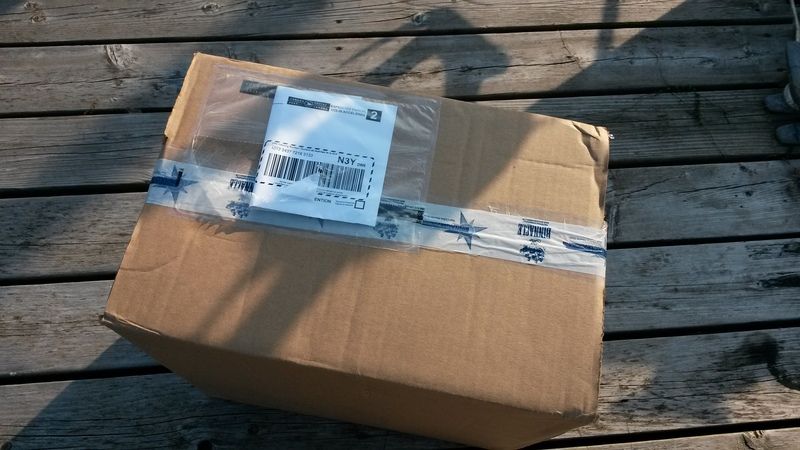
    4 days later,  a day earlier than promised, a box showed up.


   Once unwrapped, our kit is revealed;


 Okay, looks pretty much plug-and-play.

 Here's the plan:  
 1.  Measure and mark the cutout in the side of the icebox.
 2.  Drill pilot hole.
 3. Cut out panel with jigsaw
 4.  fit cooling unit into hole.
 5.  Screw into place.
 6.  Wire into distribution panel.
 7.  Enjoy cold beverage.

  I figured it would be an hour's work, tops.

  SWMBO and I emptied the icebox of contents, transferring said contents to a cooler brought aboard expressly for this purpose, and I embarked on step 1.

  Jones's 4th Law of Boatwork- no plan ever survives past step 1 unchanged.

  My initial plan, based on the measurements I had taken before buying this kit, and the measurements quoted in all of the manufacturer's literature,  was to install the unit on the aft side of the icebox.  Now, with my new Coolmatic in hand, I discover that the aft wall of the icebox was 1/4"  too narrow.

  Well, shit. 

  Okay, so I need to mount it on the forward side of the icebox, and hopefully it will clear the sink and still have decent ventilation around the fan and cooling fins.  

  So, I careful trace the cut-out, according to the template included in the installation instructions, drill my pilot hole, and discover that the forward wall of the icebox is 4" thick...and my drill bit is 3 1/2" long.

  Well, double shit.

   Did I mention that I decided to jump into this endeavour during the hottest week of the summer?

At this point I am 2 hours in and soaked in sweat. Time to call it a day.

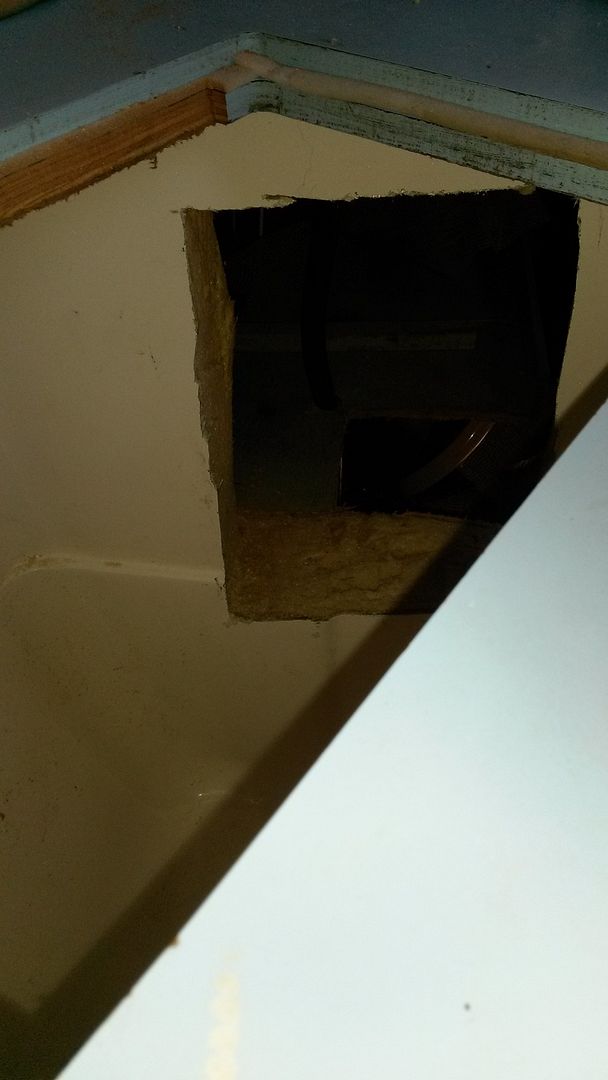
   Day 2, I cut out the inner wall of the icebox, gouge out all of the insulation ( this icebox has about 3" of insulation), then get out the sawzall  and carve out a hole in the panel between the icebox and the sink cabinet.  

 I gently slide the Coolmatic into the icebox...

  ... and it doesn't fit through the icebox opening.
   SHIIIITTTTTT!!!!!!!!!!

   Okay, new Step 4(a)- out comes the jigsaw, the ice box opening is enlarged (which means the icebox lid will no longer fit. Son of a ....)


  Now the Coolmatic will slide into the icebox...
....  but not slide into the freshly cut hole.  

   I am beyond profanity at this point.

   So, Step 4(b)- test fit, retrim, test fit, re-trim, test fit, retrim, testfit, retrim, testfit retrim, testfitretrimtestfitretrimtestfitretrimtestfit...  it FINALLY fits.

   I am now 6 hours total into this job, in 90 degree heat.  Look up "masochist" in the dictionary- See that picture?  That's not me, that's some other poor sap, because I was still installing a FUCKING REFRIGERATION "KIT"!!!

  Once the "kit" was installed, the rest was relatively straightforward- screw the reefer unit into place, seal it up with some caulking, trim the icebox shelf to fit and reinstall, clean everything up (again), wire it up, and put everything that came out of the icebox back into the icebox...


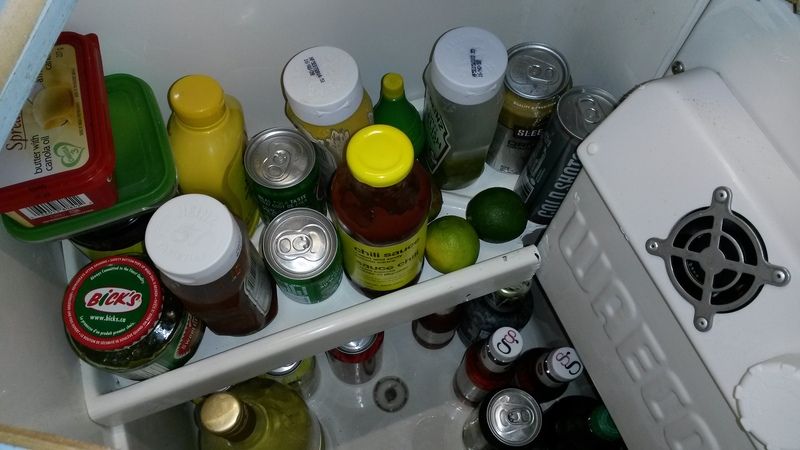
   ...Then build a new icebox lid.  I repurposed a cutting board, added some styrofoam insulation to the underside and some foam weatherstripping, and called it done.
    

    From start to finish, I had 9 hours into the job, over 3 days. 

     (To be fair, Dockneighbour Frank bought the same unit after seeing ours, and he DID get his installed on his O'day in under an hour. Having a uniform sized icebox with a big lid and easy access makes a ton of timesaving difference.)

   But, the end result is worth it.

  This unit is quiet.  It is quieter than the fridge in our kitchen at SJM.  Power consumption seems to be in line with specs.  In the spring I will rework the lid/opening flange to get a better seal, and add some more foam board to the lid for better insulation. The contents of our reefer (can't call it an icebox any more)  are kept acceptably cool, with the dial set to 4, but adding a little insulation and improving the seal can't hurt.

I'd do it again.  we now have more room in our chillybox, no more lugging ice, and no catchbottles to drain daily.

The economics are subjective, and a bit of a toss-up.  In the short term, it doesn't make sense, from a cost-savings standpoint.  A block of ice would last three days in our icebox on average, and if there were serious perishables onboard, we would load in two blocks at a time. At $3/block, call it $150/season.  Over 10 years, however, assuming the cost of ice doesn't rise or drop, that's $1500 that we don't have to spend on ice, by spending $800 (plus tax) on a refrigeration "kit"  So, long-term, it makes sense.

 It also means that, while our current electrical system is keeping up,  I am now considering adding a second house battery and another solar panel, just in case. 

  But, that's another project, for another day.

Tuesday, August 25, 2015

How Much Is There?

This post originally appeared on Windborne in Puget Sound

I recently did a post which talked about establishing what the right amount of glycol in a holding plate solution was.  Well, OK, now that we know what we want to have in there, how do we determine what we actually have?  I suppose one possibility would be to simply empty the holding plate and refill it with a solution of known concentration, one that we just made up by careful measuring.  Yeah, that would work.

But what if we just want to add a little water or glycol to what we already have?  For that we would need to be able to measure the concentration in the solution. 

Hand-held refractometer
This is the tool for that:  It is a refractometer - it measures the refractive index of a liquid.

What is that?

All transparent substances slow the passage of light thru them somewhat - some more than others.  The refractive index is the ratio of the speed of light in a vacuum compared to the speed of light in the transparent substance.  So, if I tell you that the refractive index of a particular glass is 1.33, that means that, yes, light travels thru that glass only 3/4 as fast as in a vacuum.  You have witnessed refractive index differences when you, for example, mixed water and vodka, or dove in a place where fresh water and salt water are mixing (at Shilshole, for example).

But for our purposes, it is enough to know that the refractive index of a water/propylene glycol mixture changes in a predictable way with the concentration of glycol.  We don't even have to know the details of that change because the manufacturer has taken that into account in the preparation of the scale inside the instrument. 

All that remains is for us to obtain a drop or two of the solution and put it onto the prism covered by the clear plastic flap, and look thru the lens at the other end of the instrument, for a view like this:

Approximately 33% propylene glycol shown
But there is a catch (isn't there always?).  Before I sample the holding tank solution, I have to completely defrost the freezer.  If I don't, some unknown quantity of the water in the system will be frozen out, which would skew the results in the direction of increasing concentration.  So the refractometer stands ready for duty, waiting for a freezer defrost event.

Who knows when that will be?


Tuesday, May 12, 2015

Molding A Semi-Circular Fiberglass Conduit

Aboard s/v Pilgrim, Jeff and Anne continue what can only be classed as a keel-up rebuild. Most of what they are doing is not of a scale suitable to be included here (tho I have fudged a couple of times...).  But this piece of work is. 

And I did not know that about duct tape - thanks Jeff!
When constructing the 25" long conduit running under the ice box ( see – January 17th Post) I used prefabricated, 1” thick foam core paneling.  The paneling provided additional insulation under the box and the completed assembly added structurally to the hull by serving as a stringer between two transverse bulkheads.

The 5” long section of conduit running between the aft panel of the ice box and the new cockpit locker bulkhead does not need to provide additional insulation nor contribute structurally.  It’s sole function is to provide a water tight passage way under the ice box insulation.  Thus I chose a quicker and less costly method for building a conduit… 

Save for some two-part epoxy all the components of the conduit fabrication are pictured
Using a plastic, 1G jug and some duct tape I created a fiberglass mold for the section of conduit required.

The duct tape serves as a mold release agent and as part of the mold.
I began by cutting the  jug in half.  To assist in maintaining the shape of the plastic ran one strip of tape across the open face of the jug.  I then placed the jug on a board covered with plastic sheeting and covered it with duct tape.  Epoxy will not bond to duct tape so it serves in place of mold release wax.  The duct tape also allowed me to create a nice radius at the intersection of the jug and the base.

Test fitting the 1708 cloth on the mold.
I then cut a section of 1708 cloth to cover the mold.  One layer of cloth was adequate for my application, but additional layers could be added to create a load bearing conduit.

Time to walk away and let the epoxy cure.
I then wet out the cloth and laid it over the mold and went home for the night.

Conduit fresh off the mold.
The next morning I lifted the conduit off the mold.   While wearing leather gloves I dressed the sharp, jagged edges by hand sanding with 35 grit paper then sanded the entire piece with 80 grit sandpaper.

fitting the conduit to the hull and bulkhead.
I fit the piece in position and marked the excess material.  The single layer of cloth cut easily with a jig saw with a metal cutting blade.  I believe that tin snips would also work for shaping the piece.  Fine tuning the fit was done using 80 grit paper on an orbital sander.

Conduit bonded to hull and bulkhead with thickened epoxy and cloth tabbing.
Once satisfied with the fit, I used two small sections of fiberglass cloth to tab the base flanges to the hull.  I sealed the fore and aft ends of the conduit to the adjacent bulkheads with a fillet of thickened epoxy.
Now it is time to bury the conduit under layers of ice box insulation.

More images and notes from this on-going project are available in the Ice Box Rebuild Photo Album.

Tuesday, May 5, 2015

How much is it?

This post originally appeared on Windborne in Puget Sound

I recently did a post which talked about establishing what the right amount of glycol in a holding plate solution was.  Well, OK, now that we know what we want to have in there, how do we determine what we actually have?  I suppose one possibility would be to simply empty the holding plate and refill it with a solution of known concentration, one that we just made up by careful measuring.  Yeah, that would work.

But what if we just want to add a little water or glycol to what we already have?  For that we would need to be able to measure the concentration in the solution. 

Hand-held refractometer
This is the tool for that:  It is a refractometer - it measures the refractive index of a liquid.

What is that?

All transparent substances slow the passage of light thru them somewhat - some more than others.  The refractive index is the ratio of the speed of light in a vacuum compared to the speed of light in the transparent substance.  So, if I tell you that the refractive index of a particular glass is 1.33, that means that, yes, light travels thru that glass only 3/4 as fast as in a vacuum.  You have witnessed refractive index differences when you, for example, mixed water and vodka, or dove in a place where fresh water and salt water are mixing (at Shilshole, for example).

But for our purposes, it is enough to know that the refractive index of a water/propylene glycol mixture changes in a predictable way with the concentration of glycol.  We don't even have to know the details of that change because the manufacturer has taken that into account in the preparation of the scale inside the instrument. 

All that remains is for us to obtain a drop or two of the solution and put it onto the prism covered by the clear plastic flap, and look thru the lens at the other end of the instrument, for a view like this:

Approximately 33% propylene glycol shown
But there is a catch (isn't there always?).  Before I sample the holding tank solution, I have to completely defrost the freezer.  If I don't, some unknown quantity of the water in the system will be frozen out, which would skew the results in the direction of increasing concentration.  So the refractometer stands ready for duty, waiting for a freezer defrost event.

Who knows when that will be?

Tuesday, March 3, 2015

Water Tight Conduit

Jeff and Anne have been doing a complete rebuild of s/v Pilgrim, a project which is way too large to qualify as a "small" boat project. Nevertheless, I thought you'd be interested in seeing how they created a water tite plumbing conduit under their icebox - it's a good example of fiberglass work:
Rainy, cool weather has delayed dropping Pilgrim’s rudder and forced me inside.  Fortunately a small portable heater maintains a comfortable working temperature inside the boat.

Like the original construction we plan to have multiple bilge pump discharge hoses, a propane line, and likely a couple electrical wires running under the ice box.  Now that we have fiber glassed close the gaps under the wall between ice box and the engine, any possible leaks from the hoses or spills in the cockpit locker could collect under the ice box.  My initial solution was to drill a couple limber (drain) holes along the base of the wall separating the engine and the ice box.  This solution had the downside of again allowing hot air from the engine access to the underside of the ice box.   A more elegant solution would be to create a water tight conduit between the cockpit locker and area under the stove.

Initially I looked for a large diameter PVC or fiberglass pipe to cut in half and glass down to the hull.  This search proved fruitless, but in my scrounging around I discovered some scrap pieces of 1” thick fiberglass paneling with a foam core.  Ok… the conduit will be square.

Creating templates for the conduit side walls.

The conduit began as so many custom fabrications do… by using luan plywood strips and a glue gun to create a template.  The templates of the 3” tall side walls were then transferred to the fiberglass panel.

Transferring the side wall template to the 1" thick fiberglass panel.

The more I worked with the 1” paneling the more I realize how ideal it is for this application.  The foam will add to the insulation. The strength of this stuff when laid up with heavy mat will add structurally to the hull.

Ready to tab side walls to hull and adjacent bulkheads.

After test fitting the side walls and cutting 1708 cloth tabbing, I glassed them down.  To minimize the risk of chafing hoses, I added a nice fillet along the inside corners.

Test fitting the top section.

Once the side walls cured, I was able to lay out the top section.

Beveling  the long edges along the top to allow the fiberglass cloth to smoothly lie over the corner.  After filling any gaps with thickened epoxy, I laid a single piece of 1708 cloth across the top ad down the sides.

Fiberglass work on conduit complete.

Once all the epoxy had cured, I sanded down any rough edges.

Conduit complete.

The outside dimensions of the conduit look large, but it incorporates one inch of foam insulation.

More images and notes from this on-going project as available in the Ice Box Rebuild Photo Album.

Tuesday, February 17, 2015

Dual Purpose

On any boat, even one as large as a Lagoon 46 catamaran, space is a limited and valuable commodity.  Wherever it is possible to make one thing serve two purposes is a big win because the same storage/volume/space is used for two different things.  Here, Mike and Rebecca on s/v One Love turn a single-use piece of furniture into dual-use:
The list of things that we don’t like about the Leopard 4600 is very short, and we just made the list one item shorter. The large stock salon, while perhaps good for inside dining, got very little use by us, at least for that particular application. In the warm Caribbean, almost all dining on One Love, and on our friends’ charter boats, is done outside. The table is so large that it makes it difficult to access the under-seat storage that is so important for us. It also requires someone to kind of scoot around if they want to sit on the rear side. All in all, it was an undesirable thing for us, and one that we wanted to get rid of.


Many of our friends with 4600s had already done away with the table, replacing it with a store-bought coffee table or ottoman. While they all look great, we wanted something a bit more custom to work with our Engel cooler that, up till this point, we kept under the dining table. Enter Puerto Rican Danny, a local wood worker. Over the past couple of months, Danny took our suggestions and crafted for us the table that you see in the photos below. It fits perfectly over our cooler and as you can see, the top lifts up to give us easy access to it. He also did a great job of matching the wood and design to One Love’s interior.

Ventilation for the cooler is obviously important so he left spaces at the bottom and below the table top to allow air to flow in and out. If we determine that more air is necessary, we’ll cut a vent in the rear. At this point though, it does not seem to be warm inside the box. Another thing I had him do was have the fiddles, the raised edges around the table top, not go all the way to the corners. If you’ve ever had to get crumbs off of a table with fiddles before, you’ll understand why I had it built this way.


Thursday, January 22, 2015

Rusty Hinge Replacement

This post originally appeared on Windborne in Puget Sound

You may remember that one of the early projects we did on Eolian was to rebuild the refrigerator, from the hull out.  As a part of that project, I discarded the original door and replaced it with one that I got at the old Doc Freeman's for $10 because the decor panel was damaged.  I replaced that panel with a sheet of black Plexiglas (thanks Clear Cut Plastics), and remounted it on the original hardware.

Perhaps that was a mistake - reusing the old hinges.  But at that time I did not know the marine supply business in Seattle nearly as well as I do now.  The reason that this was an issue is that the old hinges were very rusty.  I cleaned them up as best as I could, but they were always ugly, even to this day.
Ewww...
The ugliness finally got to me, and I sought out new hinges. Well, it turns out that I almost waited too long.  Tho the refrigerator is a complete custom built-in, the door (and hinges) were from a Norcold unit.  I thought that all I would have to do is order new hinges from Norcold.

BZZZZT! 

Not a chance.  That door and those hinges have been out of production for a long long time, and nobody had any left in stock - not even Fisheries.

But, as it turns out, one of the businesses in Ballard sells Norcold:  Sure Marine.  Sure Marine is one of those great places, a little off the beaten path, at the very, very end of 28th street in Ballard.  No, they had no hinges in stock, but Graham found a set of used ones in near-perfect condition in the back somewhere.  Woo HOO!

(Almost) new and shiny!

One of the last remaining vestiges of Malolo is now gone.


Tuesday, December 10, 2013

Extra insulation over the fridge

Scott aboard s/v Valkier has a quick and easy way to put some more thermal efficiency in your refrigerator:
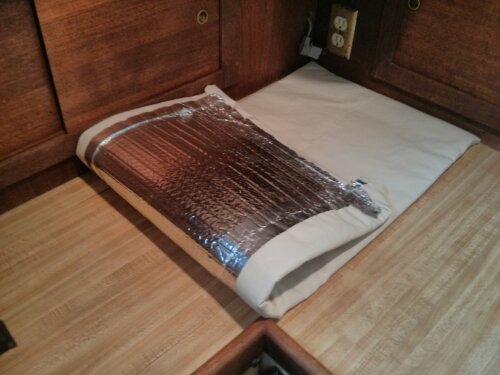
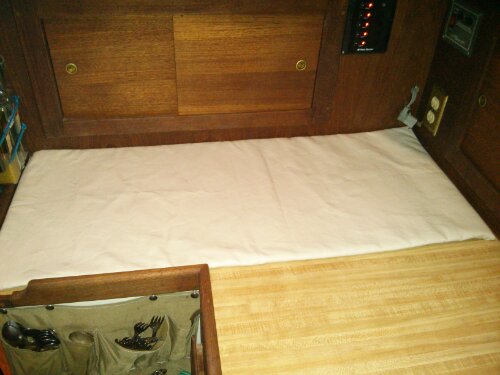
Using Reflectix and vinyl we created a cover for the top of the fridge. This is a super easy and cheap project that improves fridge efficiency significantly.  Eventually  we will do the same thing behind the kitchen utensil holder on the front of the fridge.  If you slide your hand between the Reflectix and the top of the fridge it feels very cold.  However on top of the vinyl covered Reflectix it is room temperature.

image

This is a link to the the insulation. We have used it to make ducting for our window ac unit to vent it down through a top hatch into the salon. We are gradually insulating the cabin walls and overhead with it as we do projects that expose those areas as well as the above project.
Reflectix BP24025 24-Inch by 25-Feet Bubble Pack Insulation
We used hvac tape to secure the vinyl to it.

image

Thursday, February 2, 2012

Putting a lid on it

With the construction of an insulated lid, Jason aboard
s/v hello world completes his freezer project.  I did not include the insulation of the freezer box itself here on Small Boat Projects, because I thought it was too big to be considered, well, Small.  Because Jason does everything right, even building just the lid is almost too big.  But boy, his fiberglass work is spectacular!  You gotta see it...

Our original fridge had two lids side by side. There was an air gap between the lids so there was never any reasonable way to seal the lids. The lids also were held open by those collapsible springs that always seem to collapse when my head or fingers were in the way. So we decided to build a new lid and ledge for the lid to sit on.
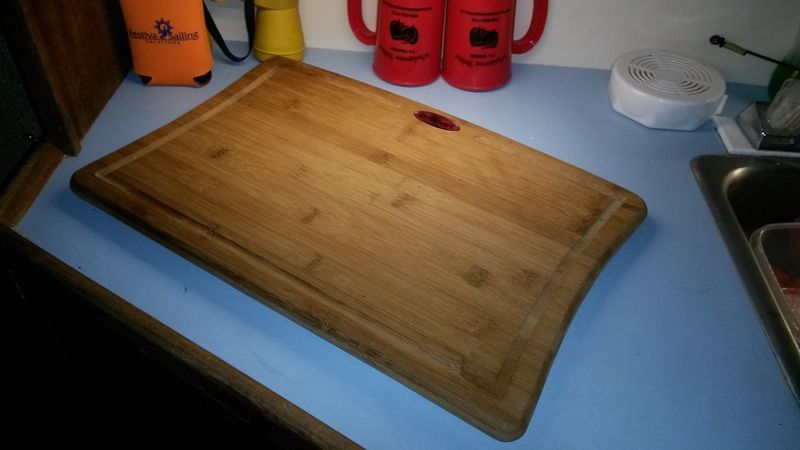
The original lid was covered in a laminate that matched the galley counter top. We stood no chance of finding a match for that laminate and were not going to re-laminate the entire galley. Instead, we decided to make the fridge lid out of a butcher block material. We found a eucalyptus butcher block counter top material from Wood Welded. It was not cheap but looks pretty cool and matches the teak interior well enough. We could only get the butcher block in 24"x36" sections - which cost $200 - so we made sure to use up the off cuts. I made a matching cutting block that drops into the sink.

The matching cutting board built from the off cuts from the fridge lid.

The R-value of hard wood is negligible so we had to insulate the underside of the lid. I used the same extruded polystyrene (XPS) insulation that I insulated the fridge with. XPS (or blue board) foam cuts and shapes really well. I was able to shape a reasonably complex piece out of the foam. After getting the shape I wanted, I fiberglassed over the foam with 10 oz. cloth.

The blue board insulation cut down to the shape of the lid insulation. The piece of foam that's cut out is where the gas spring attaches to the lid insulation. I dropped some marine ply in there so the screws were going into wood, not foam.

After fiberglassing and fixing some sanding mistakes with thickened epoxy. Our fridge is composed of approximately 35% thickened epoxy.

We also had to build a new ledge for the lid to rest on. Our new lid was a different depth than the original and I had cut away the original lid ledge in the early days of this project. I built the lid ledge with the same process as the lid insulation. I added a few more layers of fiberglass on the lid ledge since it had to withstand the weight of the lid and whatever else I drop on it.


Assembling the foam to create the lid ledge.


Fiberglassing the lid ledge.


Dry fitting the ledge along with the freezer bin.

Both the lid insulation and lid ledge were finished the same way I finished the interior of our fridge box. I mixed West Systems epoxy along with a white pigment and coated the bejeezus out of both pieces. After the 10+ coats of epoxy cured, I faired the surface down and sanded it smooth. Then I wet sanded it with every grit of paper I could find between 400 and 1200 grit. Then hit the pieces with rubbing compound followed by 3M Glaze and a shot of carnuba wax.


Working on the epoxy finish.


The last piece of the lid puzzle was how to hold up this lid that weighs 20lbs without dropping it on my fingers or head. I installed a gas spring on the lid to give an assist in lifting the lid and keeping it open while I rummage through the bottom of the fridge for the just the right can of beer. Calculating the dimensions of the gas spring was a bit more complicated than I originally planned on. It involved trigonometry, Excel spreadsheets, and a dash of wild ass guesses. In the end, the spring I used worked great. It lifts the lid with virtually no effort, holds it open, and lets you effortlessly close the lid.


The gas spring attachment to the lid insulation.


The gas spring attachment to the fridge box.


The lid insulation.


Actual food actually being cooled by our actually operational fridge!

I still haven't put a gasket on the lid. That's on my list, just haven't gotten to it yet. I will also add a blog shortly on the refrigeration system we chose and how we installed it.

Phew, good times right?
Related Posts Plugin for WordPress, Blogger...