Showing posts with label philosophy. Show all posts

Tuesday, February 21, 2017

Sailor, and now Author


Drew, a frequent contributor to Practical Sailor and to this blog, has branched out - he is now a published author!  Aside from making a few bucks to cover his time and effort in producing these books, Drew is paying it forward; he is giving new and less-experienced sailors the benefit of his extensive experience.

Drew, as an engineer (disclaimer:  as am I), has a precise, unambiguous writing style.  But he will also wax poetic, in the fashion of a man who has carefully examined his own motivations.

What is rare in the sailing genre is that Drew, again being an engineer, does not shy away from experimentation.  He does not accept "everyone knows" without actually testing it himself, rigorously.  What Drew reports is derived from first person experience and experimentation.  If he says it, he's tested it, and you can believe it.

So far, there are four books in the bookstore:
  • Keeping a Cruising Boat on Peanuts
    PDF, Pending 2017 Kindle, about 400 pages
  • Rigging Modern Anchors
    Pending 2017, TBD, about 250 pages.
  • Singlehanded Sailing for the Coastal Sailor
    Kindle, 143 pages, PDF, 154 pages
  • Faster Cruising for the Coast Sailor
    PDF, 183 pages, Pending 2017, Kindle, about 200 pages

To provide a little view into what's included, here is the Table of Contents from Singlehanded Sailing for the Coastal Sailor:
  • Acknowledgments 4
  • Preface 7
  • Part 1: The Singlehander
    • Chapter 1: The Reasons We Go Alone 11
    • Chapter 2: The Costal Philosophy 14
  • Part II: Preparations
    • Chapter 3: Docks 21
    • Chapter 4: Sailing 24
    • Chapter 5: Safety 41
  • Part III: Practices
    • Chapter 6: Sailing 63
    • Chapter 7: Safety 74
    • Chapter 8: Living 80
    • Chapter 9: Kids 85
    • Chapter 10: Summer 87
    • Chapter 11: Winter 88
  • Summary 100
  • Glossary 102
  • Appendix I: Annual Inspection 103
  • Appendix II: Tethers and Jacklines 108
  • Appendix III: Rainwater and Water Filtration 122
  • Appendix IV:  Climbing the Mast, Ladders, and Falling 136
  • Appendix V: Extension Ladders and Webbing Ladders 141
  • Appendix VI: Stropes 148
Come on, you know these books are going to make for wonderful reading at anchor!

Tuesday, May 24, 2016

Good Enough

Over at Dock Six, Brian holds forth with a little philosophy, philosophy that I must confess strikes a chord with me:
A fleet of beveraged sailors congregating to celebrate sundown (and we had some great ones last season:
),

inevitably leads to discussion deep into the dark hours.  One such confab  meandered through the usual "Cruising versus Racing", "Tiller versus Wheel", "Power versus Sail", "Rum versus Rye", "Dock 6 versus Dock 5" debates to a topic which we discovered is a lot more nuanced:

"Correct versus Incorrect Gear and Installation."

or, "When is Good Enough, Good Enough?"

  One thing all in attendance agreed on:

  The answer, as it so often is, is...

..."It depends."

  Except when it doesn't.

   Electrical/electronical stuff is kinda fussy about how it is connected, for example.  Get yer positives and yer negatives backversed and all the smoke comes out of the wires and you're left pondering how to lie on the warranty claim for your new, but now dead, chartsounderhaildar thingy.

  Same thing with wrapping jibsheets around the winch- it only works one way, clockwise, dumbass!

   On BOTH sides of the boat!

  (At least 8 of you out there just air-wrapped an invisible winch to see if I was right... after you first pointed your finger in front of you like a pistol and then rotated it in the air, lefty-loosey and then righty-tighty, to remind yourself what "clockwise" meant.)


  (( You KNOW you did.  Don't even try.))

   Restringing  6:1 mainsheet tackle takes at least two tries because nobody ever gets the sheave order right the first time and nobody bothers to take "before"  pictures before unstringing the old sheet from the blocks... and, of course, it only works one way.


   Adjusting  the valve clearance on your engine,  and flushing the head are other examples of "one way only" systems, gear and procedures.

  Most of the other stuff on your boat?

  Not so much.

  Which is kinda reassuring.

  When I am not sailing, and boatbuilding and boatpart building and wordsmithing, I am a gearhead.

   But not as gearheady as I used to be.

    Back in the day, BB (the era Before Boats),  I was a die-hard 24/7 VW freak.  Since I was 16, I owned 'em, fixed 'em, bought 'em, built 'em, sold 'em, lived 'em, and, sometimes, in 'em.  At last count I had owned 47.3 of them.

 The .3 is still in the backyard of Stately Jones Manor.


  (NOT the backyard of SJM, but at times, it was close.)


 I've laid hands on some of the rarest of the rare,


    ...and rubbed elbows with some of the coolest of the cool.

    At the top of my "I Shit You Not" Stories list, I helped a bunch of local Canadian high school kids build a race car that ran in the 2005 Baja 1000:


 As the old NASCAR joke goes, I wasn't involved, I was committed.  (Look it up.)


Occasionally my wheeled obsession met my keeled obsession.  Little known fact: my first dinghy , Chirp , built back in 2009, was sized to fit inside my VW Vanagon Syncro.


     Confession: I haven't wrenched on a VW in 5 years.

   What happened?

    I  discovered the "good enough" freedom of boats, and realized the math worked.

     See here's the deal:

     Old VWs  are not just collectible, they are appreciating.  Like crazy.  Like, a -$5000 -price -tag -on- a- rusty- dented -non-running- project- bus- that- needs -everything -is -a -steal kind of crazy.

   The shit got serious.    And when the shit gets serious, you gotta get serious about the shit- an incorrect part, an ill-fitting aftermarket panel, a wheel with the wrong date stamp, is a step backward.  A perfectly serviceable, but incorrect, $100 aftermarket muffler might cut the value of your pride and joy by $150.

   And there are plenty of enthusiasts who will happily let you know, at every show and swap meet you attend with your incorrect ride.

   As the value of the vehicles rose, the price of original and good aftermarket parts rose accordingly,  stretching my always tight fun budget.

   Meanwhile, in Old Boat World, or at least the part of it I discovered and happily reside in, nobody gives a shit about whether there are period correct bolts holding the stanchions to decks that are covered with unscuffed original non-skid.  Having peeling decals on the air filter will not hurt the value of my boat at all.

    Owning a floating summer home that will likely not appreciate in value, but will just as likely not depreciate much either, is kinda liberating.

    I was spending more time messing around with boats, and less time in the garage.  Finally, I had to face the fiscal reality:

  My fun budget can support messing around with boats, or messing around with cars. Not both.

   For now.

So, back to the original question. What was the consensus that our confab reached that night?

  When is good enough, good enough?

   We came up with the  "Good Enough" rule of thumb:  Every part, part replacement and modification on-board must answer  "Yes" to three questions-
  1. Does it work?
  2. Is it safe?
  3. Is it durable?

   That's a standard I can meet.


Thanks for stopping by.  Feel free to "Talk the Dock" and pass the word.

Tuesday, December 23, 2014

Liebster!

Bloggers do it for nothing.

Well, almost all of us do it for nothing.  I certainly do it for nothing anyway.

Well that's not exactly true.  I blog because I get enjoyment from telling stories and from helping others solve problems.

But every so often, something great just falls out of the sky...  in the blogosphere, there is a way that bloggers recognize other bloggers: the Liebster Award.  Like those coupons in the newspaper, it has no cash value (rats!).  But it is a huge honor to receive, because it is bestowed by those who know the business best: your fellow bloggers.

Aside from the awarding of honor to a fellow blogger, one of the purposes of the Liebster Award is to bring recognition to bloggers with small followings - bloggers who have a following less than that which they might deserve.  We certainly fit into that category here.  Well, the "small following" part anyway.

Like most things on the InterTubes, the meme of the Liebster Award has morphed as it was passed from blogger to blogger, thus there are any number of rules associated with it.  This is the set I like and choose to follow.  Except for that nagging and presumably arbitrary "11" part.

Thank you Brian, of Dock Six Chronicles for nominating Small Boat Projects for the Liebster!  But I cannot in good conscience take credit for the award.  This is a community blog - it exists only because of its contributors (over there on the right).  The Liebster belongs to them, not to me.  Because of that, my response is going to be a little unconventional - it will come in two parts.  First, I will answer the questions posed by Brian myself, because I cannot imagine any way to get 35 (if I counted right) folks to agree on answers:

What cruising destinations are on your sailing bucket list?
  • BVIs
  • Bahamas
  • Barkley Sound
  • Obviously (or perhaps not...) the first two would involve bareboat charters.

What piece of gear onboard did you purchase in the belief it would be essential, yet has hardly been used?
  • A Happy Hooker.  Eolian's bow is a long way above the water.  Hooking the ring on a mooring buoy and then lifting that really heavy chain up high enough to thread a line thru is a task that takes both of us.  After pulling the bronze end off of our boat hook at Fort Flagler State Park, we bought a Happy Hooker thinking that would make it much easier.  But we have not taken a buoy since that event.  Frankly, anchoring is just easier.
What was your longest passage?
  • Define "passage". If you mean the longest distance over which the boat was in continuous motion,
What has been your scariest, "I'm gonna die!"  moment?
  • We were at the south end of the Strait of Georgia, coming up on a lee shore at Silva Bay in a howling downwind gale.  Jane went forward to douse the sails, but just as she got to the mast, the staysail jibed and its boom knocked her over.  From where I was at the helm, I couldn't see her - my heart was in my mouth because I feared she had been knocked overboard.  Then she stood up, holding her head.

    Things like this don't happen on a calm sunny day - they almost always happen at the worst possible moment.  If she had gone overboard, even on her tether, I would have been faced with a man overboard incident while roaring down on a lee shore with the sails still up, singlehanded.  Oh yeah, and the water was lethally cold.

    Yeah, it scared the daylights out of me.
What tools do you keep aboard?
  • All of 'em.  No, really.  It's a fetish that Jane has to live with, but we have enough tools aboard Eolian to handle just about any eventuality, short of a complete engine rebuild, maybe.  He who dies with the most tools, wins, right?  And besides it is a two-way street: I have to live with Jane's shoes.
What has been your most satisfying sailing accomplishment?
  • I think I would award this to out trip to Desolation Sound.  We were off the dock (off any dock) for more than 30 days, a simulated trip to the Marquesas, but without the warm water.  The only thing we ran out of was stowage for garbage.
How has your sailing life changed you?
  • We have been sailing since 1972... it is difficult to remember a time before sail. Surely there were changes as a result - was there a time when we did not worry when the winds went above 25 kt?  Certainly there must have been.
Are you sailing your perfect boat?  if not, what would you change?
  • For us, Eolian is the perfect boat. She is the fourth boat we have owned, each successively longer (of course), and the ballast in each outweighing the entire previous boat. For the kind of cruising we do, I cannot imagine a boat better suited to us.
Link your most popular blog post.
  • As you might expect, this changes over time; the current favorite is this one.
Link your personal favourite blog post.
  • To date, there have been 510 posts on this blog, nearly all of 'em by our contributors.  No way am I going to show favortism by singling out one of our authors.  But so that the question doesn't go unanswered, I'll link to one of my favorite posts on a blog that I do write: here.
Now for the second part...

OK all you contributors, here is your challenge.  Please supply at least one nominee, and at least one question that that nominee will have to answer.  You can do this in a comment, or via email (to smallboatprojects at gmail dot com) if you do not want your response to be made public.  I will compile the nominees and pick the top 3-5 (11?) of them, and I will compile the question list from those you supply.  Then I will make a second post with the Liebster response.

OK - it's your turn... you're up.


Thursday, November 27, 2014

Thanksgiving

In America the last Thursday in November is set aside for giving thanks for all that we have.

Those of us in the boating world have things to be thankful for that the average American can only vaguely understand...
  • The quite peace of an anchorage at dawn, coffee in the cockpit
  • The look of filled sails against the sky
  • The feel of a boat as it slices thru the waves, propelled only by the wind
  • The stark beauty of a rocky islet topped with a cap of evergreens
  • Gulls (no, really - they are the most accomplished and graceful fliers ever)
  • A nite sky filled with an infinity of stars
  • Sleeping to the sound of water gurgling against the hull
  • And... sunsets
 I am thankful.

Thursday, November 28, 2013

On giving thanks

Because I don't think I can improve on it, I am reposting something I wrote in 2011...


In many cultures there is a harvest festival or feast, celebrating the end of the toil in the fields, growing and harvesting the food for the winter, and before the start of the rationing needed to make that harvest last until the first crops of the spring are available.

Americans have set aside the forth Thursday in November as such a holiday.  I have no familiarity with the harvest feast customs elsewhere, but in the United States, while there is typically a feast (turkey-based, traditionally), this also is a time of reflection, of recognition of the bounty which we receive on a daily basis (would you rather be the King of England in 1263, or you, today?  Yeah, exactly). 

It doesn't seem too much to spend one day in an attitude of thankfulness for our bounty.  So no matter where in the world you might be, please join us aboard Eolian in giving thanks for:
  • Our friends and families who are there for us, giving support in our times of need, and are there also on a daily basis to fulfill that most basic human need: companionship. We are all in this together.
  • The most amazing assortment of food available to mankind, in the history of the world, and all year round to boot (do any of you still remember receiving an orange for Christmas, and why that was so special?) 
  • Energy and technology that would make us all, every one, to be taken as Class 5 Wizards to those living but 100 years ago.
  • Peace, and the freedom to live our lives according to our desires (for the most part)
  • Those who gave up their time, their health, or their very lives in the service of this country that we might enjoy these things.
  • [Please add 5 items of your own here]
So, from the crew aboard Eolian, happy Thanksgiving.  But more importantly, may you have a thoughtful, contemplative, thankful Thanksgiving!

Bob & Jane

Tuesday, September 24, 2013

Dinghy Dalliance Digest

Today, in his inimitable style, Brian talks to us about dinghies and philosophy from Dock Six...
          "Everybody's got a story..."
                      -Amanda Marshall


          If you can click past the endless played-out cat memes, genealogy sites, facebook, and you don't get sucked into YouTube for hours on end, you discover that there are actually some interesting places to visit out there in the WorldWideWeb.  Like one I stumbled over recently, Humans of New York .

        The concept is genius.  It's nothing more, and nothing less, than stripped-down photojournalism:  One man, one city, one camera, one subject, one interview, one question, one story, repeat. Every day.

        One interview struck home with me last week.
 "I’m a philosophy professor."

                          
"If you could give one piece of advice to a large group of people, what would it be?"
"Never make an exception of yourself."
"What does that mean?"
"People like to make exceptions of themselves. They hold other people to moral codes that they aren’t willing to follow themselves. For example, people tend to think that if they tell a lie, it’s because it was absolutely necessary. But if someone else tells a lie, it means they’re dishonest. So never make an exception of yourself. If you're a thief, don't complain about being robbed.


       Guilty.

       I have made an exception of myself.

       Boat projects, even small boat projects, are usually labour-intensive.  Because I have done a bunch of them, and because I am more than happy to share my opinion (solicited or otherwise), fellow boaters occasionally ask how to do something...
    ...before I am able to tell them how to do it anyway.

     Usually, halfway through explaining, for example, that the only way to finish brightwork is a  multi-coat repeatedly sanded varnish schedule, the enquirer interjects, "Isn't there an easier, cheaper, quicker way to do it?"

     Which earns my standard response, "If you haven't got the time or money to do it right, when will you have the time and money to do it again?"


      My inflatable adventures over the last couple of seasons demonstrate how I have made myself an exception.

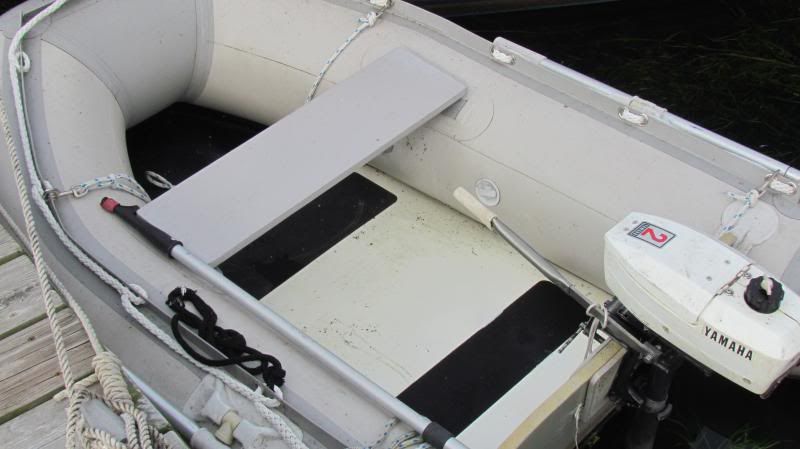
      Last year, Quack  needed a floor.  So, I quickly laminated some ply, slapped some epoxy on the exposed on all the surfaces, sloshed some varnish over it, screwed it in place, and, as the french say, Vwuh-Lah, I had me a new floor.


      Five months later, I needed another new floor:


   So, I spent the time and the money to do it...again.

    I figured out that part of the issue was that the floor was screwed into place, an issue created because I was determined to work with scraps on hand.  For Floor 2.0, I decided to make a full floor that would be freefloating, heldp in place by the tubes.  So I measured, and cut, and sheathed it in fiberglass cloth and wetted it out and filled it...


.....and sealed the edges with thickened epoxy and sanded it, and then painted it and painted it and painted it again, applied a couple of big swaths of grip-tape and I had...


   ...a durable and practical floor.

   Next item on the punchlist was a tiller extension for Quack's doughty little outboard.


 I repurposed a piece of scrap aluminum tube, formed the ends to fit the flat stock tiller, drilled and riveted the new extension into place, and ...


     It works great, and allows stand-up piloting, very nice when one has a load of dogs and water jugs.


   So, one dinghy, two projects, two successes.  What of the newest member of the growing fleet?


     This demonic deflating dinghy is proving to be my Moriarty.

     Look at her up there!  Plump. Firm. Ready for action, no?

     Hours later:


Not Honk's fault, really.  I have no one and no boat to blame for my making an exception of myself.

 See, I found the leak.
 And I patched it.
With a patch that was too small.
Unable to withstand the pressure, the patch leaked.
So, I patched the patch.
The patched patch leaked.
So I slathered it in sealant and covered it in duct tape for a few hours and pulled off the tape and...
...It leaked.


So I tore off the patch over the patch and then tore off the original patch and sanded and cleaned and repatched...
...and instead of waiting the necessary 24 hours for the patch to fully cure and harden, I reinflated to full pressure after 6 hours.

   And it leaked.

    So I deflated the offending chamber, slathered sealant on, covered it in duct tape, let it cure for 24 hours, uncovered it, reinflated and ...


    It looks like hell and it leaks, albeit more slowly.

    The patch is still too small, and the adhesive area inadequate.

     (Small and inadequate- welcome to the story of my life.)

     Tomorrow I will have to make the time and find the money to do it again.  

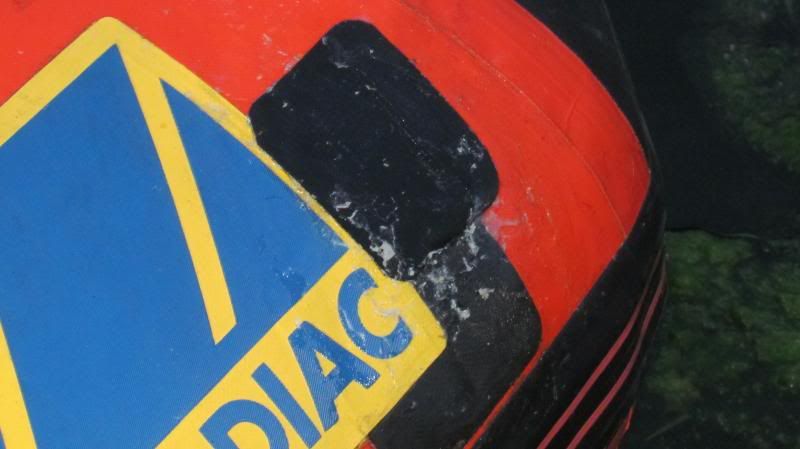
     This time, it is obvious I need to pull the "Zodiac" label off the tube, as the leak is actually a previously patched puncture just off the lower right corner of the label that was inadequately patched originally.   With a bigger patch, a properly prepared surface, the  patch firmly affixed to the tube with no air bubbles, longer cure time for the adhesive, and no inflation until fully cured,  I expect that I will have an inflatable that remains inflated.

    Hopefully.


    So, have I learned anything from being exceptional?

    Yep.

     I am not special.  I don't get any luckier than anyone else.  If there aren't shortcuts for anyone else, I don't have a Thruway either.

     And I guarandamntee I will be tempted, repeatedly, in the future to make an exception of myself.

     Once in a while, I will likely give in.

     You'll probably hear about it.

Tuesday, May 14, 2013

Boat Shopping 101, Part 1: Making the Case for the Wrong Boat

Over at Dock Six, Brian has a bit of advice that I think every potential boat buyer should read. I think it is important enough that I include it here, even tho it is not a project. Read on:

     "Another season passes by you..."
                          -Big Country

....  and you are one more season lost, another season spent dock-walking, fender kicking, online ad surfing,  ladder climbing, grinning, nodding, and doing everything but the very thing you need to be doing:

Pulling the trigger on buying a boat.


    If you're still standing on the dirt wishing you were feet-wet, and this condition has persisted more than 26 weeks, do not consult a physician.

   You're simply doing it wrong.

   Those of you who are thinking about buying a boat, a bigger boat, a different boat?

   Quit looking for the right boat.
   
   Find the boat, right now.

   See, here's the deal:

   There IS no "right boat."

   There is, however, a right TIME.

   Now.

   Look, you can spend the rest of your dirt-bound life thinking, wishing, planning, hoping, dreaming, conniving, scheming, fantasizing, about loosening the ties that bind...

   And all of that strategizing still leaves you on the dirt.
 
   Gazing longingly out to sea.
 

   Which is wrong.  Way wrong.


   I'll let you in on a secret:

   Most of us are sailing on the wrong. Damn. Boat.

   That's cool.


   We're sailing.


   *Cue the music*

   Right now.


   Why is "sailing right now" so important, my friends?

   Because no one knows what tomorrow may bring,

   There is a proverb which, in Yiddish, is written:

         דער מענטש טראַכט און גאָט לאַכט

   Loosely translated, "Man plans, God laughs."

   What has worked for me and for other Docksters may work for you...
... Or  may not,

   ....  and I accept no liability, nor any congratulations, nor any damn thing, incurred along the way.

  But, having said that,
  We are on the water, and you are on the dirt.
  How's that working out for you?   

   Friends of the Dock (henceforth known, anonymously, as FODs) are looking for a boat. 

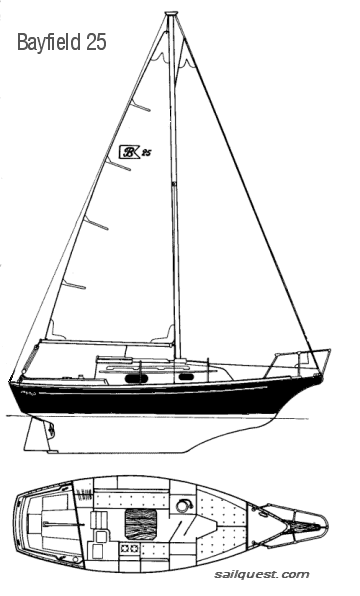
   9 months ago they were looking seriously at a Bayfield 25.


     They asked me for my advice.

     I offered it:  

      (Come on, you think I am gonna keep my piehole shut?

       A Bayfield 25  is a good, solid, capable, full-keeled, well-equipped, comfortable, small cruising boat.  Under $10 K.
  

      Want a cheap, solid $ 4 figure cruiser? 

      The Bayfield 25 is a good bet.

      A boat that would be the queen of Dock Six.

      If it suits them, they should buy it.  

      Others offered the same advice.

      It was the first boat they crawled aboard; conventional wisdom says no one should ever buy the first boat they inspect.

      So, they didn't.


      It sold.

      No problem. 

      It's fall.  Other boats will come along before spring.


      Then, I screwed up.

      I suggested they attend the Toronto Boat Show .

      The FODs climbed all over the big shiny new boats on display.

      They talked to brokers. 
     
      Some good brokers. 
        
      Brokers I trust.  

      Brokers from whom I would buy a boat.

      Brokers who happily and patiently  listened to their needs and wants, and decided that the boat in which they were originally interested, a Bayfield 25, was...

      Too small, too slow, too spartan, too under-equipped.

      
      The Boat Show consensus was, and the shoppers involved agreed, that they needed a newer, more equipped,  big body, big dollar boat...

      ... like walk-through transom Catalina over 30 feet LOA, starting over $80 000.00

     10-15 times as much as the Bayfield 25 that was in their budget and their dreams last season.

      Those brokers who recommended expanding their budget and getting a bigger, plusher, newer, better equipped, more expensive boat aren't wrong...

      If their customer can comfortably write a mid- five- figure cheque for the purchase price...
  

      ....And if the broker and the customer are 100% sure of the customer's needs....

      ...  And if an example  of that "right" boat is available on the market.


      If not?

      Another season lost. 

   
      I argue that the perfect boat for you, (for anybody, for that matter,) is smaller, older, cheaper, slower and uglier than you think it is.


      See these folks?


      Marco  and Dee are less than $3K into their boat.

      Is it perfect?
  
      No.

      Is it their "ideal" boat?

      No.

      Are they out on the water, grinning?  

      Hell, yeah.

      Meanwhile,  waaayy too many other would-be sailors are burning off another season searching for the "right " boat.

      Those of you stupid enough to still be reading, here's what I want you to do:

      Figure out how much you can comfortably write a cheque for, today, right now. 

     Find a boat in 80% of that price range.

     Buy it.

     Now.


     Next post I will explain why.

     Stay tuned.


Wednesday, April 18, 2012

Musings on the non-linear progression of projects

While refurbishing a dinghy, Jeff on s/v C'est la Vie waxes philosophical about the effects of our own aging on our projects...
The past few days have consisted of painting concoctions onto the dinghy only to then sand them back off.  My progress measured by the increasing grit of the paper 80 grit, 120 grit, 220 grit.  Today the dinghy restoration took a  leap forward - Wahoo!


I completed the interior painting and installed the seat (pictured above.)  Anne and I also applied the second coat of primer to the hull (pictured below).


If weather and schedule co-operate we will roll and tip the two top coats on Wednesday and Thursday.

My projects increase in complexity as my patience grows with maturity.  Thus far in my life the complexity to patience ratio appears to be a linear progression.   I wonder if the day will ever arrive that I am accurately able to estimate the the time such projects will consume. My current system is to double the time I initially estimate, but this equation is consistently turning up short on time.  As I age and my projects grow in complexity should I continue to increase the multiplier for time allotted?  Hmm,  If this is true I better go ahead and get the big projects done before I pass a half century.

What of the non linear progression of projects?   One day is devoted to 10 hours of sanding where progress in measured in grit.  The next day progress is a apparent as a face lift on Yoda. Guess it's best to just accept the way of things and celebrate the days where progress is measured in fair hulls and dinghy seats.

Wednesday, December 8, 2010

Caveat emptor

Everybody knows that application of label "Marine" to something seems to mean that you can double the price.  Now, there are items for which a higher price is appropriate.  An example: a marine alternator -  a specially manufactured version of an automotive alternator, made in limited quantities (by automotive standards anyway) to be able to safely run in an enclosed engine compartment which could contain gasoline vapors.  But how much more is justified?

Bob, over at Boat Bits has been decrying the cost of self-steering gear (we're all anxiously waiting to see your design, Bob).

And now Mike from Zero to Cruising brings us a couple of real-world examples where ingenuity trumps chandlery prices:

While shopping online and at the usual chain-store chandlery, we found:

* Tiller extension: $15.00 to $60.00!
* Portable stern light: $35.00 to $40.00!

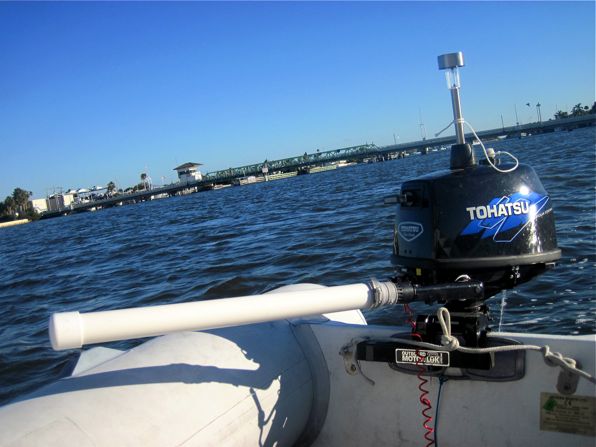
* Our tiller extension: $5.00 (piece of schedule 40 PVC, end cap and rubber connector with clamp)
* Our portable stern light: $5.00 (solar patio light, rubber stopper thing, sticky-back velcro)
Mike's example of the dinghy running light brought to mind something I saw in a flyer I received recently from a large, nation-wide marine chandlery...

This "rail lite" was offered for $29.95.  Obviously this is nothing more than a typical "solar patio light" with the bottom spike replaced by a cap, and with a cheap plastic clamp.


Harbor Freight sells this set of 10 nearly identical copper-colored stainless lights for  $34.99.  Buy the set, take off the bottom spikes and find your own cheap plastic clamp, or just use zip ties.  And then give 9 of them away to your friends at your anchorage.


The bottom line is, that while some marine-oriented items are justifiably priced higher than their non-marine equivalents, many manufacturers seem to take advantage of this and mark up everything with a marine label.  Or even apply a marine label solely so that they can mark up the price.  They get to do this, of course.  Our response should be caveat emptor - the challenge to all of us is to apply critical thinking and ingenuity to avoid being taken in by the marketing.

Monday, October 25, 2010

In praise of DIY

I have long been an adherent of the DIY philosophy - you might have guessed that, given the purpose of this blog.  Most boaters are DIY'ers by nature - thus the popularity of this site!   Aside from the obvious cost savings, when you successfully complete a project yourself, there is a wonderful feeling of satisfaction, of competence.

And in the boating world, DIY makes even more sense.  There are those who proclaim that "the only tool I need is a Visa card."  That certainly works, if your boat never leaves the dock.  But when you are at sea, that credit card is not very useful - except, perhaps, if you are in need of a thin plastic shim.

Over at Boat Bits, Robert has posted an essay on this subject that I encourage you to read.
Related Posts Plugin for WordPress, Blogger...