As I continue to work on my book on "Faster Cruising" I found myself feeling like the cobbler with no shoes for his children; I don't always follow my own advise, even when I know I'm right. In the book I argue that cruising boats are often lack the rigging and hardware needed to make basic trim adjustments quickly and easily, as though cruisers don't care about efficient sailing or understand the fine points. I care, but I have to admit my cruising cat doesn't have the quick access to fine trim that my performance cat had. I aim to fix that.
Case in point. My PDQ 32 came with a good boom and internal reefing, but the main outhaul was secured to an undersized cleat . To tension it under load, you take the tail to a mast-mounted winch, wrap the line under the cleat, and lift the line sharply when taking the line off the winch in an attempt to minimize slippage before that first wrap is on the cleat. Boy scout at best.
A few days ago I removed the undersized cleat (closely spaced holes on the seam) and I tapped four new holes to secure a proper jammer. Now I can ease the outhaul in a blink and tighten with a winch in control.
The smaller line is for the lazy jacks.
Why a double jammer? The few times I have found myself sailing with three reefs (winds gusting to over 30 knots) I found I needed a better way to winch the clew down. The tack is easily secured with a loop through the reefing tack and under the gooseneck, but there is no internal rigging for a 3rd reef. Thus, I tie a bowline around the boom under the reef clew (like the other reefs), go up through the reefing clew, and back to a snap shackle-equipped snatch block at the main outhaul. From there the reefing line is threaded through this new jammer, allowing a mast mounted winch to tension the clew outhaul.
The only challenge is to remember to thread the reefing clew while hoisting.
[The jammer came courtesy of freecycle--it patiently awaited re-purposing for several years in one of my might-need bins. Whooppee!]
Showing posts with label Sail Delmarva. Show all posts
Showing posts with label Sail Delmarva. Show all posts
Tuesday, November 21, 2017
Outhaul Jammer
I'm working thru my backlog - this is an old post from Drew at Sail Delmarva - so old in fact that he has sold this boat and gotten a new one since this was posted. And the book he mentions has already been published - I recommend it and several others he has published. You can find them in his bookstore.


Tuesday, April 25, 2017
Something Lazy, Something Free
As usual, Drew over at Sail Delmarva has been messing about with chemicals - here's a tip he has for everyone with a head...
Free is always good, except this is not quite free.
Or rather, it is free if you use any sort of holding tank treatment chemical.
I've done all sorts of holding tank stuff for Practical Sailor Mag. Chemicals, hoses, vent filters. Fun stuff. And in the process, in addition to learning all sorts subtleties, I solved all of my own odor problems, save one; odor from the bowl itself. If I flush with seawater and leave it a few days, there's some stink; sulfate in seawater is converted to hydrogen sulfide by millions of wee bacteria. If I flush with fresh water, it's better, but not zero; I guess something sneaks back down the waste hose, or perhaps up the feed hose. And either way, the bowl tends to get ratty, as marine flush volumes are limited and the water isn't chlorinated. I hate scrubbing.
Place a 20% solution of holding tank treatment in a spray bottle and mist the bowl down with each use, or at least each day, or and certainly whenever you'll be leaving the boat for a while. This cleans the bowl, treats the water in the bowl, and treats the water in the waste hose, preventing stink. And since it's the same treatment you would be using anyway, just subtract this from the usual dosage.
However, not all treatments work.
Less work. Less money.
- No blue sterilizing treatments, containing with formaldehyde and the like. Toxic, smelly, stain-prone, and well... gross. Too much like a portable toilet. Very tough on joker valves. Formaldehyde is listed as a human carcinogen. I don't understand why they still make these. Ban them from your boat.
- No bacterial treatments, like Bactank T3 or Happy Camper. They grow in the bottle and get gross. They are quite effective in the tank, just not for this.
- Pick a scent you like, preferably very mild. I like Forespar Refresh and Raritan CP, but Camco TST Ultra-concentrate is our favorite
. These are compatible with any type of holding tank treatment, including bacterial treatments. I tested a bunch for Practical Sailor Mag (February 2012 and December 2012).

Tuesday, February 21, 2017
Sailor, and now Author

Drew, a frequent contributor to Practical Sailor and to this blog, has branched out - he is now a published author! Aside from making a few bucks to cover his time and effort in producing these books, Drew is paying it forward; he is giving new and less-experienced sailors the benefit of his extensive experience.
Drew, as an engineer (disclaimer: as am I), has a precise, unambiguous writing style. But he will also wax poetic, in the fashion of a man who has carefully examined his own motivations.
What is rare in the sailing genre is that Drew, again being an engineer, does not shy away from experimentation. He does not accept "everyone knows" without actually testing it himself, rigorously. What Drew reports is derived from first person experience and experimentation. If he says it, he's tested it, and you can believe it.
So far, there are four books in the bookstore:
- Keeping a Cruising Boat on PeanutsPDF, Pending 2017 Kindle, about 400 pages
- Rigging Modern AnchorsPending 2017, TBD, about 250 pages.
- Singlehanded Sailing for the Coastal SailorKindle, 143 pages, PDF, 154 pages
- Faster Cruising for the Coast Sailor
PDF, 183 pages, Pending 2017, Kindle, about 200 pages
To provide a little view into what's included, here is the Table of Contents from Singlehanded Sailing for the Coastal Sailor:
- Acknowledgments 4
- Preface 7
- Part 1: The Singlehander
- Chapter 1: The Reasons We Go Alone 11
- Chapter 2: The Costal Philosophy 14
- Part II: Preparations
- Chapter 3: Docks 21
- Chapter 4: Sailing 24
- Chapter 5: Safety 41
- Part III: Practices
- Chapter 6: Sailing 63
- Chapter 7: Safety 74
- Chapter 8: Living 80
- Chapter 9: Kids 85
- Chapter 10: Summer 87
- Chapter 11: Winter 88
- Summary 100
- Glossary 102
- Appendix I: Annual Inspection 103
- Appendix II: Tethers and Jacklines 108
- Appendix III: Rainwater and Water Filtration 122
- Appendix IV: Climbing the Mast, Ladders, and Falling 136
- Appendix V: Extension Ladders and Webbing Ladders 141
- Appendix VI: Stropes 148
Tuesday, October 11, 2016
Boat Hooks
Over at Sail Delmarva, Drew has some comments on that ubiquitous tool: the boat hook
Six months ago I was asked to review boat hooks for Practical Sailor Magazine. Everybody needs one. How dull I thought; I've never bought one, not in 30 years. I always find them by the dumpster or on the beach, and have a stack of "spares" at home that I haven't used yet. Keeps me from getting to choked up if someone drops one. Most days we just drop it in the middle of the tramp--I've never lost one from there, even in heavy going, though I generally tie it down when it starts banging into things.
Everybody does need one.
And low and behold it was more fun than I thought.
- The most expensive, heavy duty model was the first to fail in the field.
- Most would not allow me to pull with full strength without breaking.
- The company that urged us to test, feeling theirs were best, was absolutely right.
- I still like my 20-year-old pole for daily use.
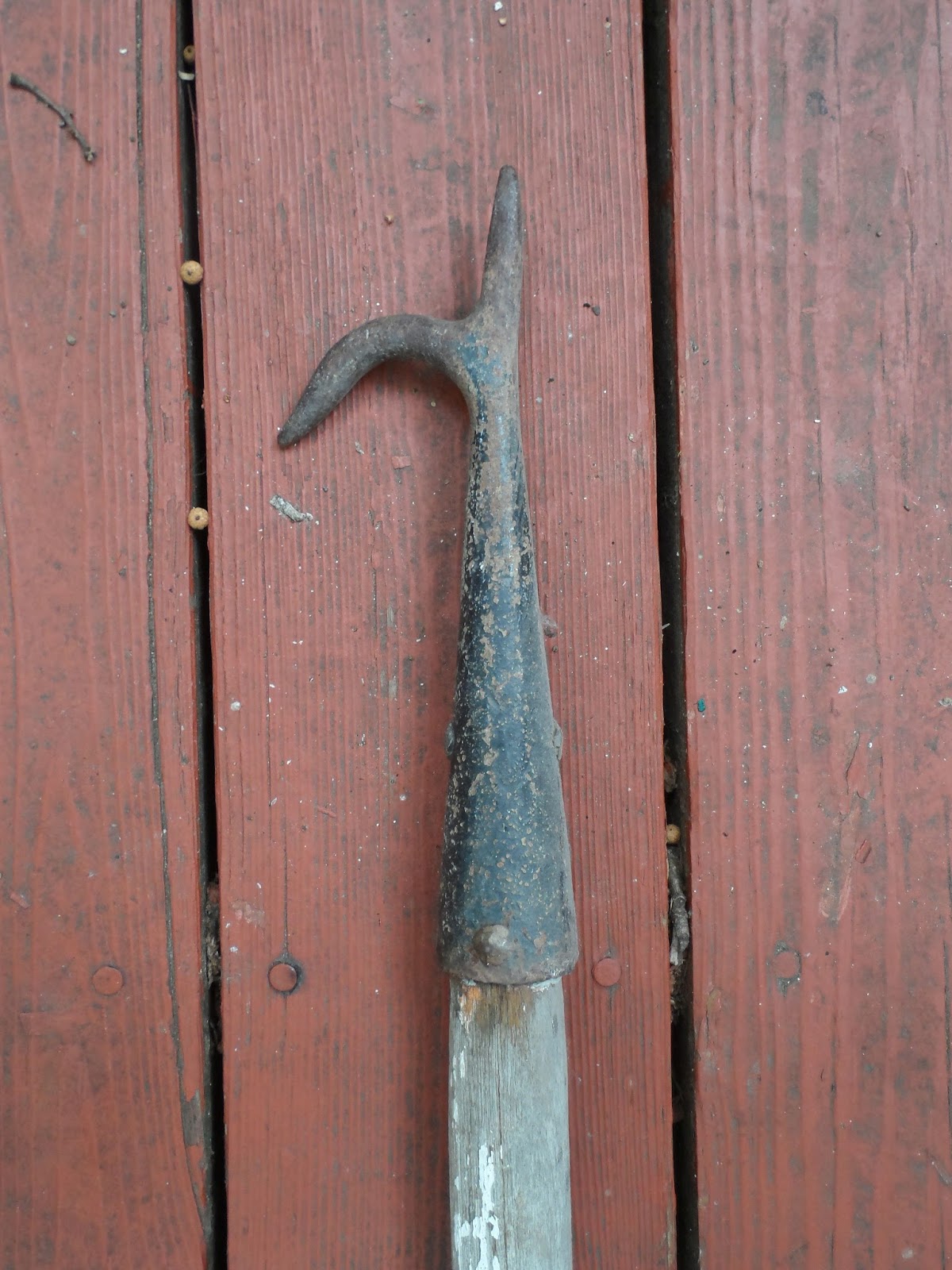
How about this classic crabber's hook? It's been hanging on the wall in my daughter's room for years, after I found it tangled up in my docklines after Isabel (I left in on the dock for 2 weeks, but no one claimed it). In fact, it was perhaps the best balanced and most suitable for all-day heavy use. No surprise.
The old guard vs. the new kids. Second from the left is my every-day pole.
I wonder who got the bright idea that a boat hook makes a good brush pole (I'm not picking on West Marine--they are ALL like that now)? All it does is snag lines. Unfortunately, about 1/2 of them won't screw into a brush because part of the hook is in the way. And nothing can be screwed into the "take" part of the hook anyway, so what's up with threads there? Worst of all...
... the bulbous padded tip makes them useless for snagging a line off a piling or dock...
Which all of the old-school poles can do easily, but only ONE of the new poles. Not an improvement in my opinion.


Tuesday, August 9, 2016
Renovating a LifeSling
Once again, Drew over at Sail Delmarva tackles a safety issue with his usual verve:
A reader wrote into Practical Sailor that his LifeSling had basically fallen apart, the result of UV exposure. The blue webbing straps tore under hand pressure (a write up in PS will certainly be forthcoming). The age was uncertain (probably more than 20 years) and I believe it may have been stored upside down, since the straps should be on the bottom, completely protected from UV.
But the other issue is that the LifeSling cases are notoriously UV sensitive, or rather parts of them are. I bet the failed LifeSling was in a failed cover. The coated polyester itself is pretty durable, but the stitching goes and all of the Velcro fastenings go at about year 5-10, depending on the latitude and whether it sits on the rail year-round, like mine does.
Packing. Packed according to the instructions, all of the critical parts are well protected. The line (VERY vulnerable is in a tube in the center, with the sling over it; triple protection. After 19 years, mine is still pristine. The tail of the rope that attached to the stanchion base is covered with webbing. Although the webbing is sunburned, the rope is fine.
I cut a section open to look. Note that there are a few failed strands on the lower left, where sun must have peaked in. Polypropylene is touchy stuff.
Velcro Top Closure. I dislike the UV vulnerability of Velcro, so I replaced it with a tubular webbing and pin system, something like a door hinge. Just pull the red flag. This endured for 10 years without damage, so I left it alone this time. Durable, secure, and fast.
Velcro Ties. Really, a stupid application, when a knot will do better and last forever. Again, the Velcro fails in 5-10 years, I cut the remaining stitches, attached a 2" x 4" webbing strip on the inside with Sikaflex, a 4" circle of Sunbrella on the outside with Sikaflex, and punched a pair of holes. I was going to install grometts, but the laminate was too thick, about 1/8", so I simply threaded webbing.
Stitiching. Some of the seams had gone at 10 years, where they rubbed on the rail. I hemstitched them 10 years ago using whipping twine, and they are still fine.
Paint. I had some white vinyl inflatable paint left over, so after a good TSP scrubbing I painted the whole thing to provide some sunscreen (I masked off the instructions--that section seemed OK and has no seams or stress points). I have used Kilz primer plus house paint on projects like this before, through, so don't run out and by special paint.
I will 20 minutes work I should get another 10 years from the cover. Since the initial cover needed repairs at 10 years, I'm OK with that.


Tuesday, May 17, 2016
Exposed Wiring
Over at Sail Delmarva< Drew cleverly fabricates a cover for some exposed wiring...
This exposed solenoid always bothered me. Non-AYBC compliant, non-USCG compliant, and a short looking to happen, the backside of this anchor windlass breaker has high-amperage exposed terminals.
I fabricated this simple cover from 0.09-inch FRP (the same materials I used for the window covers. Cut by score-and -snap, trim with disk sander, fillet corners with Epoxy + colloidal silica, finish with orbital sander and paint. In stead of screws (holes would show), attach with 3M Dual Lock.
The finished product looks factory. I think I will be using a lot of Dual Lock during the AC installation.


Tuesday, April 19, 2016
Ditch the Bent Nail
Drew at Sail Delmarva has a new take on an old method:
I've been doing a series of tests on backing plate materials, drilling, de-coring, de-epoxy filling, and re-drilling innumerable holes in balsa cored laminate. The standard method is to use a bent nail to pulverized the balsa.
Bent nail
Well, ditch that. At the suggestion of another DIY sailor I tired a notched roofing nail.
- The drill bucks less. Particularly helpful on larger holes.
- The dust is finer and hence easier to remove. No need to dig it out with a nail.
- You are less likely to miss a spot, though as the pictures show, both methods can do a very nice job.
Notched roofing nail
Dremel cutters work, producing fine dust that is easier to remove, but the undercut is only 0.09-inch vs 0.19-inch for the bent nail or roofing nail. By the time you cut a bevel for sealant, there isn't much left for a seal.
---------
The right tool for the job bay be the notched roofing nail


Tuesday, January 12, 2016
Fender Washers--Basically Useless?
Drew has been at it again... Here he is testing fender washers as might be used instead of proper backing plates for items thru-bolted on deck. Drew made two posts; I have included both of them here.
In the process or researching an article on backing plates, it seemed worthwhile to actually test some washers. After all, it was the failure of fender washers that led to cracking of my deck and the need to remount the winches.
I used a 3/4" pine board as a surrogate for a cored deck and tightened a collection of 1/4" washers untill the first damage to the wood, and until failure. To no surprise, common washers, fender washers, and HDPE were glaring failures, and FRP and thicker metal washers were fine.
(click to enlarge table)
And then there is always the matter of what happens in wet places. Though I like aluminum for ease of fabrication, I also know its limitations.
As ramp-up for some Practical Sailor testing, I thought I would share a preview.
First, unable to secure scraps of deck material for which I could be sure of the pedigree, I laid up some of my own. The testing will based upon 1/2-inch balsa core with (1) 6-ounce cloth and (1) 17-ounce biaxial layers on the deck side and (1) 17-ounce biaxial layers on the under side.
I drill a 1/4-inch hole (no epoxy plug, block of wood on the back side) and tightened down a fender washer against it. At 10 in-pounds (about 675# load) the washer had distorted and the laminate was failing. for comparison, the bolt working load of a Lewmar 40 winch (1/4-inch bolts) with a strong grinder is about 500 pounds each. In other words, without an epoxy plug the bolt will fail under working load and standard ASME bolting load, with no safety factor for aging and fatigue. It is about 5x weaker than good design suggests. It also explains why I had a PO installed winch rip out.
By 18-in-pounds the fender washer was buckled and the nut was well into the core. For comparison, this is about 50% better than a plain pine board in each case.
I repeated the test with only lock washer. The same result! The fender washer resulted in no increase in strength. The point being, that the bolting washer provided better support in close, the end result being the same.
Testing for the actual project will involve proper epoxy plugs. However, since under the load the bolt will NOT be supported on the other side (the winch or cleat will be lifting) in the real world, the top side support will be supplied by a 4-inch diameter ring spacer, allowing the washer to pull through, if that is what it wants to do. I've tested this without the epoxy plug; not surprisingly, it lowers the failure load and creates top side damage much like I saw on my failed winches.
We'll see. But for now, the moral of the story is that fender washers are basically useless; they fail as soon as they are actually needed.


Tuesday, October 6, 2015
Jacklines
Drew from Sail Delmarva is with us today, with some insightful comments on jacklines:
Vertical Jacklines
Who says they all need to be on the deck? I installed a pair of vertical lines to deflect the genoa sheets away from the mast-mounted halyard winches (one on each side), around which they loved to foul during tacks. They are anchored to strong points and the line is 1/4-inch Dyneema, selected because I had it and it was non-stretch. At first I was concerned that the deflectors would be in the way, but I soon realized that they were handy holds and clipping points when working at the mast, much better than clipping to the mast base. I can even lean on the tether in rough weather, allowing for better 2-hand work.
Jackline and Lifelines
It is often said that using the lifelines as handholds is a bad habit. While there is truth to this on a monohull (the leverage on the stanchion bases is cruel when hauling to one side from the deck of a leaner), I disagree for catamarans. The difference is that cats do not heel and that most of the motion is vertical (it doesn't show in pictures, but cat sailors know they get light on their feet when pitching up wind). Additionally, my jacklines are relatively high at the beam, since they are secured to the hard top. Thus, the safest way to traverse the side decks between the hard top and the tramp is to hold the lifeline in one hand, the jackline in the other, and pull up. Not to the side, not push down, but pull straight up such that your feet are held firmly on the deck. There is little bending stress on the stanchions because the load is vertical, and the support is steady rather than surging roughly as the boat moves. Intuitive to a lifelong climber, something may lubbers and sailors have to be shown.
Probably just a catamaran thing.


Tuesday, July 21, 2015
Honey, They Shrunk the Captain!
Making a boat yours is important, if for no other reason than emotion. But making it fit is critical. Drew shares an example with us...
Touring the Annapolis Spring Boat Show and researching for an up-coming article on access for decrepit (bad knees, like me and my wife, and an increasing number of friends getting hip and knee replacements) sailors, we came across some good things and some unbelievable things. Honestly, how many folks get $500,000 together for their dream boat before their knees start to hurt? Not so many that the designers should ignore the reality. Or like me, the knees are fine when you buy the boat, and then a lifetime of vigorous activity starts to catch up with you.
And some things are just funny. This really belongs in Disney Land in the "Honey, Who Shrunk the Kids?" theme area. The seat is 8 inches too high and 8 inches too far back; as it is, the driver has no leverage on the wheel. At the very least, it needs a foot rest or fold-down runt board. And we saw this same problem on every single helm seat. Comically unsuitable for a long turn at the wheel.
Kinna reminds me of this, early in our ownership with a temporary runt box in place. It worked, giving her something to brace against.
On Shoal Survivor we eventually added a proper runt step, and it is still a little tall for my daughter (20 years old, but somewhat vertically challenged). Our feet now touch the floor, we have leverage, and an added storage spot to boot. And the wood was salvaged from the sole replacement on a Prout.


Thursday, February 5, 2015
Dry Suit. The Ulimate in Foul Weather and Survival Gear?
Now here is a great idea from Drew over at Sail Delmarva - It might not keep you warm enough in the Bering Sea, but then how many of us are sailing there? And as Drew points out, the safety gear you are wearing beats the heck out of the best safety gear in the world stored in a locker...
Better than a Survival suit? That is the question Practical Sailor Blog asked this month. Conventional survival suits are so ungainly that sailing is impossible and they are not donned until the boat is headed down, often too late. A dry suit, on the other hand, offers the same or better agility and livability than conventional foul weather gear, with complete cold water protection (except for the head and hands). Since it can be worn while sailing, it offers protection you are more likely to have on.
But that isn't why I bought mine. Kayaking is one of my favorite activities, and once the water temperature drops below 60F, it become more and more difficult to dress safely. While I have never capsized (other than white water) on open water, there is always a hypothermia risk. Additionally, I think the dry suit will make reboarding from the water easier, because you avoid heavy, soaked clothing. Instead, you gain significant all-over buoyancy.
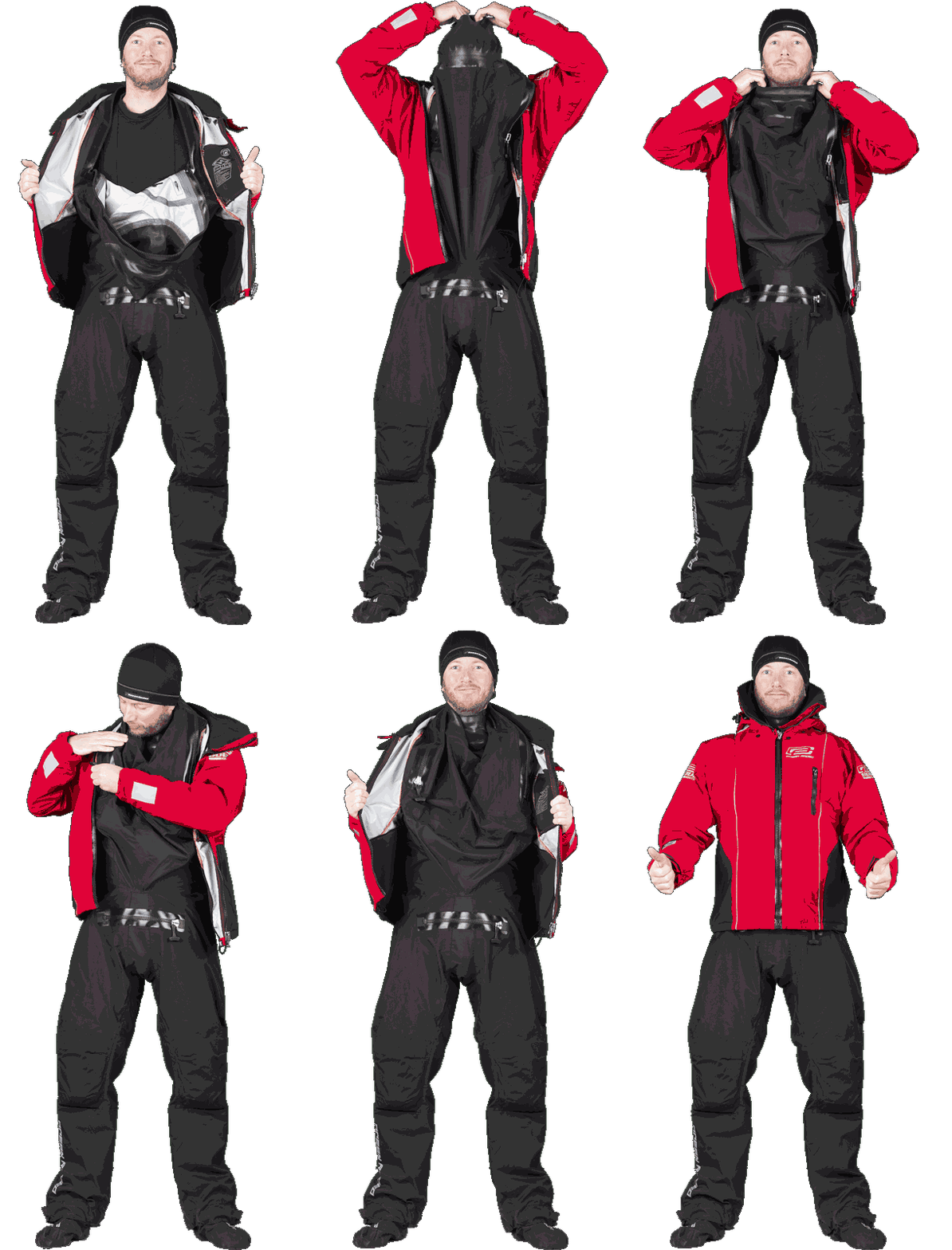
A favorite feature, and one that makes this suit (Ocean Rodeo Ignite) particularly suitable for sailors, is the standby mode. The pants are supported by suspenders and fit well, with attached socks. As shown in the above photo, the pants can be pulled up and the jacket zipped without put the head through the neck seal and zipping in, giving great ventilation. Converting to full seal takes only moments.
There are wrist seal, lotsa pockets, and a fly. The fabric is like a heavy duty 3-ply Gore Tex and seem very durable. The entry zipper is across the shoulders and doable alone (many drysuits require help). They are cut for athletic builds; if you've been hitting the pasta a bit too much, have very large shoulders, or shoulder mobility problems, go up a size; I am near the upper limit of height and weight for the medium (5'8" x 165#) and the fit was spot-on with my typical cool weather dress (long johns, fleece pants, shirt plus fleece sweater). With 2 thin fleece layers, 32F water is pretty tolerable (but the fit through the shoulders is more snug), and I've even done a little bottom cleaning like that. However, I strongly recommend trying the suit with the layers you intend to wear. Fortunately, getting out is easier than getting in, so you won't get stuck!
Note on trimming seals: the wrist and neck seals on dry suits tend to be one-size-fits-all, which is to say they are probably too tight unless you are built like a stick. In fact, over tight neck seals can inhibit blood flow to the head, which is bad. I found the wrist seals fine, but the neck seal was miserable. Trim one ring at a time with very sharp scissors, leaving no jagged areas that could stat tears, until the seal is snug but acceptable, your adam's apple can move, and blood flow seems normal. Divers keep them tighter than kayakers and sailors should. Seals are replaceable, but with care last a long time.
And when you peel it off... You're dry!
Wednesday, December 3, 2014
Snag Reduction--Or Tacking Without Tears
Tacking a boat is a time when all kinds of mischief can occur. With all the sails and sheets loose and being blown/flogged around, it is amazing sometimes what Murphy can pull off. Over at Sail Delmarva, Drew implements one of his typically elegant solutions to keep him in check:
Snagging the lazy genoa sheet on the mast-mounted winches has been my curse since the first day. The clew is just above the winch, and when it slides across the mast during a tack it just loves to loop over the winch, necessitating a trip forward. If I'm lucky, the boat doesn't fall into irons.
I tried a few simple bungees and covers for the winches. No luck. I tried better technique; OK when the wind was light, but otherwise undependable. I tried a line from the spreaders forward to the tramp; too hard to get the tack around. Finally I spent some time looking at it and found a simple solution that works the charm.
The Deflector. I ran a 40' length of 1/4 spectra double braid that I had left over from the end of the self-tacker traveler, through the lazy jack pad eye at the spreaders, and down to the other end of the traveler. It is tensioned with a truckers hitch, but not too tight, as the forces could get out of control. This keeps the sheets away from the winches AND away from the salon hatches , allowing them to remain open even when tacking. I thought it might be in the way, but in fact it makes a nice hand hold in an otherwise precarious area.
The sheet is held far away from the mast and hatch.
However, there is a significant tendancy for the clew eye and soft shackles to jam against the new deflector stays. I tried a few things before coming to a simple and entirely satisfactory solution; the sheets are now attached to the tack via a trianagular sliding bridle.
The Bridle. an 18-inch spectra climbing sling did the trick. It is luggage tagged to the eye and then each sheet is attached with a separate soft shackle. If there is any tension at all on the lazy sheet, the sling opens up into a triangle and sail clew is NOT forcibly dragged across the stay, only the sling. The clew eye is always free to move forward, away from the stay. Additionally, the shackles do not pass all at once, but rather in succession, reducing the drag.
A bit tricky to see, but both sheets are attached NOT to the clew, but to the sling, along which they are free to slide when tacking. Both are attached with soft shackles; this is required because the windward sheets are inside the shroud and the reaching sheets are outside the shroud.
Not a single snag over many tacks in many wind conditions, from ghosting to 25 knots. Why does it take so long to learn simple things?


Wednesday, October 29, 2014
Fresh Water Flush--a Miniature Water Closet?
Over at Sail Delmarva Drew has had a wonderful idea! Why not flush with fresh water - if only while at the dock (and let's be realistic here - most boats are at the dock the majority of the time):
Seawater contains bacteria and sulfate. Flush with seawater, deprive the bacteria of oxygen for long, and facilitative (those that can go aerobic or anaerobic) start using sulfate (SO4-) as an electron source. The result is H2S (rotten eggs) and the head stinks. The cure? Either use the head every 8 hours (thus, smell is not a problem when living aboard or actively cruising) or flush with fresh water.
But you can just plug the freshwater pipe into a manual head; water will blow through, flooding the compartment, and bugs can swim up-stream. The water closet, introduced a century ago, prevents both by employing a float valve and creating an air gap (bacteria can't fly, as a rule).
What about a miniature water closet? $38 from McMaster Carr
Made for commercial ice machines, this unit holds enough to flush 3' of 1.5 inch line--not enough for most manual heads--and refills at 0.33 gpm, or about 1:20 seconds per full flush (12 strokes or so). Clearly, a larger size, holding about 60 cubic inches, is what is needed. It could also be expanded by mounting a 1-3' length of 3" pipe under it to serve as a reservoir (4' of hose can be flushed for every 1' of 3" pipe). Mount it to a bulkhead somewhere handy and you should be good to go. A pair of valves would allow switching from seawater and isolation.
But I haven't tried it. I'm happy enough with sea flush and a rinse with potable using the shower head before going home.

Thursday, October 9, 2014
Warm Boots
The time of year is coming when this idea will be very welcome indeed. Warm dry sea boots? What a luxury! As usual, Drew at Sail Delmarva shows us how to have them for a very minimal investment:
A few days ago I was following a thread on a sailing forum regarding how to best dry a pair of high-dollar leather and Goretex seaboots. Suggestions from experts ranged all over, but missed that most obvious answer; a boot drier. Perhaps this won't resonate with warm climate folk, but it should; I've seen enough mold and mildew in Florida to make it the state plant... if it were a plant.
I built this one15 years ago in an evening, for the specific purpose of drying wet snow gear, but it has certainly been used far more for rain soaked gear.
Even the most sodden boots, shoes, or gloves are dry, warm, and fresh in a few hours. Odor is eliminated, as there is no chance for anything to grow. Wet gear has a proper place, and space is conserved since less gear is needed. The materials came entirely from the might-need bin, but I suppose it could be built for $30 if everything were purchased. It could be made longer, for a larger family, with very little change in cost.
The fan provides just enough flow. A bit of flashing creates an internal baffle, directing all of the air flow over the bulb before it goes to the pipe outlets. A 60W bulb seems to provide just enough warmth, but a larger bulb or lamp-base heater could adapt the design to larger sizes. Hardware cloth keeps small fingers and trash out. Pipes could be made longer for sea boots. The unused pipes are plugged by dropping a large bolt in the hole, focusing the heat on a reduced number of holes. The weight is sufficient to keep it from tipping over.
What would I change? I should have built it for 8 pipes (4 boots + 4 gloves) to better serve 2 people. I should have made the pipes just a little longer (no so much that it could tip over) and drilled a cross-wise hole near the end (so that they cannot be blocked if the boot is sitting on the end). But Jessica is off to college, so it's really just me playing outside, and it works quite well as it is.
- 110v computer fan
- ceramic socket with 60W bulb
- box and switch
- a salvaged cord
- 3/4" lumber and some screws
- 3/4" PVC pipe stubs
- a bit of flashing and some hardware cloth
- paint
I've been tempted to build something similar into the boat--it's really sweet to have warm, dry shoes in the winter--and perhaps I will if I start cruising more in the off season, now that school schedules don't matter. Perhaps something that diverts warm, dry air from the mini-dehumidifier.

Friday, September 19, 2014
Why Does My Anchor Come up Backwards?
Does yours do this? Over at Sail Delmarva, Drew asks the question, and then shows why and how to fix it:
After fixing this on 3 boats (mine was the first) I thought I would share something so obvious it is commonly overlooked.
There are many things that can bring the anchor up backwards, not the least of which is a shift in the wind. The easy solution is a swivel, but failures are not unusual; my SS swivel had a nice interior crack that I noticed only when taking it apart to replace the anchor. Many sailors have abandoned swivels for this reason, and then wondered if they made a mistake when the anchor came up reversed most of the time. Never fear.
Notice the nice straight chain. No twist.
When connecting the anchor, observe that there are 4 rotation options. Unless you considered this at the time, you had only 1 chance in 4 of getting it right.
The chain cannot rotate in the gypsy, thus, getting the twist right significantly improves the odds of the anchor coming up right way round, more so if the windlass is near the roller. Not 100% certain, but improved odds. For me, >95%.
- If you are 180 degrees out of alignment, reattach inverted.
- If you are 90 degrees out of alignment, either add/subtract a shackle or clip one link.

Wednesday, August 27, 2014
Dual Rod Holder From Scraps
Do you have a fishing rod aboard? Then you probably have a rod holder too, else you have to hold the rod and tend the tiller and sails at the same time. Over at Sail Delmarva, Drew shows us how he made a dual rod holder from scraps - for a lot less than you paid for yours!
Dual Rod Holder From Scraps
Or rather from a stern rail motor mount that the the PO liked but I had removed. In my mind, either the engine should be able to stay on the dingy or...
The mount has been resting in a might-need drawer for 6 years but now enjoys new life.
- The davits or hoist is weak. Upgrade.
- The engine is too damn big.
- The dingy moves too much, in which case it should be triced-up.
- The dingy is vulnerable in rough weather. Not the case on most catamarans, since the davits are forward of the transoms.
It's primary purpose is to hold my 2 mini-outriggers (2 x 6' outriggers give me an effective beam of 26 feet, easily trailing 3-4 lines without tangles) while not trolling. They can't left in place during docking, and placing them in the outboard rod holds inhibits easy boarding and blocks the holders for other uses. I find rod holders handy for other things as well--boat hooks, walking sticks, gaffs, oars--so i can never have too many.
I dislike commercial holders since they only grip the rail without twisting if tightened so much they scar the rail. This never will, since it uses an up-right for bracing.
Construction was simple enough. I had to slot the back to accommodate a brace. The 2" SCH 40 pipe is attached with counter sunk #10 machine screws. In the background are a pair of kayaks lashed to the top of the davits, the most convenient storage space.
The lures are home-made too.


Thursday, August 7, 2014
Freshwater Tank -- Are Bugs Swimming the Back Stroke in There?
One of the things that Drew at Sail Delmarva does is to design venting systems for large industrial tanks. When he talks about tank vents for boats, we should all listen:
According to the plumbing code and AYBC, there should be a screen on the freshwater tank vent to exclude mosquitoes, other bugs and reduce dust. But many builders, including PDQ, leave these off. On the PDQ 32 the vent line simply goes up and then down through a mushroom fitting under the bridge deck. Yup, I've seen bugs in there, so while I was up-grading my water system, I decide to fix this too.
Clean, huh? Though a strainer won't stop bacteria, it will reduce convective airflow.
The solution was to splice in a simple strainer. The code calls for 16 mesh, but no-see-ums are known to crawl through that, and 50 mesh is common anyway. This strainer is large enough to manage any air venting flow and serve as an over-flow too, though when filling fast, water will back out the fill even without the strainer in place.
Shurflo
The PDQ is a catamaran and the pressure water system is located on the bridge deck, between the hulls. Thus, the tank vent actually discharges down, through the floor, about 20 inches above the water line.
A 15 minute fix. No more bugs. Fewer bacteria and mold spores. Mostly self cleaning, every time I over fill the tank, but also easy to clean and easily accessed. I suppose I should clean the tank one last time, but the new filter is doing great.


Thursday, July 10, 2014
Is Your Tether Quick Release Actually Quick Release?
With his typically engineering analysis, Drew over at Sail Delmarva asks some hard questions about tethers:
This tether was found by rescue workers at the Wing Nuts accident site; there were several fatalities.
Where do you clip the "spare" leg of a 2-leg tether? To the harness ring, or course, if there is no loop on the tether... and there is not. Pull the quick release and you are still attached by the spare leg. A potentially fatal design error.
This is dangerous even on deck--if the tether gets wrapped around a sheet or guy he has 2 clips to release to get free. Not good.
And this points a scary trend, where equipment companies design to standards but don't actually test the gear in the field. They give the gear to sailors to use, but that is hardly the same as structured testing where all likely use scenarios are systematically tested.
The solution? some brands are adding a ring or loop near the harness end. If you make your own, leaving the loop long enough will do. Or in my case, I simply clipped in a small biner to give myself a parking space.
The typical vendor response? You should have a knife. Please. Why not say I should fall off the boat?
(No, I don't used quick-release harness end clips. I single hand and can't imagine a senario where releasing will leave me better off. On the other hand, I can imaging the quick-release letting go or me clipping it incorrectly. My compromise. I still prefer to clip to the "parking space" and have only one clip on the harness.)


Tuesday, June 10, 2014
Dynamic Travelers
Cross-fertilization between interests is a good thing. In fact, the most interesting things are usually discovered at the intersection between two fields rather than at depth in one. Over at Sail Delmarva, Drew brings a fusion of sailing and climbing. And in this particular fusion, we learn that low stretch line is not the be all and end all...
Some lines cry out for low stretch; elastic halyards and genoa sheets both allow sails to become more full in gusts, exactly when flatter is better. For other applications some give is in order; tethers and anchor lines come to mind. Travelers fall in this latter category.
We know the sound of a traveler screaming across, and we all cringe, waiting for the "bang" that follows an accidental jibe. During a proper jibe we brake the traveler car's motion by controlling slack and easing it out, but mistakes happen. Some times we're short handed and a flying jibe in light air is not a terrible thing, not if the car was at least brought to center first. Why not use nylon--better yet, highly dynamic climbing rope--to absorb the energy?
It has been suggested--by folks that haven't tried it--that nylon traveler line will stretch too much. Nonsense, it's just a matter of selecting the correct size for the boat. Yesterday I took my PDQ for a blast in 15 knots sustained, right at the edge of reefing and hence at maximum main sheet loading. Slamming waves and powering through gusts, the traveler car quietly working through a 1/2-inch range of motion. For test purposes I have crash jibed in 15 knots (with a reef in) intentionally, just to see what would happen; 2-4 inches of give and harmless thud rather than sharp impact. Obviously the jibes that can cause damage and normal working pressures are much different. Unlike easing a genoa sheet which often powers the sail up more, easing the traveler relieves pressure in the correct way, without affecting sail shape.
Yes, I can see and feel the line stretch in a breeze. The traveler may be pushed an inch further with the same settings as compared to light air, but a traveler is meant to be adjusted frequently and I would never notice were the line not marked. Why is it marked? In order to assure jibe shock absorption on gusty days it is important to maintain a 3-4 inch cushion from the traveler end stop, and a whipped marking shows that position at a glance.
What line size? For hand-tensioned travelers, 8mm should be about right for any size boat. For larger boats 10-11mm climbing rope is available. Simply use the same size as appropriate for polyester.
Climbing rope is available by the foot from MEC.

Thursday, May 15, 2014
Wire Cable vs. Stanchions
Over at Sail Delmarva Drew puts the test equipment he has built to work investigating the ability of various recommended lifeline materials to resist chafe thru the stanchions...
I've been investigating chafe protection and Amsteel as it relates to lifeline replacement. Certainly, wire cable is the gold standard. But now I'm not so sure....
After an hour of sawing back-and-forth through a 10mm hole in SS tubing, it had eaten a nice groove and built a corresponding burr on the inside:
After 1 hour.
And though the wire did not look very worn, when we flexed just a bit there was a different story....
Also 1 hour. The damage was not apparent until flexed. Most of the broken wires were inside.
How did Amsteel fare, in the same hole? Before the wire created the burr? Much better with very little wear in an hour. Afterwards, no as well, but still the damage was little more serious than that to the stainless cable. Given that I plan to use 1/4 Amsteel, which is nearly twice as strong as the cable to start with, I'm feeling OK. 1/4-inch it is sufficiently strong that even after 10 years in the Chesapeake sun (not so strong as the desert southwest or tropics) it should have equivalent strength, and with proper chafe guards, the strength loss in the holes should be less than wire. Protected from the sun, the pass-troughs may be the strongest part by then.
How does Amsteel like the new hole? Not so bad as you might think and about the same as it like the raw hole, just after I drilled it without deburring. By way of comparison, after the hole was deburred it showed ~ 1/3 this much wear, and if coated with Spinlock RP25, no wear after 2 hours (840 cycles).
After 1 hour on the wire cable gouged hole. About the same as a raw drilled hole, yet much worse than a polished hole.
Alternatively, I tried a dyneema anti-chafe sleeve floating for 3 hours. It could have run for 100 hours without showing wear.
A floating dyneema cover reduces wear to zero.
By way of comparison, this hole wore a polyester line through the cover in 20 seconds and in half in 5 minutes. Amsteel is tough stuff.


Subscribe to:
Posts (Atom)


 Posts
Posts


