Some lines cry out for low stretch; elastic halyards and genoa sheets both allow sails to become more full in gusts, exactly when flatter is better. For other applications some give is in order; tethers and anchor lines come to mind. Travelers fall in this latter category.
We know the sound of a traveler screaming across, and we all cringe, waiting for the "bang" that follows an accidental jibe. During a proper jibe we brake the traveler car's motion by controlling slack and easing it out, but mistakes happen. Some times we're short handed and a flying jibe in light air is not a terrible thing, not if the car was at least brought to center first. Why not use nylon--better yet, highly dynamic climbing rope--to absorb the energy?
It has been suggested--by folks that haven't tried it--that nylon traveler line will stretch too much. Nonsense, it's just a matter of selecting the correct size for the boat. Yesterday I took my PDQ for a blast in 15 knots sustained, right at the edge of reefing and hence at maximum main sheet loading. Slamming waves and powering through gusts, the traveler car quietly working through a 1/2-inch range of motion. For test purposes I have crash jibed in 15 knots (with a reef in) intentionally, just to see what would happen; 2-4 inches of give and harmless thud rather than sharp impact. Obviously the jibes that can cause damage and normal working pressures are much different. Unlike easing a genoa sheet which often powers the sail up more, easing the traveler relieves pressure in the correct way, without affecting sail shape.
Yes, I can see and feel the line stretch in a breeze. The traveler may be pushed an inch further with the same settings as compared to light air, but a traveler is meant to be adjusted frequently and I would never notice were the line not marked. Why is it marked? In order to assure jibe shock absorption on gusty days it is important to maintain a 3-4 inch cushion from the traveler end stop, and a whipped marking shows that position at a glance.
What line size? For hand-tensioned travelers, 8mm should be about right for any size boat. For larger boats 10-11mm climbing rope is available. Simply use the same size as appropriate for polyester.
Climbing rope is available by the foot from MEC.
Tuesday, June 10, 2014
Dynamic Travelers
Cross-fertilization between interests is a good thing. In fact, the most interesting things are usually discovered at the intersection between two fields rather than at depth in one. Over at Sail Delmarva, Drew brings a fusion of sailing and climbing. And in this particular fusion, we learn that low stretch line is not the be all and end all...


Tuesday, June 3, 2014
The Rack ... a lesson in measure first.
We haven't heard from him for a while, but Mike continues his refit of s/v Chalice. The rack he built here is a beautiful piece of work and would have looked wonderful aboard, but for one tiny detail...
My wife wanted a rack in the galley that would hold bottles of cleaner and a sponge. I thought " no problem". So i went into the galley to measure the LENGTH of the rack, but did not measure how far out it would stick. Sure it'll fit. So off to work I go. Hmmm.
First a drawing. I got carried away. I wanted it to look nice.
From update _10_1_2012
Now to build it. I wanted to try some different joints in it. Remember I wanted it to look nice.
From update _10_1_2012
From update _10_1_2012
From update _10_1_2012
From update _10_1_2012
From update _10_1_2012
The sponge holder.
From update _10_1_2012
Finished! Five coats of varnish. It is a knife rack, they fit in the top, then bottles and last a sponge on the side. I used brass rods so the sponge would dry quickly.
It was very condensed, unfortunately not enough.
From update _10_1_2012
No it did not fit. It stuck out too far and would interfere with using the sink.
Tried to find another spot, but no go. We both thought we had checked it would fit, neither one of us did.
So some really good friends of ours got to take it home and hang it in their kitchen.
Hopefully this will give someone an idea for them and their boat.


Thursday, May 29, 2014
Rebuilding Whale MK IV Tiptoe Pump
Maintenance on a boat is a constant. Maintenance tasks are small boat projects that can provide a great deal of satisfaction. Rick aboard s/v Cay of Sea deals here with one which you might not yet have faced...
Several years ago I stripped all of the 12-volt pressure-water system out of Cay of Sea. I did this for several reasons: I wanted to reduce my dependance on battery power; I knew that having pressurized water on board was an invitation to use more water, making stops for refills more frequent; I wanted to reduce the complexity of the on-board systems; it was also time to service the ancient electric diaphragm pump that powered the pressure system, and I either needed to make some changes in the way it operated, or needed to get rid of it altogether.
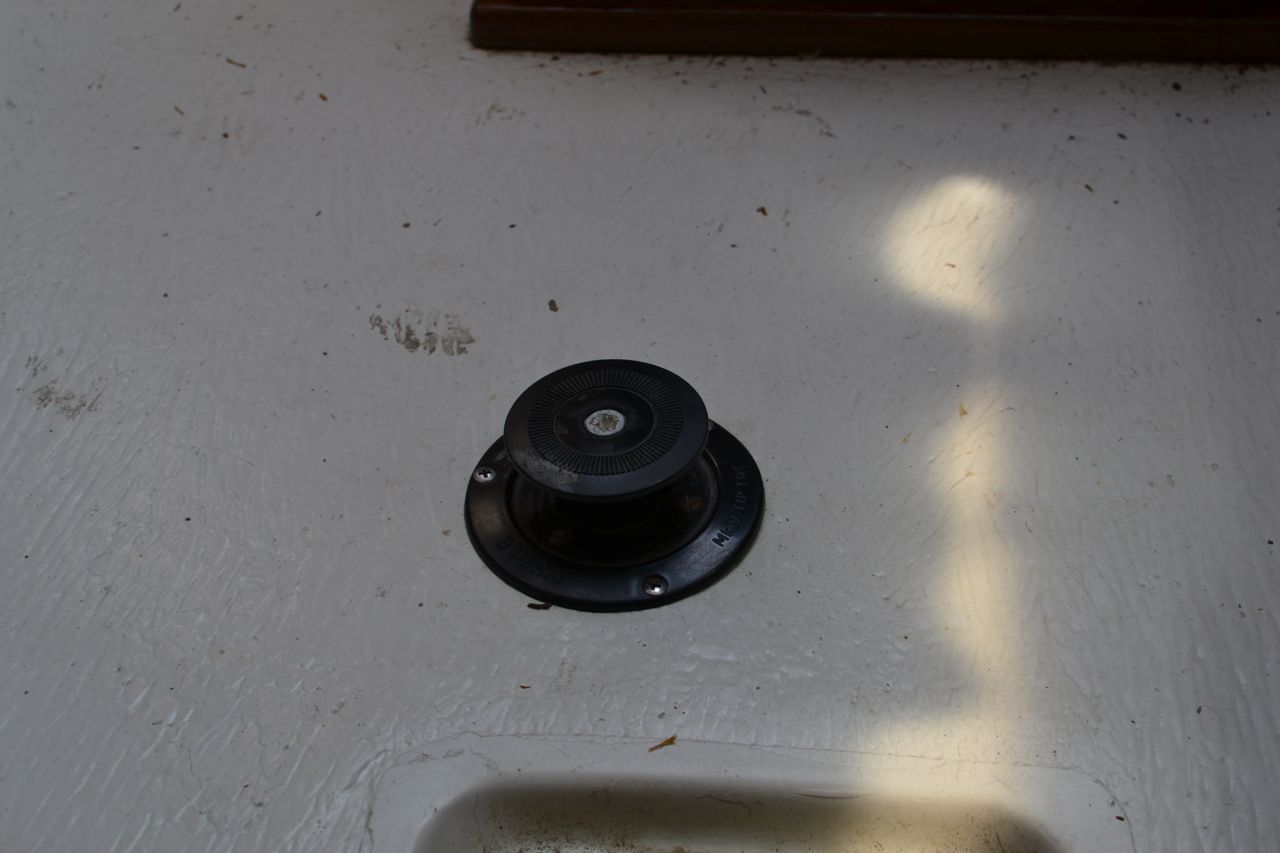
I replaced the single-circuit pressure system with two separate, discreet systems: one for fresh water for washing and showering, and one for drinking. The fresh water clean-up/showering water source is drawn from our forward 40 gallon tank (under the V berth) by the Whale Mk IV Tiptoe pump. This pump is mounted in the cabin sole near the companionway, and just adjacent to the sink, as you would expect. Our expandable capacity drinking water system is based on two collapsible 5-gallon containers that rest below the quarter berth stowage bin. These are plumbed to the galley sink through the engine compartment, and the water is drawn up by a hand-operated Whale V Pump. I have space in this stowage bin to carry an additional 10 gallons in collapsible containers. So we can carry 20 gallons drinking water and 40 gallons for other purposes. At some point before we go long-term cruising, I will replace all of the fresh water lines from the forward tank. After a thorough tank wash, that reservoir will be approved for drinking as well. Until then, we’ll keep the status quo, as the forward tank isn’t drained often enough to keep the water really fresh enough for drinking on our short cruises about the middle Chesapeake. However, 10-20 gallons in portable containers is plenty for short-range use, and easy to keep fresh.
I noticed at the end of last sailing season that we were going through 40 gallons of fresh water fairly quickly. When I investigated, I learned that the floor pump was beginning to leak at a fairly rapid rate: 15-20 drops per minute adds up to a lot of water over several days. Late last fall I ordered the rebuild kit for this pump (about $15), intending to rebuild it all winter. Now it’s spring and I couldn’t put it off anymore, so today I got to work on it.
The rebuild kit comes with an exploded view of the mechanism, which is important in order to see what parts go where, but there are no instructions regarding the process. This was a bit frustrating, as I could not figure out how to access the internal parts. I had to gently experiment on the pump body to get it apart. It appeared to be joined at the middle, but how it was actually held together wasn’t apparent from outside observation. I finally discovered that the halves are simply threaded.
I gently flexed the pump body in my shop vice, then gently held it in place within the vice without tightening the jaws. I inserted a rod into the pump outlet and applied counter-clock-wise pressure. The threads turned readily, but I hadn’t had enough leverage with just my arthritic hands alone. With the halves separated, I was able to easily access the valves and seals. You don’t need specialized instructions for this portion – just replace with the kit what you removed from the pump. There are several rubber valves, O-ring-type gaskets, and cup gaskets which go in strategic places. One thing you should know about: There is a circlip serving as a safety for a fitting on the end of the plunger. There is no way to get this clip off without circlip pliers. Just go buy a tool for $5-10 and you will save yourself a lot of frustration removing and replacing the circlip.
Reassembly and reinstallation was fairly easy, notwithstanding the usual frustrations of dropped fasteners, re-attaching supply and outlet lines, etc. Here it is mounted into its original location in the sole:
Perhaps there isn’t much demand for rebuilding these things – maybe that explains why I couldn’t find any information on the web for taking the pump apart. At any rate, I hope this post can help someone else as they look for rebuild information on this pump.
So why did it begin to leak after three years? Seems like it should have gone longer than that, with the light use we give it. I’m pretty sure that RV antifreeze shortens the life of the rubber internal parts. That’s why I’ve stopped using it – now I use my shop vac to dewater my systems. Otherwise, these are good, convenient little pumps.


Thursday, May 22, 2014
Templating
Jeff and Anne aboard s/v Pilgrim are doing some major structural work. A part of that is fitting some repaired and some new bulkheads. Here Jeff demonstrates a time-honored technique for duplicating the curve of the hull on the bulkhead, a technique called "templating":
As part of our refit we are relocating the raw water intake & strainer. Originally the through hull and strainer were located in on the port side under the cockpit locker. We are moving them to the starboard side under the quarterberth deck. We believe the through hull valve and strainer will be more accessible on the starboard side. We are also creating a new mount for the starter battery under the forward end of the quarterberth.
The original layout of the quaterberth deck and access panel.
To ensure no salt water from the strainer or through hull ever finds its way to the starter battery we are fabricating a divider in the locker that will be fiber glassed to the hull.
Providing adequate egress to the work area and future relocation of the access panels necessitated removing the forward third of the quarterberth deck.
Forward third of the quarterberth deck cut away.
Transferring the location of the divider onto the arc of the hull took some creative measuring techniques. The line drawn on the hull in the image above marks the position we wish to install the divider.
To create a template that matched the curve of the hull I used scrap lumber and hot glue. The process began by clamping a 1X4 horizontally across the deck and in line with the future divider. Then, using 1/8” plywood I glued three vertical strips down to the hull.
Creating a template using scrap wood, tin snips, hot glue, and clamps.
Using tin snips to trim the plywood, I created a piece that connected the three vertical strips near the surface on the hull. I then attached on small pieces that contacted the hull at approximately 2 inch increments.
The small pieces along the bottom make contact with the hull at a single point.
Once completed I removed the template from Pilgrim and headed over to the shop.
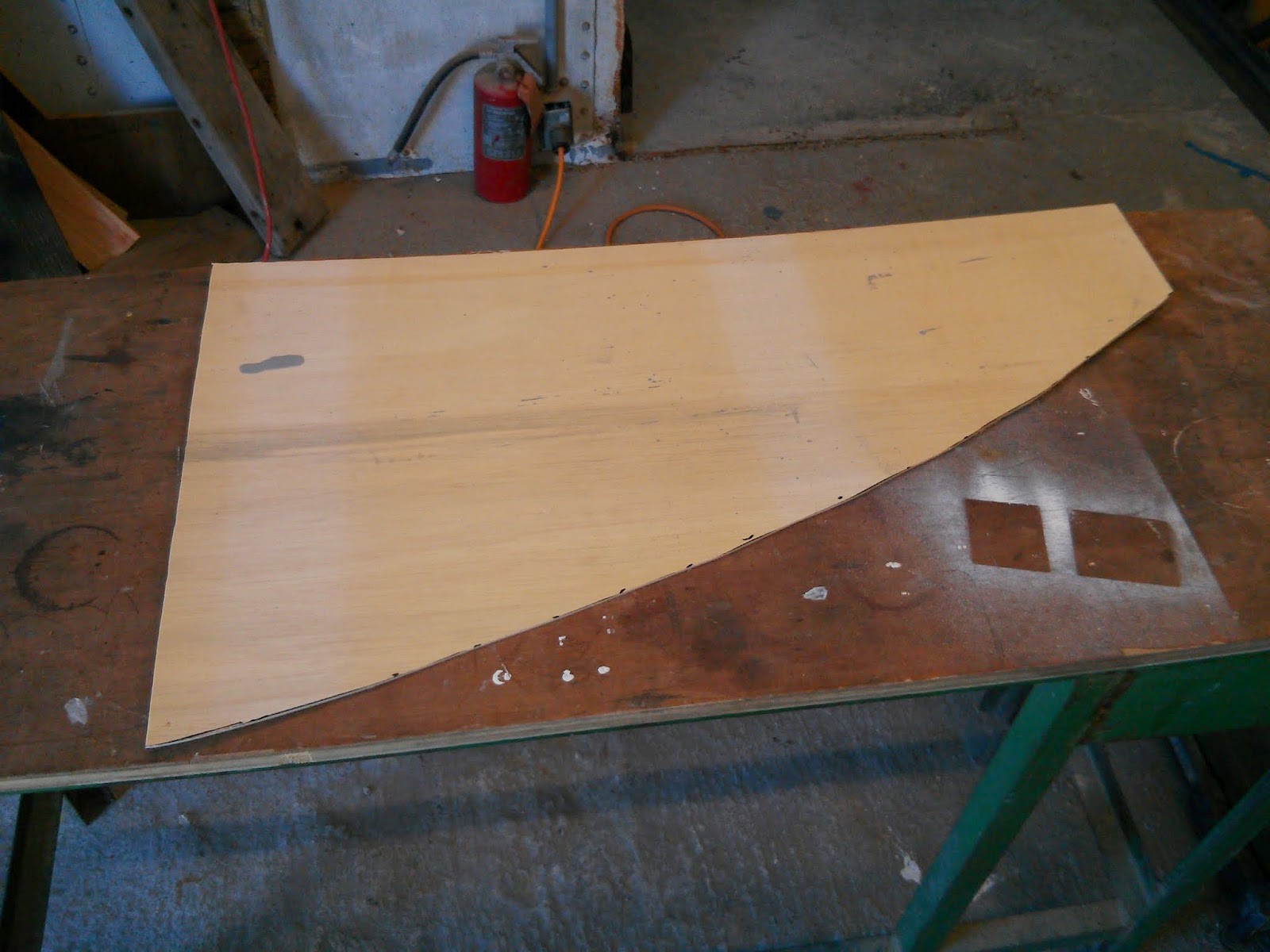
In the shop I transferred the outline of the hot glued template to a piece of 1/8” plywood.
I connected the dots free hand with a marker.
With the outline transferred to the plywood, I used a bandsaw to cut out the template.
The 1/8” template made a couple trips back and forth between the bandsaw and the quaterberth to achieve a good fit.
Once pleased with the fit, I transferred the outline of the 1/8” template to the ½” plywood that will serve as the divider.
The final piece fit precisely on the first attempt.
t Test fitting the 1/2" plywood Divider
The aft (upper in the image above) space will house the raw water intake. The forward space will house the starter battery and serve as storage for a tool box.
Using 1/8" plywood to experiment with the location of locker dividers.
Time to create templates for dividing the space up again… tool box on left. battery on right.




Tuesday, May 20, 2014
Rethinking space
Steve and Lulu who live aboard s/v Siempre Sabado have been doing so for long enough that they are having the opportunity to rethink some of their earlier decisions about interior space utilization...
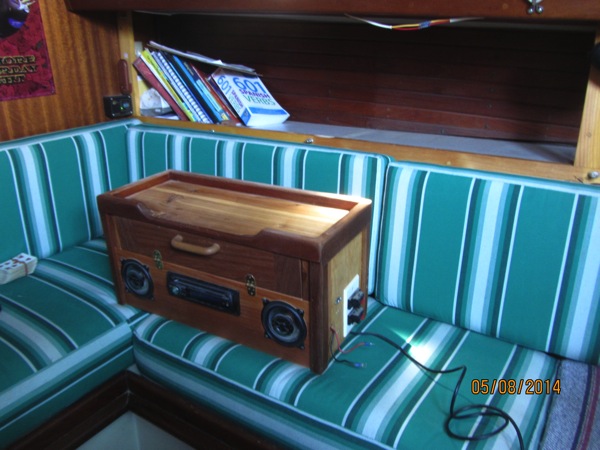
When we first got our Westsail 28, there was no stereo onboard. Matter of fact, there was pretty much nothing on board that wasn’t there when she shipped out of Costa mesa, California, back in 1977. Actually, there were a couple of major items like a relatively new Westerbeke diesel and a Webasto furnace but not much that you could see. Obviously, being music lovers, we needed a stereo. A car stereo was just the ticket although it became a little problematic where to mount speakers. Speakers tend to be a couple inches deep and the walls on the boat tend to be the thickness of one sheet of plywood, sometimes 1/4″, sometimes, 3/4″ but never more than that. So, the back side of the speaker would protrude into the space on the other side of the wall. Not knowing for sure where I wanted to put holes in walls, I decided to just build a custom cabinet and set it on the bookshelf that ran the length of the starboard side of the saloon.
It’s worked out pretty well so far. The little cabinet on top holds various chargers, disc cleaners, patch cords, etc. There’s a shelf on top where we stow the Netbook. But, we’re hurting for space and looking at this cabinet, I see a lot of wasted space. Something had to be done.
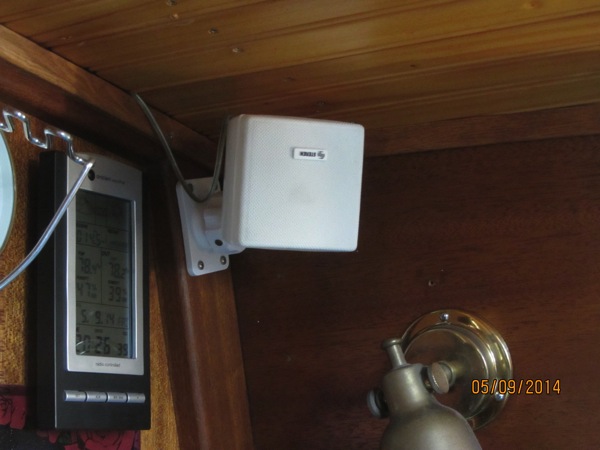
The first step was to rethink the speakers. In the past few years, the sound from small speakers has gotten better and better. Most of the surface mount speakers I found, however, were just too big for the cabin. However, in La Paz I found these little beauties:
You can turn them anywhichway and they’re small enough to not look out of place in our cabin. OK, speakers solved. Now it’s just a matter of finding a new home for the stereo.
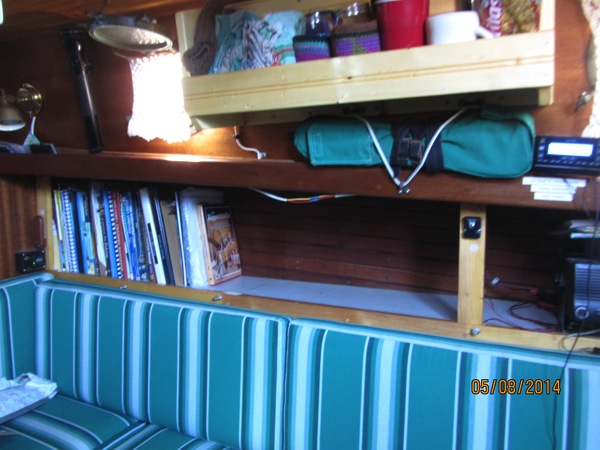
I knew I was going to do this project someday. I’ve been thinking and pondering on it for quite awhile. Well, now it was time to either take care of business or vacate the head, as they say. I entered into the project not really knowing how it was going to end. But, I knew the first thing was to pull the cabinet:
I was really pretty pleased with myself when I saw what a nice job I’d done on this cabinet. Seemed a shame to toss it but space is more important in this case. And look at how much room it frees up:
Of course, it only frees up the room if I don’t have to turn right around and fill the new space with the stereo. My original thought was that I’d build the stereo in, either on the shelf or hanging from the top of the opening. Then books could go either above it or below it, depending on how I did it. But, I wasn’t really liking this approach as much as I thought I would. The space just aft of the SSB radio was used for housing mini hard drives, blank CDs, and blank DVDs. The hard drives are currently in Flipper and will remain there until we finish our road trip. And by then, who knows? Maybe I’ll have consolidated everything I have onto a couple of 10 TB hard drives which are sure to be available by then. I’ll worry about that when the time comes.
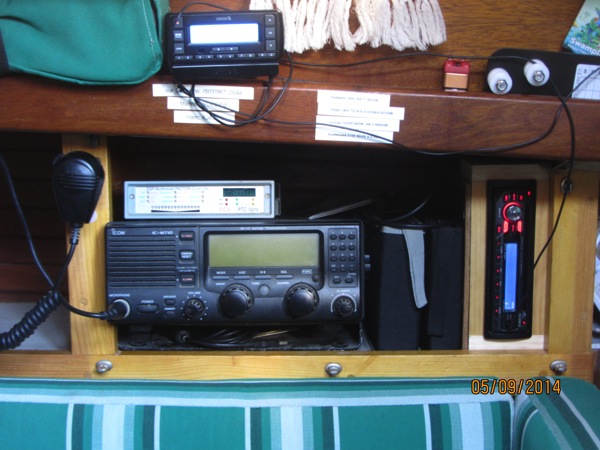
So, what did I do? Well, I decided to use the former hard drive storage space for the stereo. Trouble was, once I built an enclosure around the stereo, the space was no longer wide enough. It would have been doable back when I had a shop that had a thickness planer in it. I could just plane the wood down to the size I needed to make the enclosure fit. But that’s not the case so I had to work with what I had which was 3/4″ thick wood.
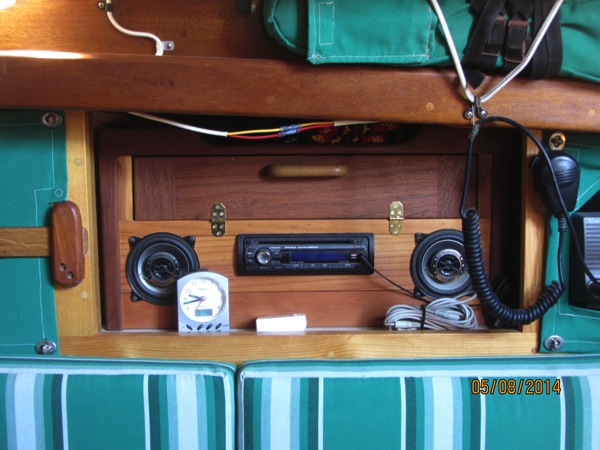
I remember the first time I ever saw a car radio mounted vertically instead of horizontally. It was on “Route 66″. I don’t know which model year it was but I think it was around the time of the advent of the Corvette Stingray (what a cool name!) and there was a shot of either Buzz or Todd hitting a button on the radio. The radio looked just like any radio except that it looked like it had been mounted sideways, except for the fact that all the letters and numbers were set up so that it was obviously supposed to be mounted that way. Cool. Different and therefore, cool. Like the vertical headlights on the first Buick Riviera or the fastback on the first Plymouth Barracuda. Different, therefore cool. Anyway, I decided that there was absolutely no reason I couldn’t mount my stereo “Stingray-style”. Of course, the words on mine are all sideways but I can adjust. We almost never play CDs but, if we do I’m sure they’ll play just fine. If they wouldn’t, the Sony Discman never would have worked. So, here it is, my Westsail Stingray:
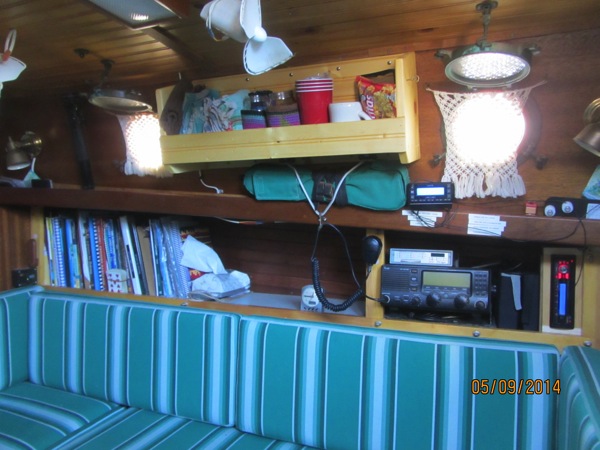
The carpentry is a little plain but it works and the system sounds great. And look at the resulting space:
BTW, the overhead (ceiling) I installed way back when proved its worth once again. I needed to run speaker wires from the forward-starboard corner to the stereo, the length of the saloon. I was able to hide the wire above the pine boards and only had to remove two boards to do it, not the entire overhead. Made the job much quicker and MUCH easier.
Tomorrow I have to figure out how to run wires to the new outside speakers. I mean I have to figure out how to run wires NEATLY to the outside speakers. Hmm. Wonder how I’m going to do it.
Friday, May 16, 2014
Hydrocoat Reevaluation and Bottom Paint Renewal
I am convinced that sailors are curious. The most curious make investigations and share the results with the rest of us. Rick over on s/v Cay of Sea is one such - he is trying the newly offered water-based bottom paint Hydrocoat. Here's his report of the current status...
I’m back. It’s been a long, cold winter here in the moderate climate mid-Atlantic region, and the weather has not been cooperative except for one or two isolated days. We finally got a break today, so I took advantage of the clear skies and moderate temps.
Back in December I reported glowingly about Hydrocoat. I am still impressed with it, but have moderated my praise slightly. I prepped the boat for paint today and got to take a good look at existing paint. It was in good shape, for the most part. There were a few chips here and there where my preparation must have been less than good, but it was mostly intact. However, the power-washer guy had originally told me there were two barnacles when he washed it. He was obviously exaggerating, as there were certainly more than two. But there weren’t many. Small clusters port and starboard at the bow, and on the leading edge of the rudder. While the barnacles were long gone from power washing, you could see where they had adhered. So the paint’s pretty good – two years of service with little hard growth.
I decided to repaint the hull and not try for three seasons, as I didn’t want to chance having the paint completely fail mid-season and leave me having to scrape the hull often to finish out the year.
I gave the hull a quick sanding, and I’m glad I did. This really smoothed the hull again, and I discovered that the existing paint coating isn’t very thick. It was fairly easy to sand right through to the old epoxy paint, which looks to be one of the original layers of paint laid down those many years ago. Thin coating is good, as this is an ablative paint, and I don’t want it to build up like it had before I stripped it all off three years ago.
The sanding took about an hour. I was able to remove all of the water marking at the water line, all the collected dried scum where the travel lift straps were, smooth out all the paint and start with a fresh slate. I used my 5 inch random orbital sander connected to the shop vac, wore my respirator. Wish I had a photo of the funny lines on my face from the respirator.
Then I wiped down the hull with water and a sponge, taped the water line, and started to paint. Painting took longer than I expected for some reason. Amazingly, I used less than a gallon of paint. I guess the paint goes quite a bit farther with a smooth hull. There was about a pint of paint left for painting the keel bottom and under the jack stand pads.
Another nice thing about Hydrocoat: When you get home, it washed right off with soap and water. Got it in your hair? Two good shampooings and it’s gone. Try that with solvent-based paint!


Subscribe to:
Posts (Atom)


 Posts
Posts


