(I really like the new paint on the bow, Lotte!)Pang-colored accessories
I actually really like the orange - but these rags, I hope not, we will need to flash too often.

One of the day's chores was to get hoisted storm sails to get measured the length of the neck, find shot points and otherwise just get an idea of how they should sit. For it should happen that one day they must be, there is a guarantee that the weather is bad snot. So we could put them both wearing seasickness, numb fingers and poor vision.
Monday, November 14, 2011
Visibility
Lotte on s/v Lunde hoists her new storm sails... her neon orange storm sails, that is. Why aren't all storm sails colored like this? If your boat is in difficulty requiring a rescue, it is likely that you will be flying your storm sails (if anything) - what a great attention-grabber!


Friday, November 11, 2011
My Favorite Bottom Cleaning Tools
The Chesapeake is kind of a unique environment... warm water, not quite enough fresh water dilution to be called "brackish", but then not that far from it either. It's an environment that grows things very well (well I know - we kept our boat Deja Vu III there for several years). Drew over at Sail Delmarva takes us on a tour of the tools he uses there in the Chesapeake to keep the critters off his hull...
My last paint job, I used Micron 66. It lasted 2 years, in spite of dire warnings that it would peel in brackish water.. It didn't. I spoke with the factory and they repeated the tale, but I spoke with a rep at the boat show in Annapolis and he explained that it was winter haul-outs that caused the trouble. He also said that if you use the bottom paint up, running for 2 years and sand a little before repainting, it's all gone and that reduces the trouble. I used Micron Extra this time, which I've used before but found slightly less effective. I'm going back to Micron 66 next time, unless the new Micron 77 is out, which is brackish compatible. But this is all off-topic.
I do end up scrubbing 2-3 times before I consider paint spent. You need a scraper that...
- gives leverage for hard growth and enough handle for 2 hands
- is soft enough not the remove paint
- floats
Mine is made from 1/8-inch polyethylene sheet and closet rod split with a saw kerf. A screw secures the blade. My first version used a Home Depot plastic paint scraper with the handles removed, which was OK but perhaps a bit too aggressive. The polyethylene sheet is better. I use the same scraper to clean off my spiffy new Manson anchor; there's just enough handle and it stashes easily in one of the winch handle holders on the bow. I keep a few on the boat, in case I can get helpers.
The best pads for removing soft growth are...
- easy to hold
- self-cleaning
- have enough loops to pull off small barnacles
- don't remove soft paint
Mine are berber carpet squares. Not pile carpet--that will just smear things around--you need the irregular loop pattern. I got the idea from a professional hull cleaner, and I like them far better than the 3M pads generally recommended. They work very well in combination with Atlas Fit gloves, which keep them from sliding out of your hand.
And they are free.

A Simple Preventer
10/8
Drew over at Sail Delmarva provides us with a minor rigging modification that will majorly add to sailing safety and pleasure...
Drew over at Sail Delmarva provides us with a minor rigging modification that will majorly add to sailing safety and pleasure...
Though sailing wing-and-wing is not supposed to be a catamaran thing, on a cruising catamaran the VMG dead downwind in a breeze is better and the ride smoother. Accept it. The moment the chute comes down, whether because you are single handing or because the breeze is too much, wing and wing is faster. Simply secure the boom as described, head down wind, and jibe the genoa over.
But accidental jibes are always a problem. Locking the traveler at the end does help, but not completely, not if the main sheet is eased a bit as it should be. Monohull sailors take a line forward to a mid ships cleat. But cat sailors have more beam and can do something simpler.
Simply attach the spinnaker sheet to the boom bail. Because I would never run a preventer when using the spinnaker--we never do that dead down wind-- this required no new equipment. It can be rigged in moments and released instantly.

Tuesday, November 8, 2011
A little structgural fiberglass repair
Livia and Carol on s/v Estrellita have been poking around down in their bilge.
We took a lot of time in San Francisco to work on boat projects because we were enjoying the town, had a lot of free places to stay, and resources through friends in the area. This is one of the projects we tackled.
We’re now certain that our gorgeous girl has been grounded hard at some point. There was the rudder shoe repair, the old bad keel repair that failed that we re-did and now we found a crack in the fiberglass in the stringer (I think technically called a “floor”) behind the mast step.
Our concern of course, was whether the crack was in the fiberglass or the underlying beam. We could tell the crack was old because of the mold (ew!). So we dug, and scraped, and ground, until we found dry, uncracked wood (phew!). Then we considered how best to deal with the big hole we had created.


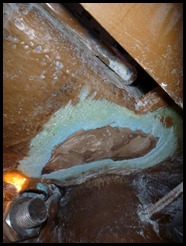
West Systems has a great series of videos, articles, and use guides for using their epoxy resin to repair fiberglass. We used epoxy resin and glass cloth. This was our first experience actually doing our own fiberglass repair so we decided to tag team it “Team Giddyup” style. Carol ground and beveled and I applied the glass. We chose epoxy resin for its strength but an unintended side effect is that it smelled WAY better than the fiberglass resin that they guy who did the keel repair used. We are very thankful for that because we weren’t looking forward to getting a hotel while the stink cleared out.
So, while enjoying the hospitality at the Oakland Yacht Club, we applied about 10 layers of glass cloth with epoxy resin. Can you believe that this still did not build it up to the same thickness that the Wauquiez builders had left? It’s *crazy*. Part of that is because we had scraped some rotten wood from the surface and part because we underestimated how thick the layer would need to be in order to match the existing glass.
Of course, our boat was build back in the days when they had no idea how strong fiberglass was so they just kept adding more to make sure the boats would be strong enough.
We’ll watch the repair job and see how it does over time. Luckily, these stringers/floors simply stiffen the boat laterally and so, unless you ground the boat, don’t normally take a lot of fore-aft stress.
We also found old repair jobs in the corners of other stringers on the starboard side. Hopefully, those repair jobs, which were smaller, won’t fail like this one did.


Thursday, November 3, 2011
How to: Make your own brass fittings
Having built her own screens from scratch, Lotte on s/v Lunde now makes the brass fittings for mounting them. Nicely done!
I know that many of you are choking with all this do-it-yourself (if you even still bother reading it). It was never originally thought that this blog would be a DIY / nerd blog, but at times it really is that which fills most of my life and ergo also what is most natural to blog about. And I would like to share some of the best tips and tricks that I have been fortunate to be enriched during the boat projects. Many of them I have not been able to google - it's about the tradition of craftsmen and other good people out in the physical world. [Ed: The best kind!][Editor's note: Apologies for my poor editing of Google Translate's translation from the original Danish.]
But hang on, it will not always be this way. For there are covers on hold.
However, I promised yesterday that I wanted to show how our mosquito nets are mounted. The criteria for mounting were:
In my father's rich stock hid some fine old fasteners. This was half of the suspension ready. But there were not enough fasteners to put on all four sides, and the screen would really like to be firmly seated regardless of whether it is removable or not. So we had to devise some sort of hardware that could meet those criteria.
- Simplicity
- fast service
- discreet
- and so it matches the interior

You will need a few strips of brass.
Cutting or trimming possibly out of a piece of old sheet or the like. It is obvious to recycle here.

Put the strip firmly in the vise so that it forms an angle at the end of the jaw (the part of the vise which clamps) of 45 degrees

Fold both ends of the strip over the vise using a sledge hammer or a large hammer

The bracket after the first bend. Next, scribe a line such that the distance between the line and the first bend corresponds to the thickness of what you want to hang up. The frame of the screens is 10mm and then the distance must be the same. Be sure to get stroke and bend to be parallel, otherwise it will mount crooked.

Tighten firmly so that the line is flush with the edge of the vise.

Fold against vise the jaws. Here I used an old cooper tool that can best be compared with a chisel which is flat at the end. But a piece of flat iron can also easily be used - or whatever you have.

After the second bending. Repeat on the other side of the bracket.

Drill holes for screws. Cut and sand the ends. Round off all edges with a file.
Eventually polish the brackets and they are ready for installation.

The bracket in place I've done a similar set of brackets, so the screens may be stored elsewhere (in this case on the underside of one of the top cabinets in forecastle) when not in use.

Mosquito net in operation. The two fasteners for easy and quick installation and removal.


Monday, October 31, 2011
Easy cockpit table
Please welcome new contributor Brian over at Dock 6! Brian has a good list of small boat projects, one of which we will pick up today:
My first foray was a cockpit table. I needed a cockpit table. Well, I, personally, didn't need a cockpit table, but SWMBO did, and I need a warm place to sleep, so you can see how the stars aligned on this one. I sussed out commercially available, marine priced cockpit tables and promptly gagged. So, I thought to myself, "Self, you could make it yourself for a lot less." One problem. Well, four actually.
So, I went to plan "c".
- I have limited woodworking skills,
- limited woodworking tools,
- and limited time. oh yeah, and
- I am cheap.
I spent some time eyeballing the cockpit in question:
Then I moseyed into action. I bought one of these for $29.99
A frenzy of measuring, remeasuring, cutting, screwing, drinking, varnishing, etc. later, and this is how it finished up:
As an added unplanned bonus, the table is reversible- install it aft of the wheel while Dockside for easy companionway access, mount it ahead of the binnacle while underway. When not in use, it simply stows under the salon table below.


Subscribe to:
Posts (Atom)


 Posts
Posts


