




Kiss o' the Sea
10 years ago


Now for the second part...
What cruising destinations are on your sailing bucket list?
- BVIs
- Bahamas
- Barkley Sound
- Obviously (or perhaps not...) the first two would involve bareboat charters.
What piece of gear onboard did you purchase in the belief it would be essential, yet has hardly been used?
What was your longest passage?
- A Happy Hooker. Eolian's bow is a long way above the water. Hooking the ring on a mooring buoy and then lifting that really heavy chain up high enough to thread a line thru is a task that takes both of us. After pulling the bronze end off of our boat hook at Fort Flagler State Park, we bought a Happy Hooker thinking that would make it much easier. But we have not taken a buoy since that event. Frankly, anchoring is just easier.
What has been your scariest, "I'm gonna die!" moment?
- Define "passage". If you mean the longest distance over which the boat was in continuous motion,
What tools do you keep aboard?
- We were at the south end of the Strait of Georgia, coming up on a lee shore at Silva Bay in a howling downwind gale. Jane went forward to douse the sails, but just as she got to the mast, the staysail jibed and its boom knocked her over. From where I was at the helm, I couldn't see her - my heart was in my mouth because I feared she had been knocked overboard. Then she stood up, holding her head.
Things like this don't happen on a calm sunny day - they almost always happen at the worst possible moment. If she had gone overboard, even on her tether, I would have been faced with a man overboard incident while roaring down on a lee shore with the sails still up, singlehanded. Oh yeah, and the water was lethally cold.
Yeah, it scared the daylights out of me.
What has been your most satisfying sailing accomplishment?
- All of 'em. No, really. It's a fetish that Jane has to live with, but we have enough tools aboard Eolian to handle just about any eventuality, short of a complete engine rebuild, maybe. He who dies with the most tools, wins, right? And besides it is a two-way street: I have to live with Jane's shoes.
How has your sailing life changed you?
- I think I would award this to out trip to Desolation Sound. We were off the dock (off any dock) for more than 30 days, a simulated trip to the Marquesas, but without the warm water. The only thing we ran out of was stowage for garbage.
Are you sailing your perfect boat? if not, what would you change?
- We have been sailing since 1972... it is difficult to remember a time before sail. Surely there were changes as a result - was there a time when we did not worry when the winds went above 25 kt? Certainly there must have been.
Link your most popular blog post.
- For us, Eolian is the perfect boat. She is the fourth boat we have owned, each successively longer (of course), and the ballast in each outweighing the entire previous boat. For the kind of cruising we do, I cannot imagine a boat better suited to us.
Link your personal favourite blog post.
- As you might expect, this changes over time; the current favorite is this one.
- To date, there have been 510 posts on this blog, nearly all of 'em by our contributors. No way am I going to show favortism by singling out one of our authors. But so that the question doesn't go unanswered, I'll link to one of my favorite posts on a blog that I do write: here.
The last four days have kept us pretty busy; a dinghy chap is not an easy sewing project and was on our list for a while. Indeed, the shape is complex with all the curves add to that the handles it definitely needs a minimum of precision to achieve something that looks half descent. The pattern had been done while we were in Panama, along with the purchase of the fabric, so we were ready. In the end, we are still talking to each other, I (Valerie) have gained even more confidence in my sewing machine and learnt a few tricks of the trade and that’s all thanks to Mum who gave me many memories to cherish and new knowledge. As for the guys they kept clear at all times from the working area and provided us with delicious and nutritious lunches every day! Thank you for that too.
We won’t be the ugliest dinghy on the dock or surfing the wave anymore!
Suppose, suppose... Suppose we had a tiller instead of a wheel in our boat. Wouldn't the cockpit be much more spacious, wouldn't the mechanical complexity be much less and the reliability much greater, wouldn't it be easier to feel the boat and balance the sails, and wouldn't a wind vane be much more effective. All good reasons but when we suggested the conversion to most of our sailing friends, they thought we were nuts.
pic 1
pic 2
pic 3
pic 4
pic 5
pic 6
pic 7
pic 8
pic 9
pic 10
pic 11
pic 12
pic 13
pic 14
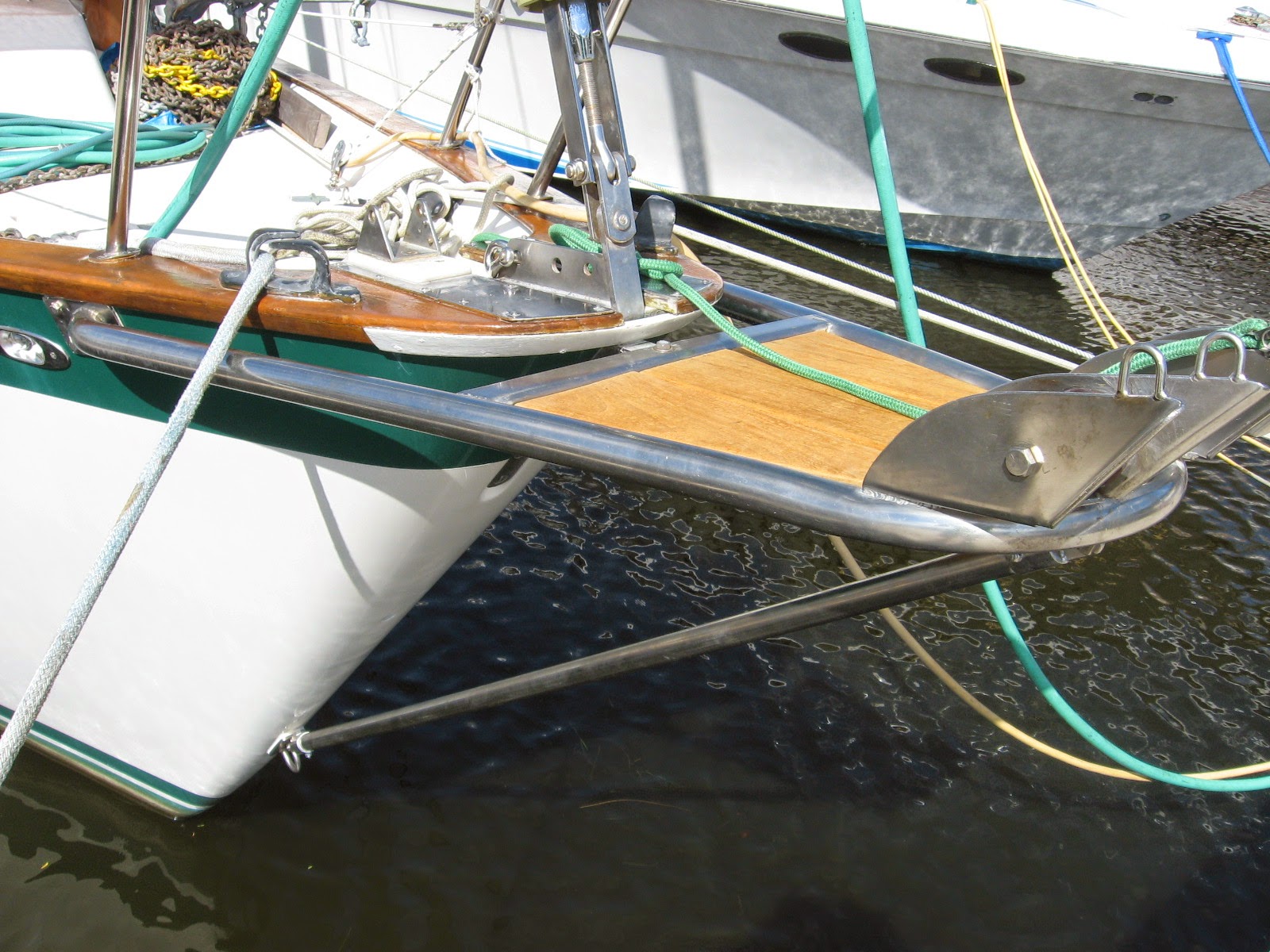
Not too long ago on the Pearson 424 forum that I hang out, someone asked if there was any information or drawings, or possible "who" fabricated the anchor platform that was offered to Pearson owners when having a new boat built.
Nobody had any concrete answers, so I offered to the gentlemen inquiring that I would give him an accurate detailed drawing that he could have the exact piece reproduced from any competent fabricating shop.
All I had to do was go forward with measuring tape, paper and and pencil. I noted in my drawings (I shared with the forum) that I would add a third or fourth point to stiffen the platform as it seemed to me it having a weak spot with potential heavy loads from getting a stuck anchor off the bottom. Not to mention that mine was bent at least 5 degrees....I never noticed it till I starting measuring for the drawings.
I had some ideas and traded some unwanted stuff at Sailors Exchange in St Augustine, FL for some various bits and pieces of stainless steel hardware that I could fabricate into something to help beef up the platform. A 1/2" U-Bolt was my starting point. The actual finished bracing point saw a few different ways before I settled on a robust 3/8" plate that supports the brace for the anchor platform and offers me a point near the waterline to lead a snubber line for anchoring. After coming up with a definitive plan, I removed the platform and brought it to a local shop to have straightened and weld up my various pieces.
I backed it all up with 12" x 5" shaped block epoxied into the forward stem. Not sure if I would tow my boat at sea in an emergency from this point, but for sure at anchor it will be fine.
I'm thinking this will take a load off my concerns of have an oversize anchor bury itself a little deep and need some persuasion to pop it free.
Snagging the lazy genoa sheet on the mast-mounted winches has been my curse since the first day. The clew is just above the winch, and when it slides across the mast during a tack it just loves to loop over the winch, necessitating a trip forward. If I'm lucky, the boat doesn't fall into irons.
I tried a few simple bungees and covers for the winches. No luck. I tried better technique; OK when the wind was light, but otherwise undependable. I tried a line from the spreaders forward to the tramp; too hard to get the tack around. Finally I spent some time looking at it and found a simple solution that works the charm.
The Deflector. I ran a 40' length of 1/4 spectra double braid that I had left over from the end of the self-tacker traveler, through the lazy jack pad eye at the spreaders, and down to the other end of the traveler. It is tensioned with a truckers hitch, but not too tight, as the forces could get out of control. This keeps the sheets away from the winches AND away from the salon hatches , allowing them to remain open even when tacking. I thought it might be in the way, but in fact it makes a nice hand hold in an otherwise precarious area.
The sheet is held far away from the mast and hatch.
However, there is a significant tendancy for the clew eye and soft shackles to jam against the new deflector stays. I tried a few things before coming to a simple and entirely satisfactory solution; the sheets are now attached to the tack via a trianagular sliding bridle.
The Bridle. an 18-inch spectra climbing sling did the trick. It is luggage tagged to the eye and then each sheet is attached with a separate soft shackle. If there is any tension at all on the lazy sheet, the sling opens up into a triangle and sail clew is NOT forcibly dragged across the stay, only the sling. The clew eye is always free to move forward, away from the stay. Additionally, the shackles do not pass all at once, but rather in succession, reducing the drag.
A bit tricky to see, but both sheets are attached NOT to the clew, but to the sling, along which they are free to slide when tacking. Both are attached with soft shackles; this is required because the windward sheets are inside the shroud and the reaching sheets are outside the shroud.
Not a single snag over many tacks in many wind conditions, from ghosting to 25 knots. Why does it take so long to learn simple things?


 Posts
All Comments


